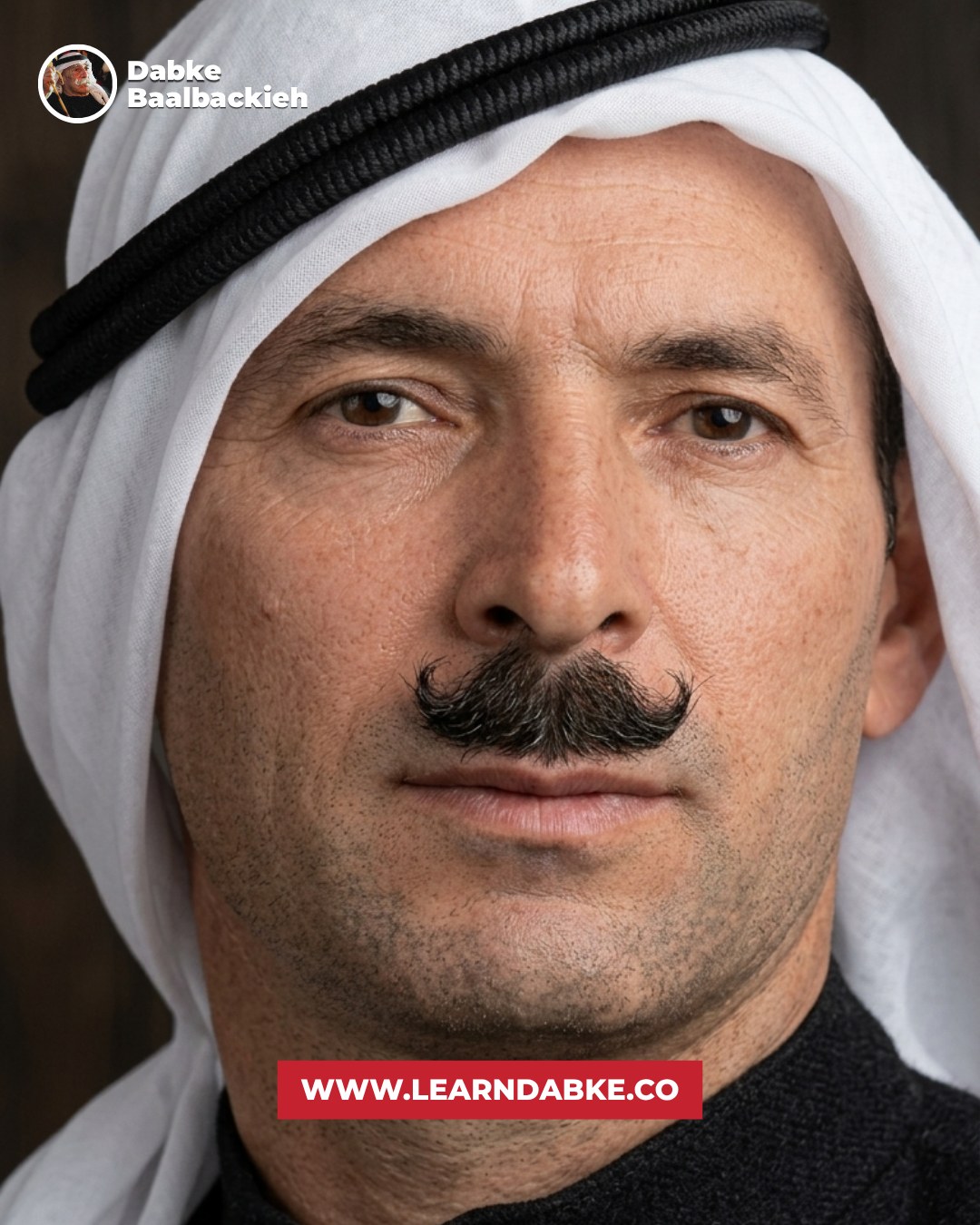
In the history of Baalbeki Dabke, there are names that are remembered, and there are names that define the art itself. Doukhi Solh, known as Abu Ali, belongs to the second category.
He is widely regarded as one of the greatest, if not the greatest Dabke dancer ever born in the Beqaa region. Yet, unlike many who came after him, his legacy was not fully captured on camera. His era lived in memory, not in archives.
For this reason, his story is not only about mastery. It is also about a generation of artists whose greatness was witnessed, not recorded.


The Meaning of “Doukhi”
His nickname, “Doukhi” (Dokhi), means “Teacher.” It was not symbolic. It was literal.
He was the primary instructor behind an entire generation of Dabke masters, including his nephew Zakaria Solh (Abu Yahya), who would later be known as the “King of Dabke.”
In Baalbek, knowledge of Dabke was not written. It was transmitted from body to body, from rhythm to rhythm. Doukhi stood at the center of that transmission.
A Presence That Defined the Wedding
In Baalbek, a wedding was not complete without Doukhi. His presence alone elevated the event. When he stepped into the Dabke line, the rhythm changed, the posture of the dancers shifted, and the circle tightened around him.
He did not follow the music.
He led it.
The relationship between the tabl (drum) and the dancer becomes clear when observing masters like Doukhi. The drummer sets the Doum–Tak pattern, but the master interprets it. A slight delay, a heavier stamp, or a held pause can reshape the entire movement of the line. Doukhi understood this dialogue deeply.


Mastery Beyond the Step
What made Doukhi exceptional was not only his command of traditional Dabke steps, but his ability to expand them into something unforgettable.
He was known for extreme balance and control, performing while holding or balancing objects such as:
- Swords and daggers
- A water jug
- A hookah (nargila)
These were not tricks. They were demonstrations of control over rhythm and body.
His most legendary feat remains the dagger eyeliner movement. While dancing, he would lean his body backward all the way to the ground and simulate applying eyeliner using the tips of daggers. It was dangerous, precise, and executed with calm confidence.
He was also a master of the Sword and Shield dance (Saif wa Turs), a tradition inherited from his father and passed down to his sons and students. In this form, Dabke returns to its older roots, closer to combat rhythm than celebration.

Dabke Theory Class
Music, Poetry, and Rhythm
Despite being illiterate, Doukhi possessed a deep understanding of rhythm and language. He was skilled in Qardi, a form of improvised rhythmic poetry that flows with the beat of the drum.
He also used finger cymbals (Faqashat) while dancing, adding an additional layer of rhythm to his movements. This ability to create rhythm while moving placed him in direct dialogue with the musicians, not separate from them.
Dabke, in his case, was never silent movement. It was sound expressed through the body.
The Baalbek Festival and a Different Kind of Reward
In the 1950s, as the Baalbek International Festival began shaping Lebanon’s cultural image, Doukhi was invited to train the first generation of professional folk dancers.
He accepted the role, but refused any financial compensation.
For him, Dabke was not a profession. It was identity.
In recognition of his contribution, the festival committee granted him a lifelong free entry pass to all performances at the temples. This became one of the few formal acknowledgments he received during his lifetime.


Family and Continuation
Doukhi Solh built not only a legacy of students, but also a lineage.
His confirmed sons include:
- Ali Doukhi Solh (Abu Hassan)
- Mahmoud Doukhi Solh (Abu Tamer)
- Mohammad Doukhi Solh (Abu Bilal)
- Abdel Karim Doukhi Solh (Karim Solh / Abu Doukhi)
Karim Solh, in particular, continues today as one of Lebanon’s prominent Dabke figures, carrying forward both the athletic discipline and artistic presence of his father.
It is important to note that figures such as Abu Yahya and Walid Doukhi Solh were his nephews, not his sons, though both were deeply shaped by his teaching.
Humor, Spirit, and Humanity
Despite his authority, Doukhi was known for his humor. One of his well-known playful chants during performances was:
“Lik lik ya lik… lik hayda bya‘mal heyk.”
These moments revealed another side of him. Dabke was not only discipline. It was also joy, spontaneity, and connection with the audience.
A Legacy Without Footage
Doukhi Solh passed away in 1973, in a simple and symbolic moment, seated in a barber shop in Baalbek.
His life ended quietly, but his impact did not.
Today, many consider him the greatest Dabke dancer of his time, yet his work was never fully documented. There were no cameras to preserve his movement, no recordings to replay his performances. His art lives through memory, through stories, and through the bodies of those he taught.


This absence is important.
It reminds us that much of Baalbek’s cultural heritage was built before documentation, in a time when art existed in the moment and disappeared with it.
The Sheikh of Sheikhs
Doukhi Solh is often described as the “Sheikh of Sheikhs.” Not because of titles, but because of influence.
Every major figure in Baalbeki Dabke traces something back to him — a step, a rhythm, a posture, or an understanding of how the body should carry the music.
He may not have received the full recognition he deserved during his lifetime, but his imprint remains in every serious Dabke line that respects its roots.
Doukhi was not just a dancer.
He was the foundation others built on.
Leave a Reply