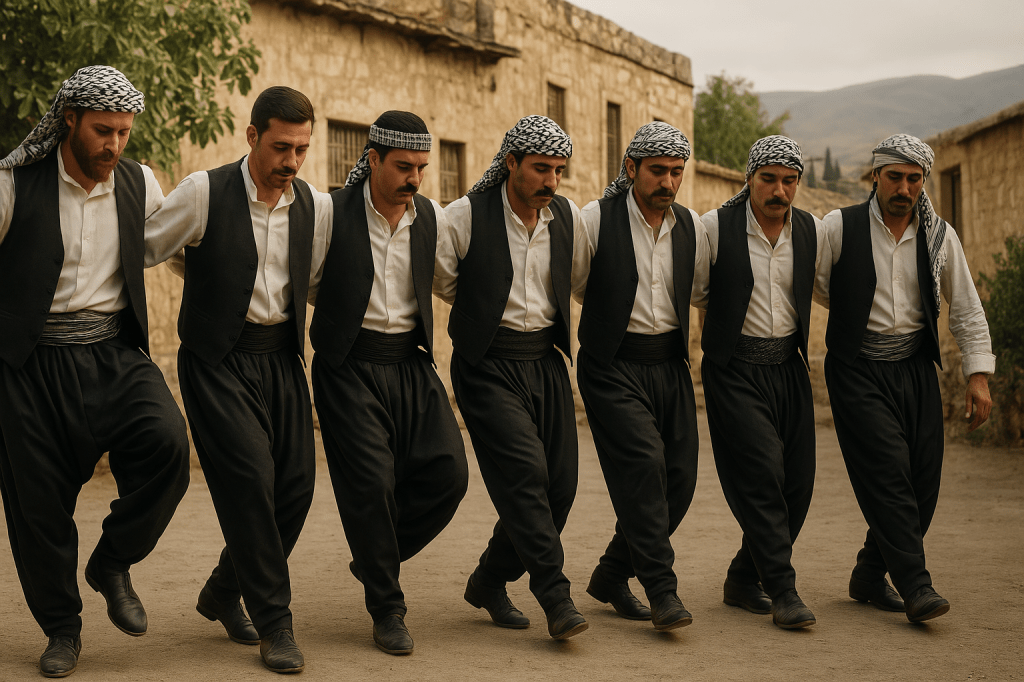
What Is Zeno Dabke? The Right-Footed Rhythm of Baalbek
Among the six main Dabke styles of Baalbek, Al-Zeno (الزينو) — sometimes spelled Zaino — stands out immediately for one striking feature: it’s the only Dabke in the region that begins with the right foot instead of the left. Rooted in the Kurdish-influenced rhythms of the Beqaa Valley, this Dabke combines strength and swing in a hypnotic six-count pattern.
Baalbek’s Only Right-Led Dabke: A Style With Kurdish Origins
While most Levantine Dabke forms follow the traditional left-foot lead, Zeno Dabke breaks that rule, reflecting influences from Kurdish heritage, particularly communities that settled in the Baalbek region. The dance’s name — “Zeno” — is believed to reference a Kurdish family or origin tribe, and its rhythm differs noticeably from the better-known Dal’ouna or Shamaliyya styles.
Structure and Timing: The Six-Step Signature of Zeno
Zeno Dabke follows a 6-count rhythmic structure, usually performed in circular formation. The steps feel more flowing and airy compared to the stomp-heavy styles like Askarieh. Each 6-beat cycle lasts around 3 seconds, with dancers lifting and landing in perfect unison. It creates a sense of graceful motion — as if the line itself is gliding in a circle, connected by invisible threads of rhythm.
Learn Dabke
Zeno and the Baalbeki Identity: Quiet Power in Motion
In Baalbek’s folklore, Zeno is seen as a more refined and melodic Dabke — less showy than the sword-flashing Arja or Askarieh, but just as emotionally resonant. It’s often danced during quieter moments of weddings or village gatherings, when the focus turns inward and the crowd follows the music with closed eyes and gentle movements.
Where You Can Still See Zeno Dabke Today
Thanks to the oral tradition of Baalbek’s elders — especially the Solh family — Zeno Dabke continues to be taught in local troupes and dance schools, including in diaspora communities. It features prominently in performances by the DabkeBaalbackieh project and is occasionally taught in Zorba Academy’s workshops for intermediate dancers. If you see a Dabke where the leader starts on the right foot — chances are, it’s Zeno.




 Learn Dabke
Leave a comment