
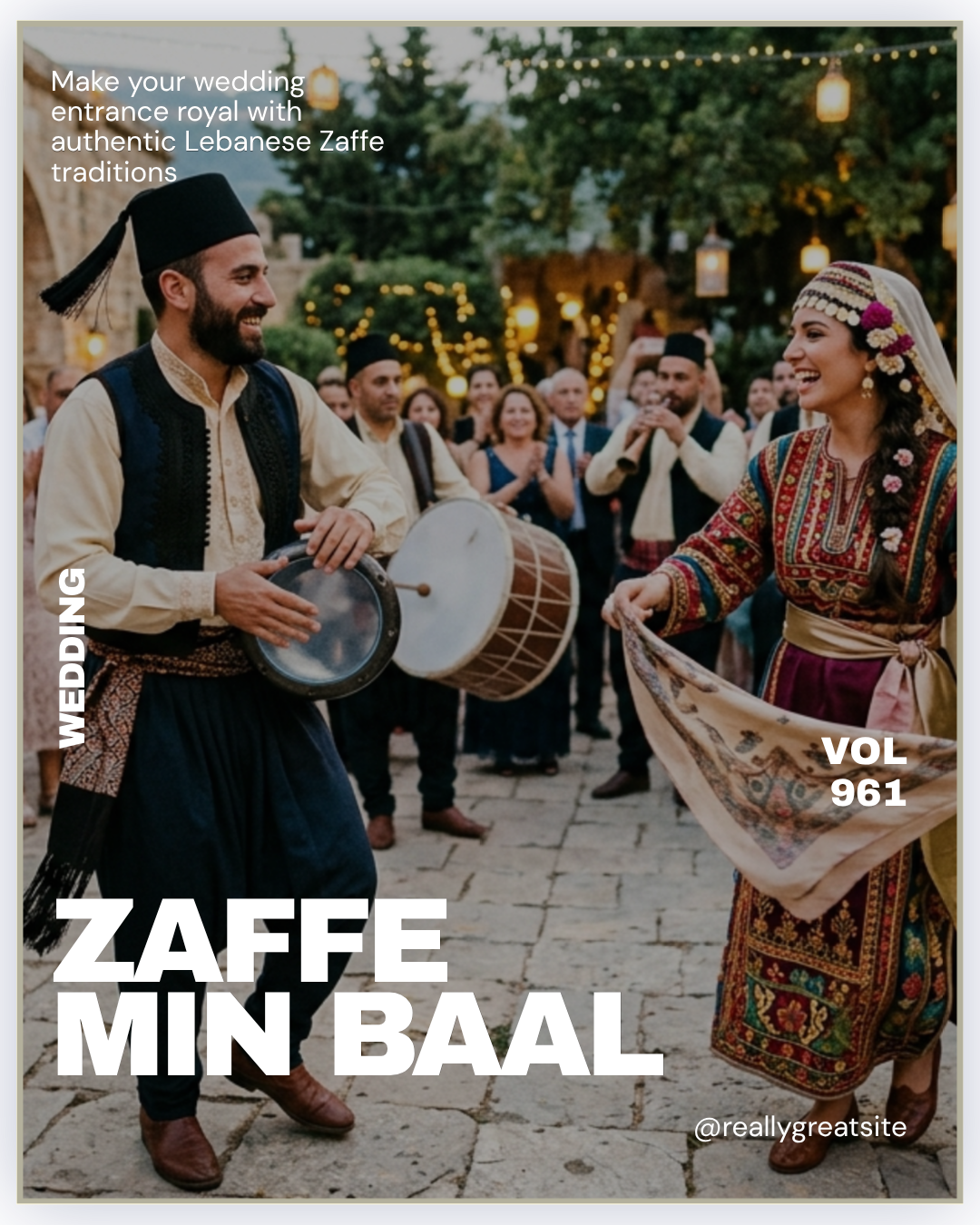
What Is a Lebanese Zaffe?
A Lebanese Zaffe is a traditional wedding entrance performed to celebrate the arrival of the bride and groom. It usually includes live drums, music, chanting, Dabke, dancers, family participation, and a strong ceremonial procession that leads the couple into the wedding celebration.
In simple words, the Zaffe is the moment when the wedding truly begins.
It is the sound of the drums before the couple appears. It is the clapping of the family. It is the movement of the dancers opening the way. It is the bride and groom entering together while everyone’s attention turns toward them. In Lebanese weddings, the Zaffe is not just a performance. It is the public announcement of joy.
For many people, the Zaffe is one of the most emotional parts of a Lebanese wedding. The decoration may be beautiful, the dinner may be elegant, and the venue may be luxurious, but the Zaffe is the moment that gives the wedding its soul. It brings sound, movement, tradition, and family energy into one entrance.
That is why Lebanese couples still care deeply about choosing the right Zaffe. It is not a small detail. It is the first major scene of the wedding night.
The Meaning of Zaffe in Lebanese Weddings
The Lebanese Zaffe is more than a wedding show. It is a ceremonial entrance with cultural meaning.
Traditionally, weddings in Lebanon were not quiet private events. They were community celebrations. Families, neighbors, relatives, and friends gathered around the bride and groom. Music, rhythm, dancing, and ululation were part of announcing the marriage and sharing the joy with everyone present.
The Zaffe carries that spirit into the modern wedding.
Today, the wedding may take place in a hotel ballroom, a luxury venue, a garden, a beach resort, or a village square. The setting may be modern, but the feeling behind the Zaffe remains the same: the couple is being welcomed, honored, and celebrated.
The Zaffe says something very simple and very powerful:
The bride and groom have arrived.
The families are united.
The celebration has begun.
This is why the Zaffe is often placed at the beginning of the reception or at the couple’s main entrance. It changes the energy of the room. Before the Zaffe, guests are waiting. After the Zaffe begins, everyone becomes part of the celebration.
What Happens During a Lebanese Zaffe?
A Lebanese Zaffe can be simple or large, traditional or modern, but most Zaffe entrances follow a clear structure.
The entrance usually begins with rhythm. The drums start before the couple appears. This creates anticipation. Guests begin to turn, clap, and gather their attention toward the entrance point.
Then the performers appear. Depending on the style of the Zaffe, this may include drummers, Dabke dancers, traditional performers, singers, or a full Zaffe group. The performers do not only fill the space. Their role is to open the way for the bride and groom and build the emotional energy of the entrance.
After that, the bride and groom enter. This is the heart of the Zaffe. The performance should support the couple, not overpower them. A professional Zaffe group understands how to frame the couple, create space for them, and keep them at the center of the moment.
Family members may join by clapping, dancing, ululating, or walking near the couple. In many Lebanese weddings, this family participation is what makes the Zaffe feel alive. The Zaffe is not only watched. It is felt and shared.
The entrance usually ends when the couple reaches the dance floor, the stage area, or the center of the venue. From there, the celebration may move into Dabke, a first dance, a family dance, or another planned wedding moment.
A strong Zaffe has rhythm, timing, movement, and control. It should feel exciting, but not chaotic. It should be loud enough to create energy, but organized enough to keep the couple visible and comfortable.
Zaffe and Dabke: What Is the Difference?
Many people confuse Zaffe and Dabke, but they are not the same thing.
Dabke is a traditional group dance performed in Lebanon and across the Levant. It is usually danced in a line or semicircle, with dancers moving together through repeated steps, stomps, rhythm, and shoulder or hand connection. Dabke is common at weddings, festivals, village celebrations, and cultural events.
Zaffe is the wedding procession or entrance.
A Zaffe may include Dabke, but it is not only Dabke. It can include drums, chants, singers, dancers, swords, shields, traditional clothing, modern music, or theatrical elements depending on the group and the style.
The easiest way to understand the difference is this:
Dabke is the dance.
Zaffe is the wedding entrance ceremony.
In a Lebanese wedding, Dabke can happen many times during the night. Guests may dance Dabke after dinner, during the party, or around the couple. The Zaffe usually happens at a specific moment, most often when the bride and groom enter the reception.
This distinction matters because couples should know what they are booking. Some groups focus mostly on loud drums and a short entrance. Others include real Dabke performers and a more traditional structure. Some offer modern wedding entertainment with a Zaffe-inspired style. The right choice depends on the feeling the couple wants.
Why the Zaffe Is Still Important Today
Lebanese weddings have changed a lot. Venues are more modern. Music is more mixed. Wedding videos are more cinematic. Couples now think about lighting, photography, social media clips, and the full guest experience.
Still, the Zaffe remains important because it gives the wedding something that decoration alone cannot give: identity.
A Lebanese wedding without a Zaffe can still be beautiful, but for many families it may feel like something is missing. The Zaffe brings the Lebanese character of the night to the front. It reminds people that this is not only a formal event. It is a cultural celebration.
The Zaffe also creates a shared emotional moment. Everyone in the room understands that something important is happening. The couple is not simply walking in. They are being received.
This matters especially today, because many couples are looking for weddings that feel personal rather than copied. A Zaffe can be adapted to the couple’s background, region, family style, music preference, and venue. It can be traditional, modern, elegant, loud, simple, royal, or deeply authentic.
The best Zaffe is not the one with the most performers. It is the one that matches the couple and creates the right feeling in the room.
Traditional Lebanese Zaffe
A traditional Lebanese Zaffe usually depends on drums, folk rhythm, Dabke movement, and a strong group presence. It may include traditional clothing and performance elements that reflect Lebanese heritage.
This style is often chosen by couples who want their wedding entrance to feel rooted. They want guests to recognize the sound and movement as something connected to Lebanese culture, not just general entertainment.
Traditional Zaffe works especially well when the couple values family identity, regional heritage, and a powerful entrance that feels connected to the past. It can be elegant, but it should not feel empty. Its strength comes from rhythm and presence.
In a traditional Zaffe, the performers should know how to move as a group. The drums should not feel random. The Dabke steps should look controlled. The entrance should have a beginning, a build-up, and a clear final moment around the couple.
Modern Lebanese Zaffe
A modern Lebanese Zaffe may include new music arrangements, stage effects, lighting coordination, saxophone, electronic beats, modern choreography, or fusion performance. This style can work very well in luxury weddings, hotel venues, and couples who want a more contemporary entrance.
The challenge is balance.
A modern Zaffe should still feel connected to the Lebanese wedding mood. If the performance becomes too generic, it may look impressive for a few seconds but lose the cultural feeling that makes Zaffe meaningful.
Modern elements are not a problem when they support the entrance. They become a problem when they replace the identity of the Zaffe completely.
A good modern Zaffe keeps the couple at the center, respects the rhythm of the entrance, and uses modern touches to improve the moment rather than distract from it.
Baalbek-Style Zaffe
Baalbek-style Zaffe has a special place because Baalbek is strongly connected to Lebanese heritage, Dabke, and powerful traditional performance. A Zaffe inspired by Baalbek usually feels more grounded, rhythmic, and serious in its presence.
This style is not only about costume or volume. It is about character.
A Baalbek-style Zaffe often gives the entrance a stronger folk identity. The movement feels heavier. The rhythm feels deeper. The performers are expected to carry themselves with confidence and control. When done properly, it gives the wedding entrance a sense of pride.
For couples who want an authentic Lebanese wedding entrance, especially one connected to Dabke and heritage, Baalbek-style Zaffe can be a strong choice. It works well in Beirut weddings, village weddings, luxury venues, and diaspora celebrations where the couple wants to bring Lebanese identity into the room.
The power of this style comes from its roots. It does not need to look artificial to impress people. The rhythm, the steps, and the group presence are already enough when performed well.
When Does the Zaffe Happen?
The Zaffe can happen at different moments depending on the wedding plan.
The most common moment is the bride and groom’s entrance into the reception. Guests are already seated or gathered, the music stops or changes, the drums begin, and the couple enters with the Zaffe group.
In some weddings, the Zaffe may also happen at the bride’s house before she leaves, at the groom’s house, outside the church, before the ceremony, or during a village-style celebration. Some couples choose more than one Zaffe moment, especially if the wedding includes several traditional stages.
For modern weddings, the most important thing is coordination. The Zaffe group should know the exact entrance point, the path to the dance floor, the timing with the DJ, and where the bride and groom should stop for photos or video.
A Zaffe should feel spontaneous to the guests, but behind the scenes it must be planned.
How Long Should a Lebanese Zaffe Last?
There is no single perfect length for every Zaffe. The right duration depends on the venue, number of performers, entrance path, and the couple’s preference.
A short Zaffe can be powerful if it is well executed. A long Zaffe can be exciting if the energy keeps building. But if the entrance becomes too long without structure, guests may lose attention and the couple may feel uncomfortable.
In most weddings, the Zaffe should be long enough to create a strong entrance and short enough to keep the moment focused. The goal is not to fill time. The goal is to create impact.
A professional Zaffe group should be able to advise the couple based on the venue. A hotel ballroom entrance may need a different length than an outdoor venue or a large village wedding.
How to Choose the Right Lebanese Zaffe Group
Choosing a Zaffe group should not be based only on short social media clips. A short video can show one strong moment, but it does not always show the full entrance, the timing, the coordination, or the quality of the performance.
Before booking a Zaffe group, couples should look at several things.
First, watch full videos when possible. A full video shows whether the group can build energy, maintain rhythm, and complete the entrance smoothly.
Second, ask about the number of performers. A small venue does not always need a large group, and a large venue may feel empty with too few performers. The group size should match the space.
Third, ask about the style. Is the group traditional, modern, Baalbek-style, Dabke-focused, drum-focused, or mixed? The couple should know exactly what feeling they are booking.
Fourth, check how the group coordinates with the DJ and venue. The Zaffe needs good timing. If the drums, music, lights, and entrance path are not coordinated, the moment may feel messy.
Fifth, make sure the group understands that the bride and groom are the center of the entrance. The performers should create energy around them, not block them or take attention away from them.
The right Zaffe group should make the couple feel confident before the wedding even starts.
Why Zaffe Looks So Powerful on Video
One reason the Zaffe remains popular today is that it naturally creates strong wedding video moments. It has rhythm, movement, emotion, family reaction, and a clear visual focus.
The drums create anticipation. The entrance creates drama. The family creates emotion. The couple creates the meaning.
But a Zaffe does not look good on video only because it is loud or crowded. It looks good when it is organized. The couple should remain visible. The performers should frame the entrance. The rhythm should build at the right time. The photographer and videographer should know where the couple will appear and where they will move.
A well-planned Zaffe gives the wedding video one of its strongest scenes. It becomes the moment people replay, share, and remember.
This is why couples should think about video without turning the entrance into something fake. The best Zaffe videos come from real energy, not forced acting.
What Makes a Zaffe Feel Authentic?
Authenticity in Zaffe does not come from using old costumes or loud drums only. It comes from understanding the culture behind the performance.
An authentic Zaffe has respect. It respects the couple, the families, the rhythm, and the tradition. It does not treat the entrance as random noise. It treats it as a ceremonial moment.
The performers should know how to carry the mood. They should know when to raise the energy and when to leave space. The Dabke should look connected to real movement, not copied steps without feeling. The drums should lead the room, not attack it.
A Zaffe feels authentic when guests do not only watch it, but recognize something familiar in it. They feel Lebanon in the rhythm. They feel family in the clapping. They feel pride in the entrance.
That is the difference between a Zaffe that fills the room with sound and a Zaffe that fills the room with meaning.
Is Zaffe Only for Lebanese Couples?
No. A Zaffe can be included in many weddings where one or both partners are Lebanese, Arab, Middle Eastern, or simply connected to Lebanese culture. It is also common in mixed-culture weddings where the Lebanese side of the family wants to share an important tradition with guests.
In mixed weddings, the Zaffe can be a beautiful way to introduce non-Lebanese guests to Lebanese celebration culture. It gives them something to see, hear, and feel immediately. They do not need a long explanation to understand that this moment is important.
Still, it is helpful to explain the Zaffe briefly on the wedding website, program, or through the master of ceremonies. A simple explanation is enough:
“The Zaffe is a traditional Lebanese wedding entrance with drums, dancing, and celebration. It welcomes the bride and groom and marks the beginning of the wedding celebration.”
This helps guests appreciate the moment rather than see it only as entertainment.
Lebanese Zaffe for Destination Weddings
For Lebanese couples living abroad, the Zaffe can be one of the most meaningful parts of the wedding. It brings Lebanon into the room, even when the wedding takes place far from home.
A diaspora wedding may include guests from different cultures, languages, and backgrounds. The Zaffe becomes a bridge. It shows people how Lebanese families celebrate. It gives the couple a way to honor their roots in a joyful and visible way.
Planning a Zaffe abroad requires more coordination. The couple should check the venue rules, sound limits, entrance space, performer availability, and music setup. If a professional Lebanese Zaffe group is traveling, the planning should start early.
But when done well, a Zaffe at a destination wedding can become the most memorable part of the night. It gives the wedding a cultural identity that cannot be replaced by decoration alone.
Common Mistakes Couples Should Avoid
One common mistake is choosing a Zaffe group only because the video looks exciting for a few seconds. A good entrance needs more than a highlight clip. It needs control from beginning to end.
Another mistake is making the entrance too crowded. More performers do not always mean a better Zaffe. If the venue is small, too many people can block the couple and make the video look messy.
A third mistake is not coordinating with the DJ. The transition between drums, music, and dance floor should be smooth. If the music cuts badly or starts at the wrong moment, the entrance loses power.
A fourth mistake is choosing a style that does not match the wedding. A very loud Zaffe may not suit an intimate elegant wedding. A very soft entrance may not suit a large family celebration. The style should fit the couple and the room.
The biggest mistake is forgetting the purpose of the Zaffe. It is not there to show off the performers. It is there to honor the bride and groom.
Final Thoughts
A Lebanese Zaffe is one of the most powerful wedding traditions because it brings together everything that makes a celebration feel alive: rhythm, family, culture, movement, and emotion.
It is not just an entrance. It is the moment the wedding announces itself.
Whether the couple chooses a traditional Zaffe, a modern Zaffe, or a Baalbek-style Zaffe, the most important thing is that the entrance feels true to them. The drums should not only be loud. The movement should not only be decorative. The performance should carry meaning.
A beautiful Zaffe gives the bride and groom a moment they can feel while it is happening and remember long after the wedding is over.
For couples who want their wedding entrance to feel Lebanese, powerful, and unforgettable, the Zaffe remains one of the strongest traditions to keep.
Frequently Asked Questions About Lebanese Zaffe
A Lebanese Zaffe is a traditional wedding entrance performed with drums, music, Dabke, dancing, chanting, and family celebration. It usually welcomes the bride and groom into the wedding reception.
In a wedding, Zaffe means the ceremonial procession that announces and celebrates the entrance of the bride and groom.
No. Dabke is a traditional group dance. Zaffe is the wedding entrance ceremony. A Zaffe may include Dabke, but they are not the same thing.
The Zaffe usually happens when the bride and groom enter the wedding reception, but it can also happen at the bride’s house, groom’s house, ceremony entrance, or village celebration.
The length depends on the venue, group size, and wedding plan. A good Zaffe should be long enough to create excitement but short enough to keep the entrance focused and powerful.
A good Zaffe group has strong rhythm, organized movement, clear timing, respect for the couple, and the ability to coordinate with the DJ, planner, photographer, and venue.
Yes. A modern Zaffe can include new music, lighting, choreography, or fusion elements, as long as it still respects the Lebanese wedding feeling.
Baalbek-style Zaffe is a Zaffe inspired by the strong rhythm, Dabke heritage, and cultural presence associated with Baalbek and the Bekaa region.
Yes. Zaffe is often a beautiful way to introduce Lebanese culture to non-Lebanese guests and make the wedding feel more personal.
Zaffe is important because it turns the couple’s entrance into a shared celebration. It honors the bride and groom, includes the family, and brings Lebanese cultural identity into the wedding.
Leave a Reply