
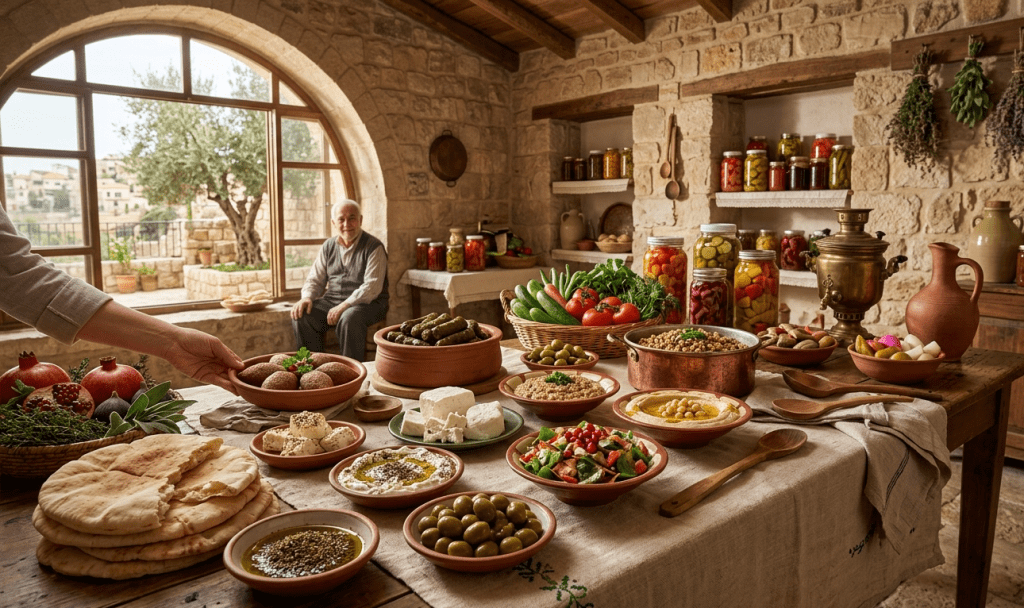
Lebanese food heritage is often reduced to recipes, restaurant menus, or famous dishes. But in lived Lebanese life, food heritage was never only about what was eaten. It was also about how food was prepared, where it was stored, when it was served, and what kind of social meaning it carried inside the house. In older Lebanese domestic life, architecture itself supported food practices: thick walls held storage niches, the open service area outside the house carried much of the cooking, and the main hall organized family gathering, hospitality, and sometimes dining. In Ragette’s study of the Lebanese house, storage, bread-baking, family gathering, and hospitality were not separate cultural themes. They were built directly into the structure of daily life.
That is why any serious discussion of Lebanese food heritage has to move beyond recipes. It has to look at the larger system that made food meaningful in the first place: the seasonal logic of mouneh, the visible labor of tannour bread, and the social timing of coffee. Together, these three practices reveal how Lebanese households once worked across the year, across the day, and across the visit. Mouneh belongs to the calendar and the fear of winter. Tannour belongs to the morning and the work of feeding the house. Coffee belongs to the threshold between host and guest, where welcome is expressed before many words are spoken. These are not side stories in Lebanese heritage. They are central ones.
Food heritage in Lebanon was part of the house itself
In traditional Lebanese domestic architecture, food was not an activity hidden inside a modern kitchen.
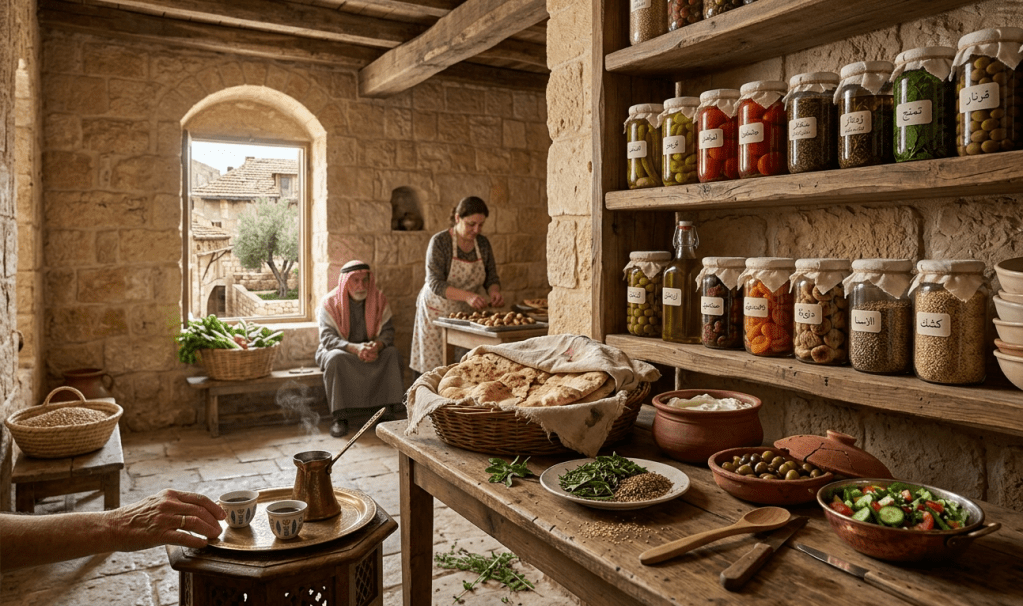
The older house distributed food-related work across different parts of the home. Ragette describes how, in the simpler closed rectangular house, the open service space in front of the house mattered greatly because much of daily work and living happened there. Cooking was usually done in this outside zone, and bread was baked in an earthen oven. Storage was also built into the house itself, through thick walls, niches, silos, and spaces for provisions. This means food heritage in Lebanon was not only culinary. It was spatial. The house itself anticipated food preparation, storage, and seasonal readiness.
As Lebanese houses evolved, the central hall became the most important room in many homes, furnishing the main space for family and kinship. Ragette notes that in some central hall layouts, the rear of the hall was used for dining, while mezzanine areas above the kitchen and pantry served servants’ accommodation and storage. In other words, the architecture of the house preserved a hierarchy of food work: preparation near service zones, storage built into the structure, and dining linked to the social center of the home. This is crucial for understanding Lebanese food heritage because it shows that nourishment, hospitality, and family life were organized as one connected system.
Later, as twentieth-century apartments became more common, the older integration of storage, service, and living began to loosen. Ragette describes how the full separation of services, living area, and sleeping area became a defining feature of newer domestic arrangements, while imported materials and new construction forms severed many links with the past. That is one reason older food practices such as mouneh, tannour bread, and coffee matter so much in heritage work today: they preserve older relationships between house, labor, time, and family, even after the architecture itself has changed.
Mouneh: the seasonal intelligence of the Lebanese household
Among the three topics, mouneh may be the deepest expression of Lebanese food heritage because it connects food directly to seasonality, preservation, and domestic foresight. Contemporary Lebanese academic work defines mouneh as a set of traditional food products preserved from crops harvested in spring and summer to be used through the year, especially in fall and winter.
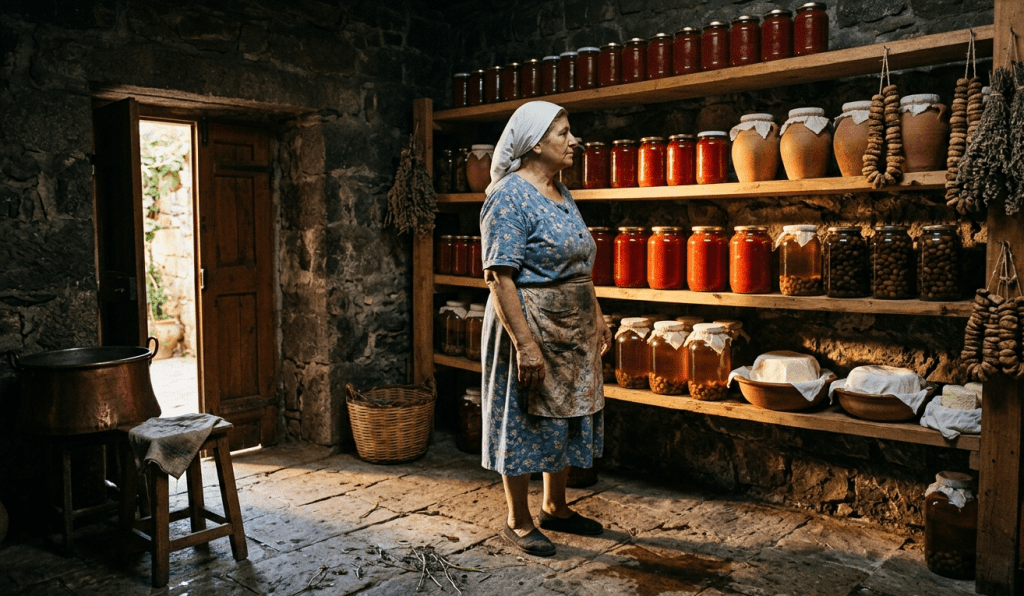
That same research identifies a mouneh season running mainly from June to September and lists examples such as fruits made into jams and syrups, tomatoes into paste, pomegranates into molasses, herbs and legumes dried, and vegetables like cucumbers and eggplants pickled. In other words, mouneh is not one food. It is a whole preservation system. (AUB ScholarWorks)
This matters because mouneh is often misunderstood as nostalgia or decoration: rows of jars on a shelf, or a “traditional” scene remembered fondly. But the sources show that mouneh was practical before it was sentimental. The same AUB-linked ethnographic study found that many women still preferred preservation methods rooted in rural communities over freezing, and documented homes where repurposed glass jars, carefully organized containers, and sometimes entire rooms were dedicated to mouneh storage. That is not the logic of display. It is the logic of preparedness. (AUB ScholarWorks)
Your attached architectural material reinforces this from a historical angle. In the older Lebanese house, storage was not improvised. Thick exterior walls included niches for storage, and larger house plans incorporated silos and dedicated provision spaces. Ragette describes houses in which one part of the interior was raised for family life while other parts handled storage, fodder, and associated domestic needs. In the same tradition, provisions such as oil, olives, milk products, meat, and grain could be stored in cool protected conditions. This means the logic behind mouneh was present at the level of the house itself: to preserve food was to preserve the household’s continuity across seasons.
Historically, mouneh belongs especially to the rhythm of mountain life. Ragette’s broader discussion of Lebanon’s socio-economy emphasizes how mountain populations lived through agriculture, tireless cultivation, and relative independence. The house was not a detached urban shell. It was part of an agrarian cycle. Later ethnographic and academic work on mouneh confirms that this preservation culture remained linked to rural knowledge, women’s work, household management, and food security. A 2017 AUB thesis on kishk, one of the best-known mouneh products, shows that kishk production in Lebanese rural areas still has both food-security and income value, and that this production is mainly carried out by women. (AUB ScholarWorks)
That is what gives mouneh its deeper meaning in Lebanese heritage. It is not just preservation. It is care made early. It is the household thinking ahead. It is the refusal to meet winter empty-handed. The tomatoes are not prepared only because they are abundant now. They are prepared because the house must be ready when abundance is gone. In that sense, mouneh represents one of the most intelligent and dignified aspects of Lebanese domestic culture: the ability to turn seasonal fragility into stored resilience. This is one reason mouneh still resonates so strongly with the Lebanese diaspora. It carries not only taste, but a memory of people who thought in months, not in hours. (AUB ScholarWorks)
Tannour bread: when bread was part of the house’s visible life
If mouneh belongs to the long arc of the year, tannour bread belongs to the rhythm of the day. It is the food heritage of heat, hands, and repetition. Contemporary AUB research treats tannour as one of the recognized bread categories consumed in Lebanon, which makes it credible to discuss it as part of the national bread landscape rather than as a local curiosity. Another AUB source on Baalbek explicitly distinguishes between bread made with the saj and tanoor bread, linking the latter to a different oven-baking technique. That distinction matters for accuracy. Tannour bread is not simply another name for saj bread. It belongs to a different baking world. (AUB ScholarWorks)
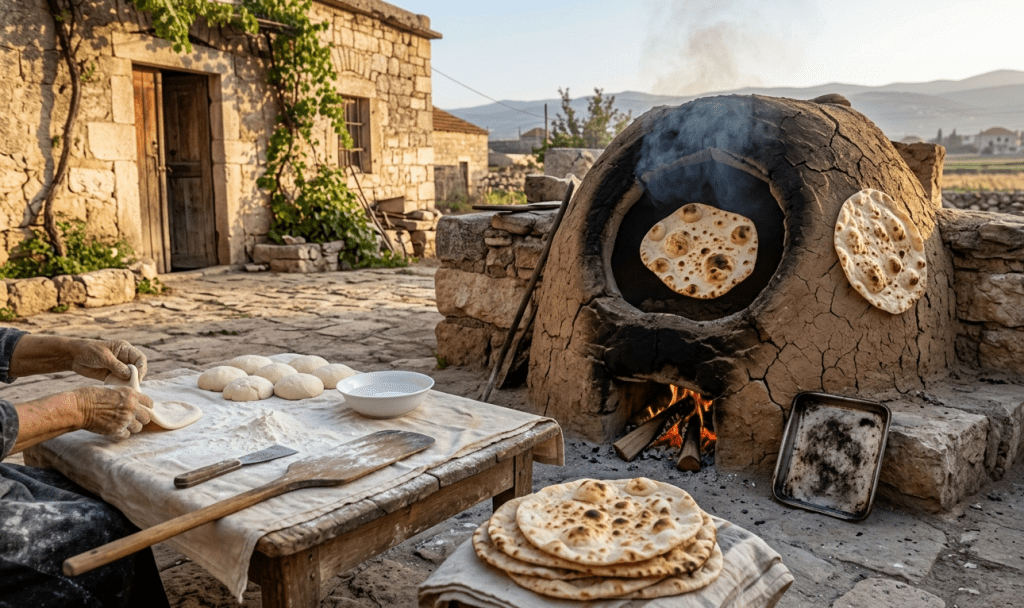
The attached architecture source gives the most important Heritage Lebanon angle: in older Lebanese houses, most cooking was done outside, in the open service space in front of the house, and bread was baked there in an earthen oven. This detail is more than technical. It changes how we should think about food heritage. Modern kitchens hide labor. The older service yard made labor visible. Bread was not an object that appeared finished on the table. It was a process witnessed by the household. You could see the oven. You could smell the fire. You knew bread was being made before it arrived.
That visibility matters culturally. In food heritage terms, tannour bread preserves a domestic world in which making and receiving food were not separate experiences. The oven outside the house meant that bread-making was embedded in daily movement: the same zone might hold water, shade, work surfaces, and the earthen oven. Ragette describes that outside area as a true service space, with cooking and bread-baking happening there as part of everyday household function. This suggests that tannour bread belonged to the lived environment of the home, not to a specialized or distant kitchen.
Bread’s importance in Lebanese life strengthens this further. One AUB-linked food-history study cites village accounts in which a meal without bread was not considered a real meal. Even if that source is not specifically about tannour, it reveals how bread occupied a central place in domestic life and daily eating. Tannour bread therefore carries more than a baking technique. It carries the status of bread itself as necessity, comfort, and continuity. In many heritage memories, what stays in the mind is not only the taste but the sensory environment around it: the heat of the oven, the smell reaching the road, the rough edges of handmade bread, the fact that the household knew bread was being made. (AUB ScholarWorks)
This is what makes tannour such a powerful topic for Lebanese food heritage. It gathers multiple levels at once. It is architectural because the oven belongs to the service space. It is culinary because it produces one of the most basic foods. It is social because the act of baking is visible to others. And it is emotional because bread, more than many foods, carries the feeling of care at the beginning of the day. In heritage work, tannour bread helps recover an older truth: bread was not only consumed. It was witnessed. That is why its memory remains so strong. (AUB ScholarWorks)
Lebanese coffee: the ritual that organizes hospitality
If mouneh prepares the house and tannour feeds it, coffee receives the guest. Coffee belongs to a different register of food heritage: not preservation and not labor, but timing, social reading, and ritual. While the attached books are not coffee manuals, they provide the domestic framework that makes a coffee ritual legible. Ragette stresses that mutual hospitality was of immense importance in Lebanese society and that the central hall furnished the desired main space for family and kinship. In some layouts, hospitality and sitting areas organized the most visible zones of the house. This is the environment in which coffee becomes meaningful: not simply as a drink, but as part of how the house expresses welcome.
For Heritage Lebanon, the important point is not to reduce Lebanese coffee to a product description. The deeper meaning lies in behavior. In many Lebanese homes, coffee comes early in the visit, sometimes before the real purpose of the visit is named directly. The tray arrives first. The cup is held before the important conversation begins. This is not something most people are formally taught. It is part of social literacy. It belongs to the same world as the unspoken rules of hospitality: how long someone stays, when insistence means sincerity, what silence communicates, and how the host gives shape to the encounter without turning it into a speech.
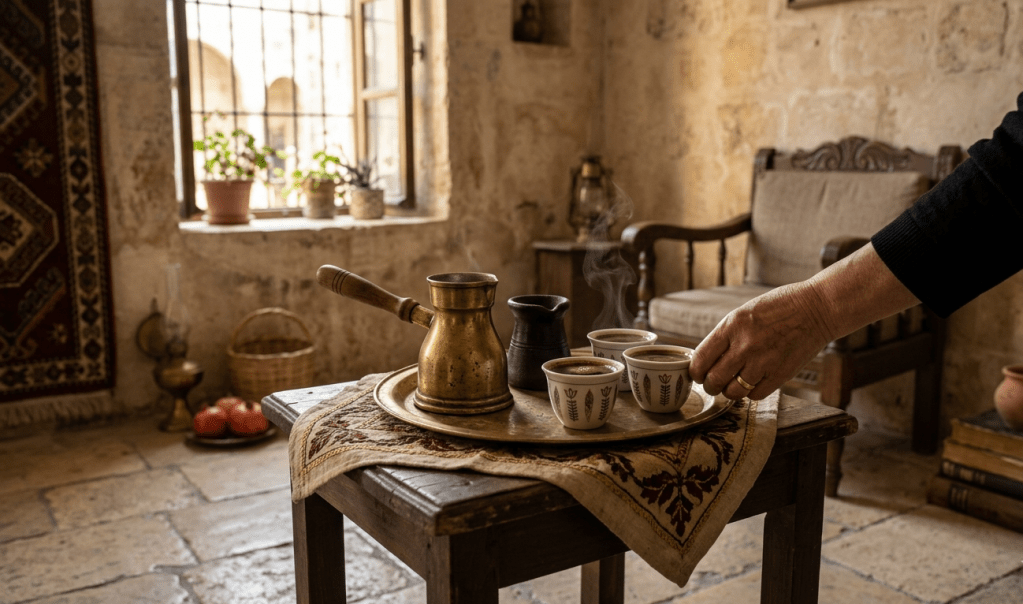
That is why coffee deserves a place beside mouneh and tannour in any serious account of Lebanese food heritage. Mouneh speaks to planning ahead. Tannour speaks to embodied domestic labor. Coffee speaks to hospitality as social intelligence. It shows that food heritage is not limited to edible things. It also includes the choreography around them: the tray, the pause, the offer, the second cup, the feeling of whether a conversation is opening or beginning to close. In a Lebanese setting, coffee is often the smallest object in the room, but one of the most socially powerful.
There is also a historical resonance here, even if it sits at a different scale. Salibi notes that the decline of the Yemeni coffee trade helped reshape larger economic conditions in the eighteenth century Ottoman region. That does not tell us how Lebanese domestic coffee was served, but it reminds us that coffee was never culturally neutral in the eastern Mediterranean. It moved through trade, habit, and social life long before modern café culture. In the Lebanese house, however, coffee became something more intimate than commerce: a domestic language of welcome.
Why these three topics belong together
Mouneh, tannour, and coffee should not be treated as random food topics. They belong together because they reveal three different time scales of Lebanese domestic heritage.
Mouneh belongs to the season. It answers the question: how does a house prepare before the need becomes visible? The answer is through preservation, foresight, and seasonal intelligence. Tannour belongs to the day. It answers the question: how does food enter the life of the house? The answer is through labor, heat, repetition, and visibility. Coffee belongs to the visit. It answers the question: how does the house receive a person? The answer is through ritual, timing, and quiet hospitality. Read together, they form a complete domestic philosophy. One makes the future manageable. One feeds the present. One gives social meaning to the moment of encounter.
This is also why these three subjects work so well for SEO and answer-engine visibility. People searching for what is mouneh, what is tannour bread, what is Lebanese coffee culture, or what makes traditional Lebanese food heritage unique are not only looking for definitions. They are often looking for context: how these practices fit into Lebanese daily life, family culture, and the traditional house. Your strongest advantage is that this article answers exactly that. It does not isolate food from life. It returns food to the social and architectural world that produced it. (AUB ScholarWorks)
Food heritage in Lebanon is really heritage of care
At the deepest level, what unites mouneh, tannour, and coffee is not just food. It is care.
Mouneh is care that starts early. It is the household thinking months ahead. Tannour is care that begins before the day fully opens. It is bread made in heat and repetition so that the house can eat. Coffee is care expressed through welcome, through small gestures that tell the guest they have entered a social space where they are seen and received. These are different forms of care, but all of them belong to heritage because they are repeated, inherited, and recognized without needing constant explanation.
This is why Lebanese food heritage matters far beyond cuisine. It preserves a vision of life in which the home was active, responsive, and morally charged. It prepared. It fed. It welcomed. Even when architecture changed, even when apartments replaced village houses, even when freezers replaced some jars and modern kitchens hid more labor, the older meanings did not disappear entirely. They survived in gestures, in memory, in the language around food, and in the objects people still recognize instantly.
To speak seriously about Lebanese heritage, then, is not only to speak about monuments, identity debates, or national symbols. It is also to speak about jars on a shelf, bread on an oven wall, and coffee arriving before the sentence is finished. These are smaller things, but not lesser things. In many ways, they are the things that made heritage livable.
Conclusion: a more complete way to understand Lebanese food heritage
Lebanese food heritage is not just a collection of famous dishes. It is a system of living knowledge shaped by season, house, labor, and hospitality. Mouneh shows how food preservation became a form of household foresight. Tannour bread shows how baking belonged to the visible life of the home and the service space outside it. Coffee shows how the smallest drink can organize the social meaning of a visit.
Taken together, these three topics offer a more complete answer to the question of what Lebanese food heritage really is. It is not only what was cooked. It is also what was stored, what was baked in view of the house, and what was served at the beginning of welcome. It is recipe, yes — but it is also readiness, rhythm, and relationship.
That is the level at which food becomes heritage: when it does not only feed the body, but teaches a way of living.
 Learn Dabke
Leave a comment