
An architectural reading of the Lebanese house as a lived system of climate, family life, storage, hospitality, and daily rhythm.
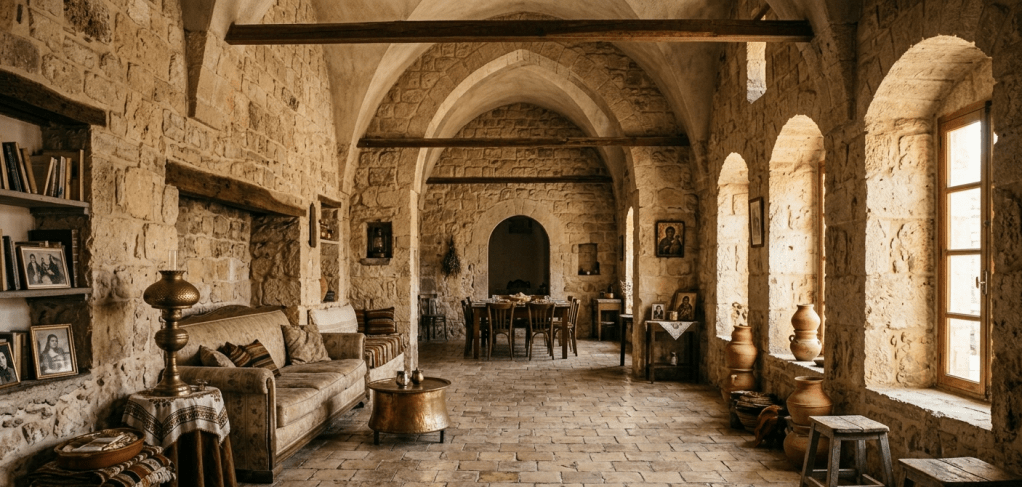
When people speak about the traditional Lebanese house, they often reduce it to one image: the triple arch. It is beautiful, yes. It became iconic for a reason. But the Lebanese house was never only a façade. It was a whole domestic system. The roof worked in summer. The threshold separated clean from unclean. The lower storey preserved food and absorbed labor. The built-in walls stored bedding, grain, and household life. And at the center, eventually, stood the dar—not just a hall, but the room that gathered family, kin, breeze, light, and social life into one space.
This article is based primarily on Friedrich Ragette’s Architecture in Lebanon: The Lebanese House During the 18th and 19th Centuries, the most detailed architectural study among the books attached to this project. For broader historical context about Mount Lebanon’s social world, it also draws selectively on Kamal Salibi’s A House of Many Mansions: The History of Lebanon Reconsidered. Where the article discusses architectural terms, materials, plans, and domestic functions, Ragette is the principal source.
The Lebanese House Was a System, Not a Set of Rooms
Ragette makes clear from the beginning that his subject is not one elite building type but the full development of Lebanese domestic architecture in the eighteenth and nineteenth centuries, from simpler peasant houses to more elaborate mountain residences. His point is essential: Lebanese domestic architecture grew out of the interaction between broader Near Eastern building traditions and the very specific geography, climate, materials, and social life of Lebanon (Friedrich Ragette, Architecture in Lebanon, Foreword, 1980 [first published 1974]).
That means the house must be read as an adaptation to mountain slopes, dry summers, winter rain, local stone, reduced timber resources, village life, and a society in which hospitality and kinship mattered deeply. Ragette also stresses the importance of climate in understanding Lebanese building. He describes Lebanon’s yearly cycle as rainy winters, early spring, four hot dry summer months, and a mild autumn, then explains how ventilation, insulation, shading, and mass construction shaped domestic solutions (Ragette, Architecture in Lebanon, pp. 3–7, 1980 [1974]).
So the old Lebanese house should not be imagined as a collection of decorative features. It was an organized answer to daily life.
Before the Triple Arch, There Was the Raised Living Platform
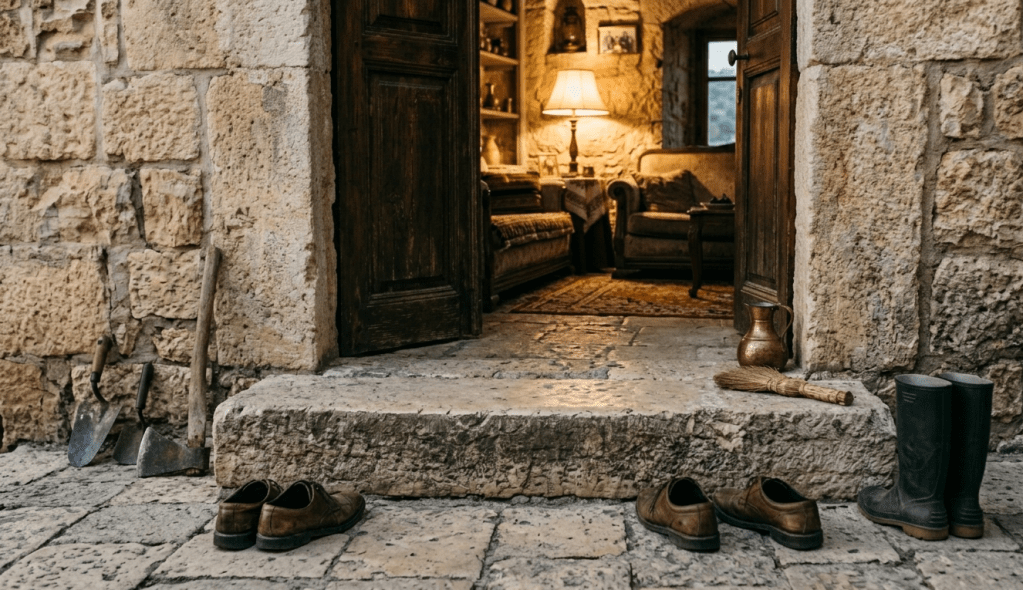
One of the most revealing parts of Ragette’s study appears in his discussion of the older closed rectangular house. He explains that the entrance zone was not treated as ordinary interior space. The area near the entrance formed a lower, more service-oriented strip, while the living section was raised. The threshold itself had weight. In his glossary, Ragette records bertash / bratish as the term for a stone threshold (Ragette, Architecture in Lebanon, Glossary, p. 202, 1980 [1974]).
Inside, he describes the living area as “generally raised and surrounded by built-in furniture,” with floor levels helping articulate the space. That raised section was not only practical. It expressed a domestic order: the lived space of the family was set apart, defined, and slightly elevated from the rougher zone of entry and work (Ragette, Architecture in Lebanon, pp. 30–31, 1980 [1974]).
This matters because the threshold in the Lebanese house was not simply where you crossed from outside to inside. It was where the house began to sort the world. Dirt stayed lower. life rose higher. The architecture itself taught order before anyone had to explain it.
The Roof Was Not Empty: It Was a Summer Surface
One of the most misunderstood parts of the old Lebanese house is the roof. In modern imagination, a roof is usually only a cover. In the older Lebanese house, especially the flat earthen-roof forms, it was much more than that.
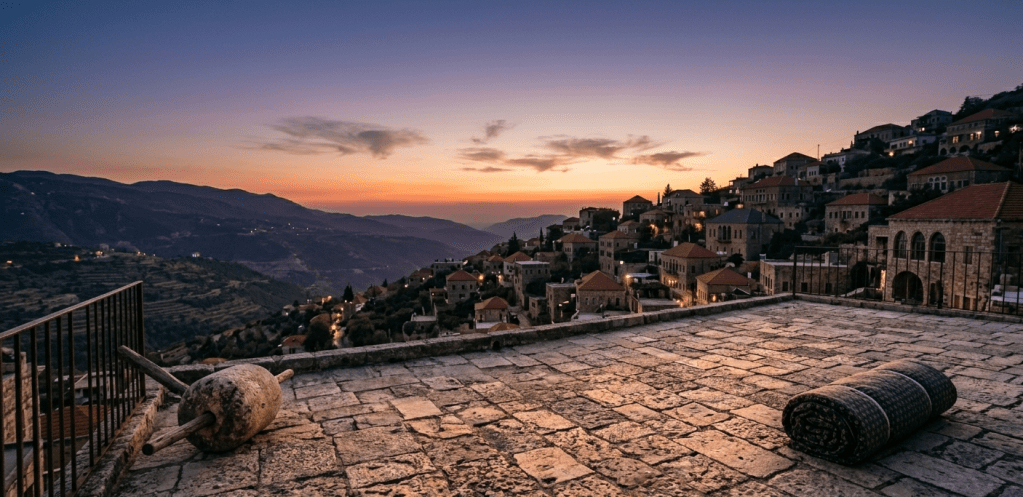
Ragette notes that the glossary includes bayt ṣayfi—literally a summer house—showing that seasonal use of upper surfaces was part of the architectural vocabulary itself (Ragette, Architecture in Lebanon, Glossary, p. 202, 1980 [1974]). In his index he also points repeatedly to roof rollers, roof trusses, stone rollers, and roof construction, which signals how important the roof was as a maintained domestic surface rather than a passive top layer (Ragette, Architecture in Lebanon, Index, pp. 213–214, 1980 [1974]).
Even where the attached excerpts do not reproduce every line of his roof chapter, Ragette’s broader climatic argument helps explain the function. Lebanese houses had to balance insulation, summer heat, winter rain, and local materials. Earthen construction, mass, and insulation were not crude survivals. They were climate strategies (Ragette, Architecture in Lebanon, pp. 3–7, 1980 [1974]).
In practical terms, the roof in many traditional settings was part of household labor and seasonal life. It was where drying, airing, and summer use became possible. Even when the later central hall house shifted toward timber-framed hip roofs with red tiles, the memory of the roof as a lived upper surface remained part of the older domestic logic. Ragette says the widespread adoption of the central hall house depended in part on this newer, lighter roof construction, which made the upper hall more feasible structurally (Ragette, Architecture in Lebanon, p. 108, 1980 [1974]).
So when people remember the old Lebanese roof as a summer place, they are not romanticizing it. They are remembering a real domestic layer of the house.
The Lower Storey Was the House’s Cool Memory
If the upper parts of the house received light and air, the lower parts held coolness, weight, work, and preservation.
Ragette says that in the central hall house, the lower floor is usually vaulted, while the upper floor carries the living hall and roof above. Full basements are rare, but half-basements are frequent, especially on slopes, where the lower floor may extend only halfway through the building and the rest of the structure rests into the hillside (Ragette, Architecture in Lebanon, p. 108, 1980 [1974]).
In the earlier closed rectangular house, he gives an even more intimate description: the house often contains “a small cool space” lower than the rest of the floor, with a small door and no window, where “oil and olives, milk products and meat are kept.” He immediately links this to the massive construction of the house, which provides “excellent thermal insulation” (Ragette, pp. 30–31, 1980 [1974]).
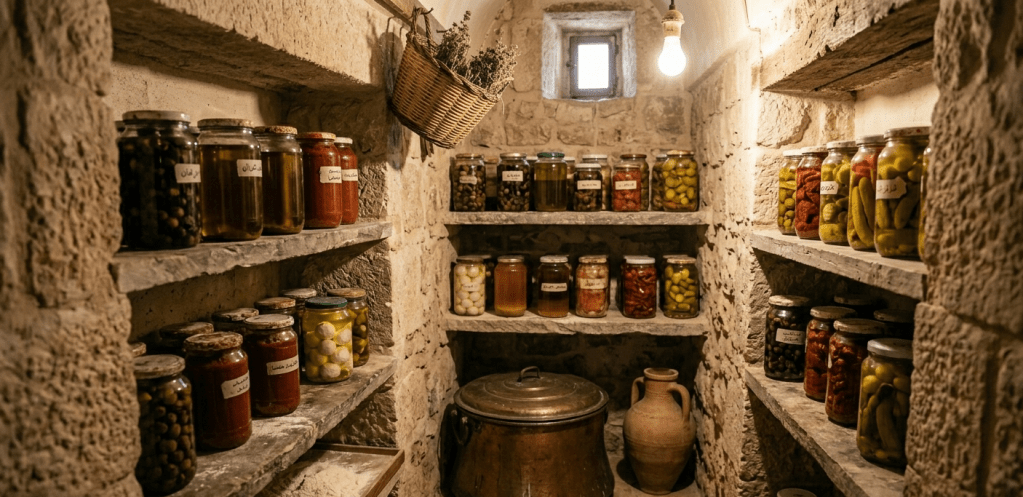
This is one of the most important clues in understanding the Lebanese house. Food preservation was not an afterthought. It was literally built into the structure. Whether later people call such a space a qabw or kaboo, what Ragette documents clearly is the function: the lower, cooler, darker, heavier part of the house was where perishability met architecture.
That lower level also belongs to a mountain economy that Salibi helps explain. He describes Mount Lebanon and Beirut as bound together by a silk economy, mountain agriculture, and a particular social world shaped by Maronite and Druze mountain societies and a commercially open Beirut. By the nineteenth century, this made Lebanon a unique social phenomenon rather than simply a political one (Kamal Salibi, A House of Many Mansions, pp. 164–165, 1988). In such a world, preserving food through seasons was not quaint. It was part of survival, rhythm, and household competence.
The Walls Stored Life
One of Ragette’s richest observations is that the traditional Lebanese house used its walls as storage.
He writes that next to the kitchen area there are “small silos for cereals, small cupboard units with wooden doors and chicken cages.” He also says, “As a rule, all separating walls are designed as storage elements,” while wooden wardrobes are rare (Ragette, pp. 30–31, 1980 [1974]). In the glossary he gives kuwwiira / kuwwiiriit as the term for a silo (Ragette, p. 202, 1980 [1974]).
This tells us something bigger than mere layout. In the Lebanese house, furniture was not meant to dominate the room. Storage belonged to the architecture. Grain, bedding, containers, shelves, and cupboards were absorbed into walls and niches. The house was not filled with separate objects in the modern sense; it was itself the container of life.
Ragette’s description of interior space captures this beautifully. He notes the “absence of large detached pieces of furniture,” the role of floor levels, and the sculptural design of partition elements. He even says the interior achieves a shell-like unity of floor and wall, with a continuity of materials and surfaces that feels organic and human-made (Ragette, p. 31, 1980 [1974]).
In other words, the Lebanese house did not just hold the family. It held their things in a way that reduced clutter and strengthened spatial coherence.
The Yuk Turned One Room into Two Times of Day
Among the most important built-in features of the house, Ragette singles out the yuk. He calls it “the most important element,” because it defines the living area that serves at night as sleeping space. It is a large niche used to store mattresses and blankets during the day, often given artistic decoration because it dominates the room (Ragette, p. 30, 1980 [1974]).
This detail is small only if you read it quickly. In fact, it opens a whole philosophy of domestic life.
The room was not permanently assigned one function. It could live twice in one day. Daytime meant sitting, gathering, talking, working. Nighttime meant bedding unfolded from the wall and the same space becoming a sleeping place. Modern houses often divide every activity into a separate room. The older Lebanese house did not always have that luxury, but it had something else: flexibility that was built into the architecture.
This is one reason the house feels so tied to rhythm. Morning and evening did not merely change the light. They changed the room itself.
The Dar Became the Heart of the House
If the older house teaches us about thresholds, platforms, storage, and transformable living, the later central hall house introduces the most famous element of all: the dar.
Ragette says plainly that the central hall is called dar, a word that “basically means home,” and that it is “the most important room of the house.” Sometimes, he adds, the term maʿad is used, meaning “seat” (Ragette, p. 113, 1980 [1974]).
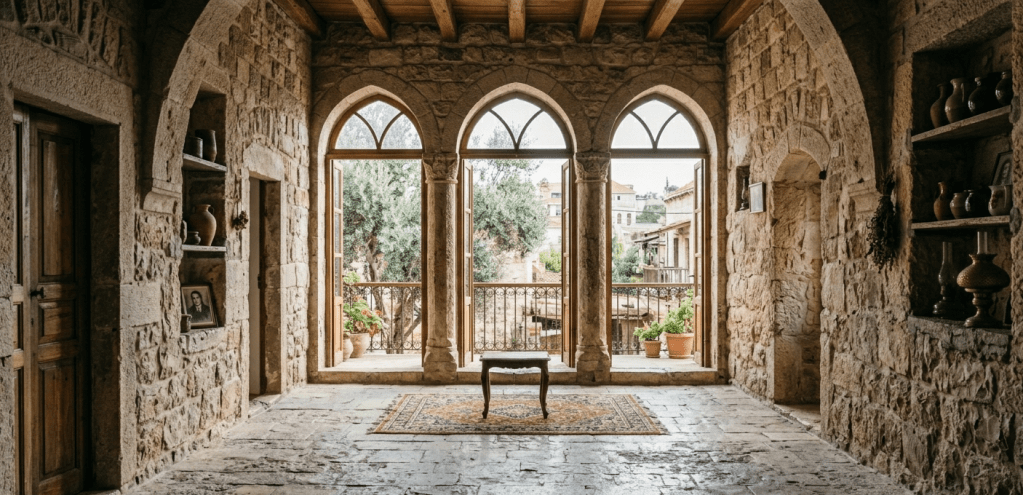
He also explains why this hall mattered so much. Climatically, it opened toward the valley and received the breeze from the sea. Topographically, it opened to the view and made the environment a natural extension of the interior. Socially, it answered the needs of a Lebanese society based on strong extended-family bonds, but often organized residentially around nuclear households. It became the desired main space “for family and kinship” (Ragette, pp. 113–114, 1980 [1974]).
This is not just a formal room. It is an architectural summary of Lebanese life:
- open, but not exterior
- central, but not empty
- social, but not ceremonial only
- practical, but still beautiful
Ragette describes the hall as large and high, usually part of a single-floor apartment ranging roughly from 100 to 300 square meters, with most examples between 140 and 200 square meters. He notes that in houses with side entrances, the rear of the hall is often used for dining and separated by an interior arcade, while in rear-entry houses the hall organizes movement, sitting, and the main area near the arcade (Ragette, p. 114, 1980 [1974]).
In the dar, circulation, hospitality, family life, dining, and the landscape all meet.
The Triple Arch Was Beautiful, but Also Climatic
The triple arch is often treated as a symbol only. Ragette restores its deeper logic.
He shows that the central hall house usually places the main hall on the upper floor, opening outward through the arcade. The hall is not simply lit by the arches. It is ventilated through them. Ragette says drafts can be controlled through doors and windows, and that the hall receives the breeze entering the valley from the sea. He also notes that the most frequent orientation among his examples is west-north-west, corresponding to the sea view (Ragette, p. 113, 1980 [1974]).
So the triple arch was not only an image of elegance. It was part of how the room breathed.
The same holds for the house’s relation to slopes and lower storeys. Ragette notes that the central hall house is usually a detached multi-level stone house, with the lower floor vaulted and the upper floor framed in timber under red tile roofs. The development of this lighter roof system was, in his words, one of the reasons the central hall house spread so widely (Ragette, pp. 107–108, 1980 [1974]).
Beauty and performance were not separate in this architecture. They were the same decision seen from two angles.
The House Also Opened Through Windows, Planters, and Detail
Ragette’s later chapters on architectural elements remind us that the Lebanese house was not only organized in plan. It was also refined in detail.
He calls the coupled window with two arches and a colonette “particularly typical of Lebanon,” and describes the care given to smooth finishes, geometric capitals, recessed panels, hood moulds, and ornamental cut-outs. He also notes the projecting stone window planters and says this combination of windows and plant-boxes is unusual in the Orient and “testifies to the Lebanese people’s love of flowers” (Ragette, pp. 145–148, 1980 [1974]).
This may seem secondary beside the dar or the roof, but it is not. It shows that the Lebanese house was not merely utilitarian. It was domestic in a full sense: lived in, looked out from, softened, and adorned.
Why This House Belonged to a Specific Lebanon
Architecture does not emerge in a vacuum. Salibi is useful here—not for plan details, but for context.
He describes Ottoman Lebanon as a place of strong mountain societies, especially Maronite and Druze, linked to Beirut, to commerce with Europe, and to a silk economy that tied the mountains to the city. He insists that what made Lebanon distinctive was not mainly political autonomy but a unique social formation shaped by those relationships (Salibi, A House of Many Mansions, pp. 164–165, 1988).
He also describes the period of Emir Bashir II, already in princely residence at Beit el-Din by 1811, with roads, bridges, waterworks, and a visible mountain order under his rule (Salibi, A House of Many Mansions, pp. 108–109, 1988).
This wider historical frame helps explain why the Lebanese house took the form it did in the eighteenth and nineteenth centuries. It belonged to a mountain society that was neither isolated nor fully urban, neither purely tribal nor simply bourgeois. It was rural, connected, stratified, proud, and adaptive. The house held all of that.
Why the Traditional House Changed
Ragette is also very clear about the end of this domestic order.
He says that in the first half of the twentieth century, the dar remained central, but new service zones expanded. Pantries, laundries, maids’ rooms, bathrooms, and buffer spaces increasingly separated service from living. Dining rooms moved toward the kitchen side. Internal corridors increased privacy. Reinforced concrete changed structure. The arcade lost its structural role. And finally, “the slow disintegration of the tightly knit family unit into a group of individuals” and a growing “preference for privacy as opposed to togetherness” led people to discard the central hall scheme (Ragette, pp. 189–190, 1980 [1974]).
He adds that apartment buildings after World War II forced living rooms to line the main façade, reducing cross-ventilation and ending the old full-depth house pattern. The result was a full separation of service area, living area, and sleeping area (Ragette, pp. 190–191, 1980 [1974]).
This is one of the deepest cultural changes in modern Lebanon. The old house gathered. The new apartment separated. One is not morally better than the other in every case. But they do not teach the same way of living.
What the Traditional Lebanese House Really Was
The traditional Lebanese house was not just a heritage postcard. It was a sequence of domestic decisions.
It raised the living floor. It made the threshold matter. It turned walls into storage. It used the lower cool zone to hold food and time. It used the roof seasonally. It let one room become sleeping space by night and sitting space by day. Then, in its central hall form, it gathered breeze, family, hospitality, dining, and view into one luminous room called dar—home itself.
That is why these houses still stay in memory even after many of them have disappeared. They were not admired only from the outside. They taught a rhythm of living from within.
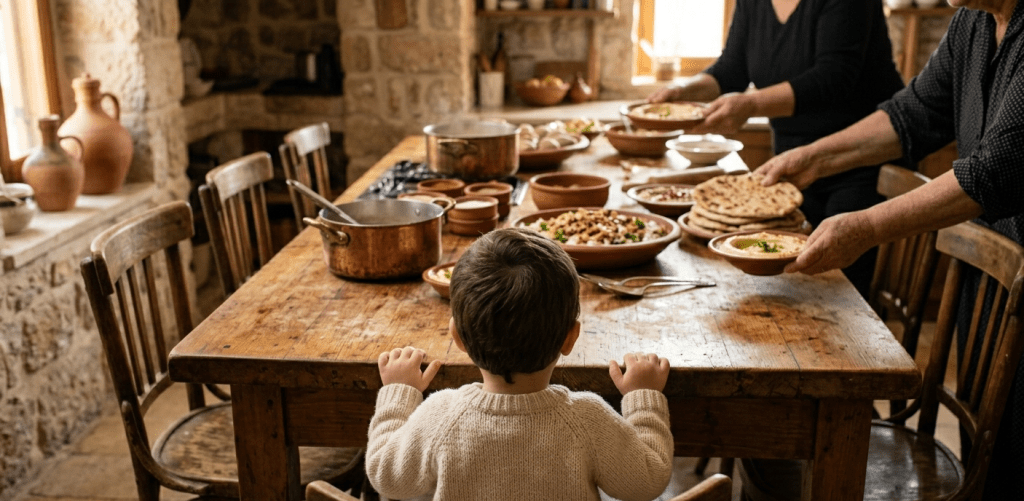
And that may be the most important thing to remember: the Lebanese house was never only built of stone, timber, vaults, arches, and tiles. It was built of habits—of entering, storing, cooling, gathering, sleeping, hosting, and staying.
Those habits are part of the architecture too.
Books used in this article:
Friedrich Ragette, Architecture in Lebanon: The Lebanese House During the 18th and 19th Centuries (American University of Beirut, 1974; Caravan Books, 1980)
Kamal Salibi, A House of Many Mansions: The History of Lebanon Reconsidered (I.B. Tauris, 1988)
 Learn Dabke
Leave a comment