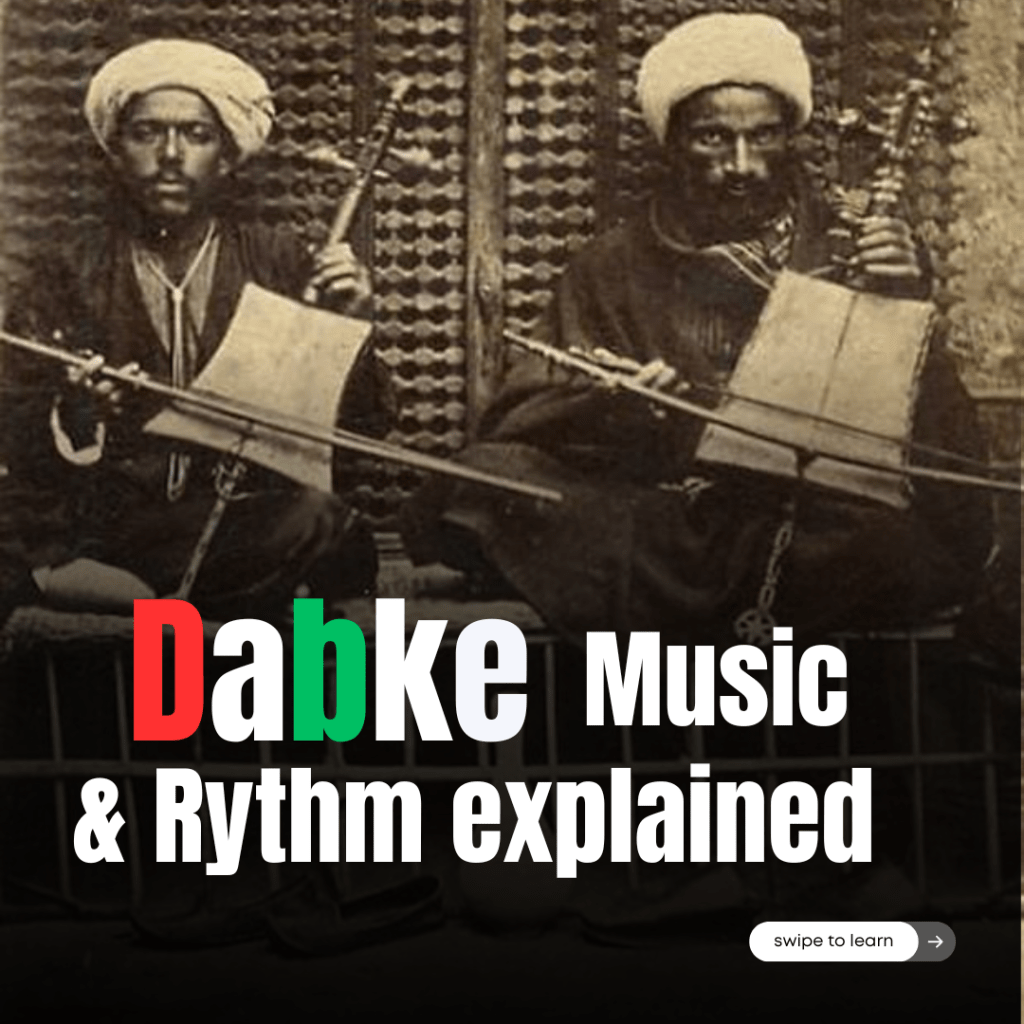
Dabke is often described as a dance, but across the Levant it is better understood as a musical system translated into movement. What separates one Dabke style from another is not the costume, the speed, or even the step shape alone — it is how the drum speaks, how the Doum and Tak are placed, and how dancers respond to that placement with their bodies.
Across Lebanon, Palestine, Jordan, and Syria, Dabke shares a common root yet develops distinct identities shaped by rhythmic phrasing, regional instruments, and social function. At the center of all of it stands one rule that dancers understand instinctively:
The drummer controls the dancers.
A single shift in Doum–Tak emphasis can transform the entire Dabke mid-performance.
The Core Idea: The Drum Controls the Dance
In every country mentioned here, Dabke is built around a conversation between:
- The tabl (bass drum): the deep heartbeat that tells dancers where the ground is
- The derbakke/darbuka (goblet drum): the sharp accents that carve the step
- The mijwiz (double-reed pipe) and yarghoul/arghul: the piercing melodic engine that raises intensity and signals transitions
What changes from one Dabke to another is not only speed. It is the rhythmic structure:
- Malfuf (2/4): fast, rolling, used for intros and transitions
- Ayyoub (2/4): heavier, trance-like, with space after the first Doum
- Maqsoum (4/4): stable and grounded, common in slower or march-like Dabke
- 6-count phrasing (often felt like 6/8): the backbone of many “Shamaliyya/Dalouna” environments
- 12-count phrasing: reserved for heavier, ritual-like openings in some Lebanese traditions (notably Bedewe & Arja)
One important detail: people often mix “style” and “song name.” For example, Dalouna is primarily a song family and refrain, while Shamaliyya is commonly used as a style label. In real practice, the drummer and mijwiz player can keep the Dalouna musical identity while the dancers switch step logic inside it.
Learn Dabke
Lebanese Dabke Styles (Corrected and Defined)
Lebanese Dabke is not one dance. It is a system of related styles, each defined by rhythmic logic.
1. Arja
- Phrasing: 12-count
- Rhythmic role: ceremonial, grounding
- Musical behavior: dominant Doum, restrained Tak
- Movement logic: asymmetry, controlled weight, dignity
Song suggestion:
Often performed to instrumental introductions or dedicated arja-style phrasing rather than a pop-known “hit,” because the count structure is the priority.
Arja is not about speed. It tests balance, authority, and patience. It is often used as an opening because it establishes gravity before movement accelerates.
2. Bedewe (Bedouin Dabke)
- Phrasing: 12-count
- Rhythmic role: tribal, grounded
- Musical behavior: heavy Doum, sparse ornamentation
- Movement logic: direct stomps, minimal flourish
Song suggestion (practical stage usage):
“Al-Hida’a” style & most of Assi Hellani & Melhem Zein songs (“Sawt Al Heda”, “Al Ain”, “Ghibi ya Shames”) Bedouin chants (non-melodic, drum-led) or Bedouin sections used by the Rahbani school.
The reference here is rhythmic authority, not lyrics — heavy tabl, clear count phrasing, space for foot weight and pauses
Bedewi Dabke emphasizes earth contact. The body does not float — it declares presence.
3. Shamaliyya (Shmelieh)
- Phrasing: 6-count
- Rhythmic role: momentum and flow
- Musical behavior: faster Tak articulation, lighter Doum
- Movement logic: lifted hops, lateral surge, continuous motion
Song suggestions (classic Lebanese folklore repertoire):
- “A‘ala Dal‘ouna” performed by Nasri Shamseddine (documented track listings; widely used in Dabke sets).
- “Ya Zarif El Toul” (often performed in the classic Lebanese festival repertoire by Fairuz with Nasri Shamseddine).
Shamaliyya is the most widely shared Lebanese style and often the bridge between regions and countries.
Dabke Theory Class
4. Zayno
(Lebanese Zayno — same family as Lebanese Karadiyya, distinct from Palestinian Karadiyya)
- Phrasing: 6-count
- Rhythmic role: dignified continuity
- Musical behavior: balanced Doum–Tak, steady tempo
- Movement logic: proud posture, controlled transitions
Song suggestion (folk repertoire):
“Zayno Zayno” or “Ya Ghzayel” (traditional melody used widely in Baalbek circles; often played before faster transitions).
Zayno carries a calmer authority than Shamaliyya. It is less about speed and more about composure.
5. Tirawiyah
- Phrasing: measured, often slower 8-count feel
- Rhythmic role: regional expression
- Musical behavior: elongated phrases
- Movement logic: wider steps, breath between strikes
Song suggestion (folk repertoire):
“Ya Rakid ‘al ‘bayya” by Samira Toufik
Tirawiyah reflects village identity more than spectacle.
6. Askariyya
- Phrasing: commonly 4/4 (Maqsoum)
- Rhythmic role: discipline and precision
- Musical behavior: straight accents, reduced ornamentation
- Movement logic: clean lifts, synchronized execution
Song suggestion (practical stage usage):
Askariyya often works best with clear, marching percussion rather than a famous “one song.” If you want a reference vibe: Rahbani-era stage percussion patterns and “Raje3 yet3ammar Lebnan” by Zaki Nassif are the best model (not because of lyrics, but because of discipline).
Askariyya demands obedience to the drum more than improvisation.
Palestinian Dabke Styles (Music-Driven Identity)
Palestinian Dabke shares rhythmic DNA with Lebanon but carries a denser collective weight.
Core Styles
- Shamaliyya: same 6-count engine, often with stronger line cohesion
- Darrazi (Druze-influenced): close to Shamaliyya but steadier, more grounded
- Karadiyya (Palestinian): slower, circular, flute-led rather than drum-led
- Sahja / Dahhiya: vocal rhythm replaces the drum
Palestinian Dabke often emphasizes collective force over individual display, with shoulders and arms reinforcing unity.
Jordanian Dabke Styles
Jordanian Dabke expands vertically and athletically.
Notable Forms
- Shamaliyya / Dal‘ouna: shared Levant base
- Karadiyya (Jordanian): faster, more airborne
- Joufiyya: facing lines with sung exchange
- Askariyya: disciplined and formal
- Dahhiya / Samir: chant-driven Bedouin form
Jordanian drumming often pushes tempo aggressively, demanding stamina and lift.
Syrian Dabke Styles
Syrian Dabke reflects regional diversity more than strict taxonomy.
Regional Characteristics
- Southern Syria (Hauran): heavy stomps, agricultural rhythm
- Coastal & Northern regions: faster Shamaliyya-like phrasing
- Urban staged Dabke: orchestrated, choreographed adaptations
- Bedouin forms: chant-based, minimal instrumentation
Syrian Dabke often shifts between grounded rural logic and formal national presentation.
The Universal Rule: Rhythm Before Step
Across all countries, one truth remains constant:
Dabke does not begin with steps. It begins with rhythm.
Change the Doum placement, and:
- A Shamaliyya becomes heavier
- A Bedewi becomes ceremonial
- An Askariyya becomes aggressive or restrained
This is why experienced dancers watch the drummer, not the leader.
Closing
Dabke across Lebanon, Palestine, Jordan, and Syria is a shared heritage with local grammars. Each region speaks the same rhythmic language, but with different accents. To truly understand Dabke is not to memorize steps, but to hear the beat, feel the phrasing, and let the drum write the dance.
Website: www.learndabke.co
WhatsApp: +96103301443
 Learn Dabke
Leave a comment