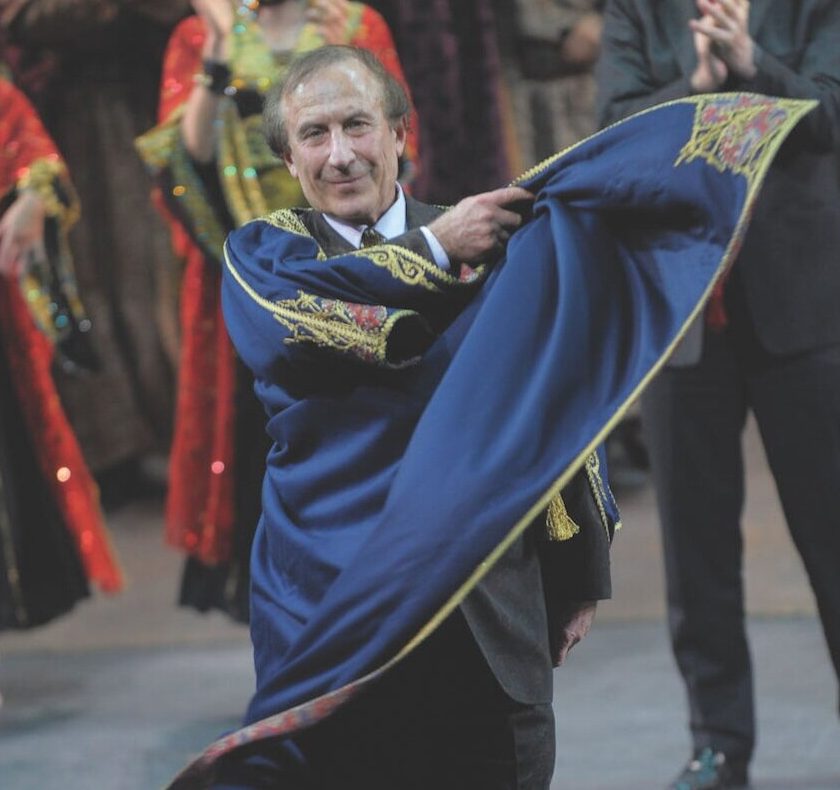
What does it take to turn Lebanese folklore into a global theatrical legacy? For Abdel Halim Caracalla, the answer was a lifelong fusion of imagination, discipline, and love for his heritage.
Born of Baalbeck, Raised by Rhythm
Abdel Halim Caracalla was born in 1938 in Baalbeck, Lebanon—home to ancient temples and the beating heart of Lebanese folk tradition. Son of Abbas Caracalla, a poet known as “Sheikh of the Youth of Baalbeck,” and Ramza Hamieh, Abdel Halim inherited both artistic sensitivity and cultural pride. Before stepping onto the stage, he shined as an athlete, winning Lebanese championships in pole vault, sprinting, and long jump—discipline that would later shape his choreography.
From the Desert to the World: Caracalla Dance Theatre
In 1968, Caracalla founded what would become the Arab world’s most celebrated dance company: the Caracalla Dance Theatre. The group’s debut, “The Black Tents,” told the story of a desert Bedouin, blending native rhythms with modern stage techniques. His choreographic language was not just steps—it was poetry, costume, lighting, and Lebanese identity in motion.
The company’s first major performance took place on the iconic steps of Baalbeck’s Temple of Jupiter. By 1972, they were performing in Japan’s Osaka Festival before Prince Mikasa. Soon followed tours in Europe, the U.S., and China, where “One Thousand and One Nights” dazzled audiences.

Learn Dabke
A Stage Dreamer, A Cultural Engineer
Caracalla is more than a choreographer—he is a cultural engineer. He writes scripts, designs costumes, selects music, and directs every detail of his stage. One piece of fabric might inspire an entire wardrobe. A single drumbeat could evoke centuries of history. His theatrical style bridges Arab traditions with global techniques.
He was mentored by world figures in Paris and London between 1962 and 1966 and later studied global folklore. Inspired by directors like Zeffirelli, he reinterpreted Western music classics (like Scheherazade or Boléro) using oriental instruments to create cross-cultural masterpieces such as “One Thousand and One Nights.”
An Institution Beyond Performance
The Caracalla Theatre Institution is now a fully-fledged cultural hub with its own venue, the Espace Caracalla (formerly Théâtre de l’Ivoire), a dance school, and a heritage research center. The school offers free training to 300 students and subsidized programs to keep Lebanese dance alive.
Caracalla’s company is the first Arab troupe to own its own theatre, offering world-class sound, lighting, costume, and rehearsal facilities.
Global Recognition & Timeless Commitment
From King Hussein of Jordan to presidents of Algeria, Tunisia, and Lebanon, Caracalla has received cultural honors from across the Arab world. His play “November: March of Dignity”—starring Warda and Algeria’s national ballet—was performed for Algeria’s 50th independence anniversary.
A Promise Carried from Village to Globe
Abdel Halim Caracalla swore never to let Lebanese heritage fade. Today, through Caracalla Dance Theatre, he carries that oath across continents, generations, and languages—turning Lebanon’s stories into global art.
 Learn Dabke
Leave a comment