
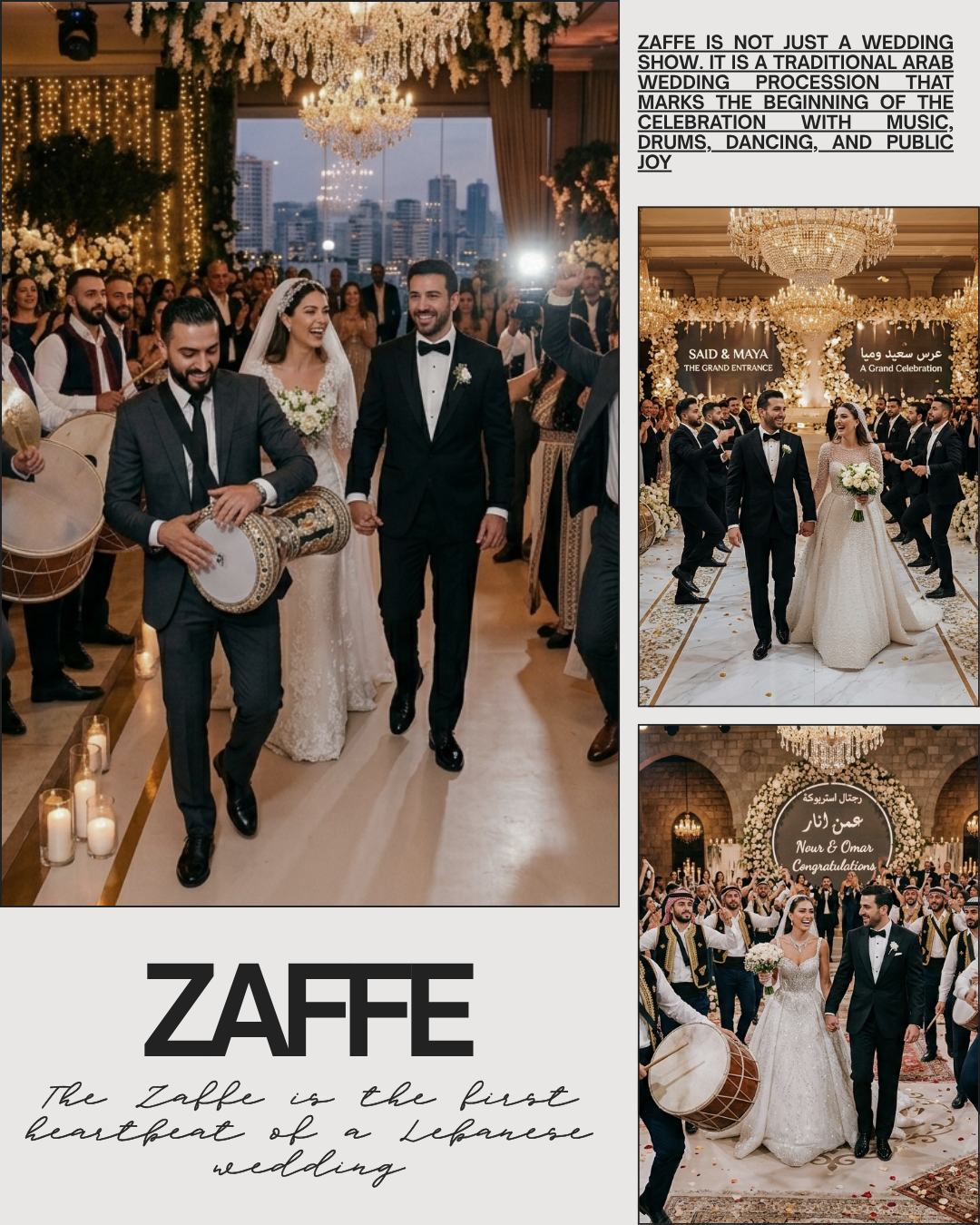
When it comes to choosing the style of Zaffe for your Lebanese wedding, the real question is not simply whether you want something traditional or modern. The better question is this: what kind of feeling do you want your entrance to create?
A Lebanese Zaffe is more than a performance. It is the moment that announces the bride and groom. It is the sound that tells the guests to stand, clap, smile, and gather around. It is the first emotional rise of the wedding night. Before the dinner, before the first dance, before the long hours of celebration, the Zaffe opens the room.
That is why the style matters.
Some couples want the full traditional feeling: live drums, strong Dabke steps, folkloric clothing, chanting, and a powerful group entrance. Others prefer a more modern wedding entrance with edited music, elegant staging, lighting, flower details, or a softer performance that matches a luxury venue. Many couples today want something in between. They want the tradition to be there, but they also want the entrance to feel personal, tasteful, and suitable for their wedding.
This is the direction many Lebanese weddings are taking today. Couples are no longer choosing details only because “this is how it is always done.” They are asking what feels right for them, their families, their venue, and the story they want their wedding to tell.
A traditional Zaffe gives the wedding a strong Lebanese identity. It usually depends on rhythm, drums, Dabke, group movement, and family energy. The performers create a ceremonial path for the couple. The bride and groom do not simply walk into the venue; they are received, celebrated, and carried by the sound of the group around them.
This kind of Zaffe feels rooted. It reminds people of village celebrations, family gatherings, old wedding customs, and the strength of Lebanese folk culture. It is especially powerful when the group understands real Dabke rhythm and does not treat the performance as decoration only.
A modern Zaffe, on the other hand, often focuses more on the visual experience. It may include modern music, dramatic lighting, special effects, saxophone, flower entrances, modern costumes, or a more theatrical arrangement. This can be beautiful when it is done with control. A modern entrance can feel elegant, clean, and impressive, especially in hotels, outdoor venues, and luxury wedding spaces.
The risk is when the modern side becomes too much. If the Zaffe loses its rhythm, its cultural meaning, and its connection to the couple, it can start to feel like a generic show. It may look expensive, but it may not feel Lebanese. It may fill the room with sound, but it may not move the room emotionally.
The best wedding entrances usually know how to balance both sides.
A couple can choose a traditional drum entrance but keep the formation short and elegant. They can include Dabke without making the entrance too long. They can use modern lighting without turning the Zaffe into a stage show that forgets the bride and groom. They can add a personal song, a family moment, or a regional Dabke style without losing the structure of the entrance.
The goal is not to choose tradition against modernity. The goal is to create a Zaffe that feels alive.
For couples who want a more traditional entrance, the most important thing is authenticity. Traditional does not mean random loud drums. It does not mean putting on old-style clothing and walking in without structure. A proper traditional Zaffe should have rhythm, coordination, clear movement, and respect for the couple at the center of the moment.
The drums should build excitement, not create noise. The dancers should frame the bride and groom, not block them. The Dabke should show discipline, not confusion. The entrance should feel powerful, but still organized.
For couples who want a more modern entrance, the most important thing is taste. Modern does not mean removing the Lebanese soul from the wedding. It means choosing modern details that serve the moment. A modern music transition can work. Elegant lighting can work. A shorter entrance can work. A mix between drums and a romantic song can work. But everything should support the couple’s entrance, not distract from it.
The bride and groom should remain the focus.
This is where many wedding entrances go wrong. The Zaffe group becomes the main show, and the couple disappears inside the crowd. The guests watch the performers instead of watching the bride and groom. The camera cannot find the couple. The family cannot join naturally. The entrance becomes crowded, noisy, and tiring.
A good Zaffe should do the opposite. It should make the couple look more important. It should open space for them. It should guide the energy toward them. It should make the guests feel that this is the beginning of something meaningful.
Personalization is now one of the most important parts of wedding planning. Couples want their wedding to feel like their own, not like a copy of every other wedding they have attended. In Lebanese weddings, the Zaffe is one of the best places to show that personality.
A couple from Baalbek, for example, may want a stronger Dabke feeling, with a rhythm connected to Baalbek-style heritage. A couple from Beirut may want a clean and elegant entrance that fits a ballroom or rooftop venue. A diaspora couple may want a Zaffe that explains Lebanese identity to guests who are not familiar with the tradition. A mixed-culture couple may want the Zaffe to introduce Lebanese culture in a way that feels welcoming, not overwhelming.
This is why the first conversation with the Zaffe group should not only be about price. It should be about style.
Couples should ask: What kind of Zaffe do we want? Do we want traditional Dabke? Do we want Baalbek-style energy? Do we want a modern entrance? Do we want live drums only, or a mix with music? Do we want family members to join? Do we want the entrance to be short and sharp, or longer and more ceremonial?
The venue also matters.
A traditional Zaffe in a wide outdoor space can be strong and open. A Zaffe inside a narrow hotel entrance needs more control. A wedding in a village can handle more family interaction. A luxury wedding venue may require a more elegant formation and better timing with the DJ, photographer, and lighting team.
A Zaffe should never be chosen separately from the venue. The same performance that looks beautiful in one space may feel crowded in another. Professional Zaffe groups understand this. They ask about the entrance path, the dance floor, the number of guests, and the timing of the couple’s arrival.
The music also shapes the feeling.
Traditional Zaffe often depends on drums, chants, and Dabke rhythms. Modern Zaffe may include edited tracks, wedding entrance songs, or emotional transitions. The strongest entrances are usually those where the music has a clear build. The sound should not start at its highest point. It should rise gradually, allowing the guests to feel that something is coming.
The best entrances have a beginning, a build-up, and a release.
The beginning catches attention. The build-up brings the couple forward. The release happens when the bride and groom fully enter the space and the guests respond. This structure is what makes the Zaffe feel like a real moment instead of a random performance.
](https://i0.wp.com/learndabke.co/wp-content/uploads/2026/05/11-1.png?resize=1080%2C1080&ssl=1)
An early glimpse of Lebanese Dabke as a social tradition, rooted in village life, collective rhythm, and the shared memory of people gathering through music and movement.
@heritage.lebanon | [www.learndabke.co](http://www.learndabke.co)
For couples trying to decide between traditional and modern Zaffe, here is a simple way to think about it.
Choose a traditional Zaffe if you want your wedding entrance to feel cultural, strong, family-centered, and connected to Lebanese roots. This is the better choice if you want live drums, Dabke, folkloric presence, and a feeling of heritage.
Choose a modern Zaffe if you want your entrance to feel polished, elegant, theatrical, and designed around the style of the venue. This is the better choice if your wedding has a luxury setup, a specific visual theme, or a more contemporary atmosphere.
Choose a mixed Zaffe if you want both: the strength of Lebanese tradition and the smoothness of modern wedding production. For many couples, this is the ideal choice. It allows the wedding to feel authentic without feeling old-fashioned, and modern without feeling disconnected.
The most important thing is that the Zaffe should feel honest.
Guests can feel when a wedding entrance is forced. They can also feel when it is real. A real entrance does not need to be the loudest or the longest. It needs to carry emotion. It needs to match the couple. It needs to make the family proud and the guests excited.
A Lebanese Zaffe becomes powerful when it respects three things: the tradition, the couple, and the room.
Respecting the tradition means keeping the rhythm, the Dabke spirit, and the cultural meaning alive. Respecting the couple means making them the center of the moment. Respecting the room means adapting the entrance to the venue, the guests, and the flow of the wedding.

This is how Lebanese couples can personalize their Zaffe without losing what makes it special.
Traditional or modern is not the final decision. The real decision is whether the entrance will feel meaningful.
A wedding entrance should not be created only for a video. It should be created for the couple walking into the room, for the parents watching with emotion, for the guests clapping before the night begins, and for the memory that will remain after the music ends.
The best Zaffe is the one that carries the couple into the celebration with identity, beauty, rhythm, and pride.
A traditional Zaffe usually focuses on live drums, Dabke, folkloric movement, chants, and cultural energy. A modern Zaffe may include edited music, lighting, modern costumes, special effects, or theatrical staging. The best choice depends on the couple’s style, venue, and the feeling they want to create.
Traditional Zaffe is not automatically better, and modern Zaffe is not automatically weaker. A traditional Zaffe is better for couples who want heritage, Dabke, and strong Lebanese identity. A modern Zaffe is better for couples who want a polished, elegant, or contemporary entrance. Many couples choose a mix of both.
Yes. A Zaffe can include traditional drums and Dabke while still using modern lighting, smooth music transitions, and elegant staging. The key is to keep the Lebanese identity clear and avoid turning the entrance into a generic show.
A Zaffe should be long enough to create excitement but not so long that it becomes tiring. The right duration depends on the venue, the number of performers, the entrance path, and the couple’s preference. A strong entrance is not always the longest one; it is the one with the best timing and flow.
Couples should ask about the style of Zaffe, the number of performers, the use of live drums, the type of music, the entrance duration, the group’s experience with the venue type, and whether they coordinate with the DJ, photographer, and wedding planner.
An authentic Zaffe feels connected to Lebanese rhythm, Dabke, family celebration, and the couple’s identity. It should not feel like a random performance. It should have structure, cultural meaning, and emotional presence.
Leave a Reply