
The Solh LegacyMasters of Baalbeki Dabke
The dancers, musicians and families who carried a city’s rhythm from one generation to the next.

Before a Dabke line could fill a stage, it filled a wedding. In Baalbek, the masters did not need a curtain to announce their arrival. A reed flute could begin the melody, a drum could establish the pulse, and the first dancer would give the others a reason to move together.
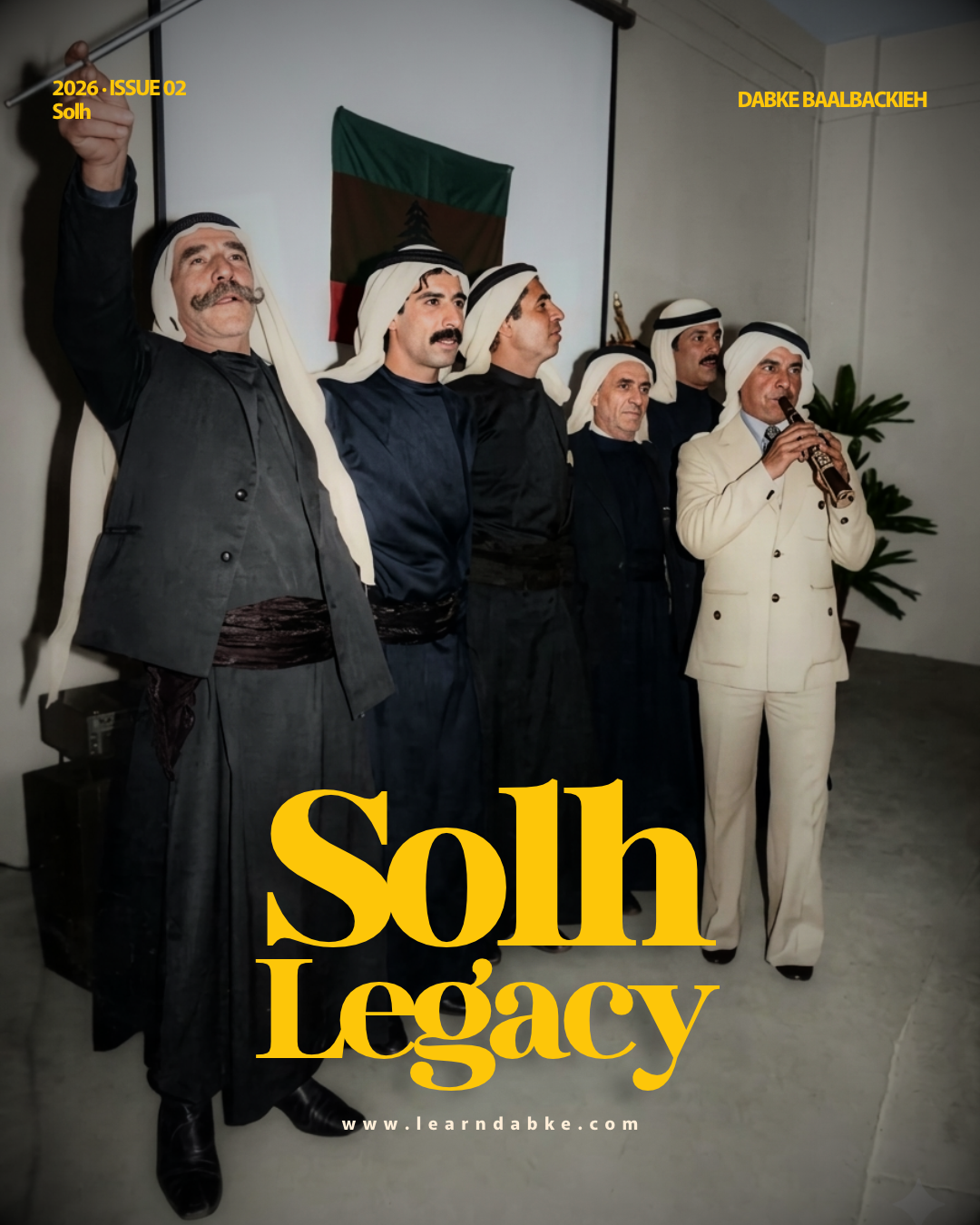
The men in the photograph above became familiar figures in the city’s celebrations. Some led the line, some sang, some played, and others answered the music with a particular turn of the shoulder or a forceful stamp. Their reputations were built among neighbors long before they were preserved in newspaper archives.
The Solh family stands at the center of this story. But the heritage was never the work of one surname alone. Hassan Shalha, Ali Hlehel, the reed-flute player Abu Rashid, and many other collaborators helped make the dance a living exchange between musicians, performers and the people around them. Their history belongs as much to Baalbek’s social life as it does to the history of Lebanese folk performance. [1][2][3]
Before the Famous Line
To understand why these performers mattered, it helps to picture the setting in which they learned their art. Traditional Dabke was not simply a sequence to be reproduced for an audience. It was part of the wedding itself, a way of welcoming people, showing skill, celebrating kinship and bringing neighbors into the same rhythm.
A line could be exacting and communal at once. The person at the front, often called the raas or leader, had room to improvise and signal a change. The people behind him needed to know the steps well enough to answer together. A good leader was judged not only by his own footwork but by what he could draw out of the entire line.
Reporting from Baalbek in 2003, As-Safir described the veteran dancers as men who had spent decades transforming weddings and local gatherings into memorable celebrations. The newspaper used several names for the ensemble: the Solh family troupe, Abu Yahya’s troupe, and the Baalbeki troupe. Such labels tell us how closely the performers were identified with both family and place. [2]
That same report placed a ceremony honoring the masters at Ras el-Ain, not far from the monumental setting of Baalbek’s international festival. The contrast is revealing. One celebration recognized an art made through everyday community life; the other represented the formal concert stage. Neither can replace the other in the history of Lebanese performance.

These photographs make an important point about memory. An individual portrait can tell us who a master was. A group image shows the relationships that made the performance possible: who stood beside whom, who listened, and how many different talents shared the same public space.
Doukhi Solh, the Pioneer
One name leads back toward an earlier chapter of Baalbeki Dabke: Doukhi Ali Doukhi Solh (دوخي علي دوخي صلح), remembered as Abu Ali. In a 2024 report for Manateq, journalist Shahira Zaiter traced his life through family testimony and local recollection. The article gives his birth year as 1902 and his death as 15 January 1972. Some later accounts use a different death year, so the published date is best understood as the one supported by this particular family-history source. [1]
Doukhi’s working life was not that of a professional dancer in the modern sense. The same account describes him as a farmer and livestock keeper. His performances belonged to a world in which labor, family, neighborhood gatherings and artistic expression were not separated into different careers.
According to those recollections, his reputation grew during the 1930s and 1940s. People gathered on the flat roofs of earthen houses, laid out carpets and turned ordinary domestic space into a place for performance. The image is striking: no elaborate stage machinery, only a performer, an audience and the expectation that something memorable was about to happen. [1]
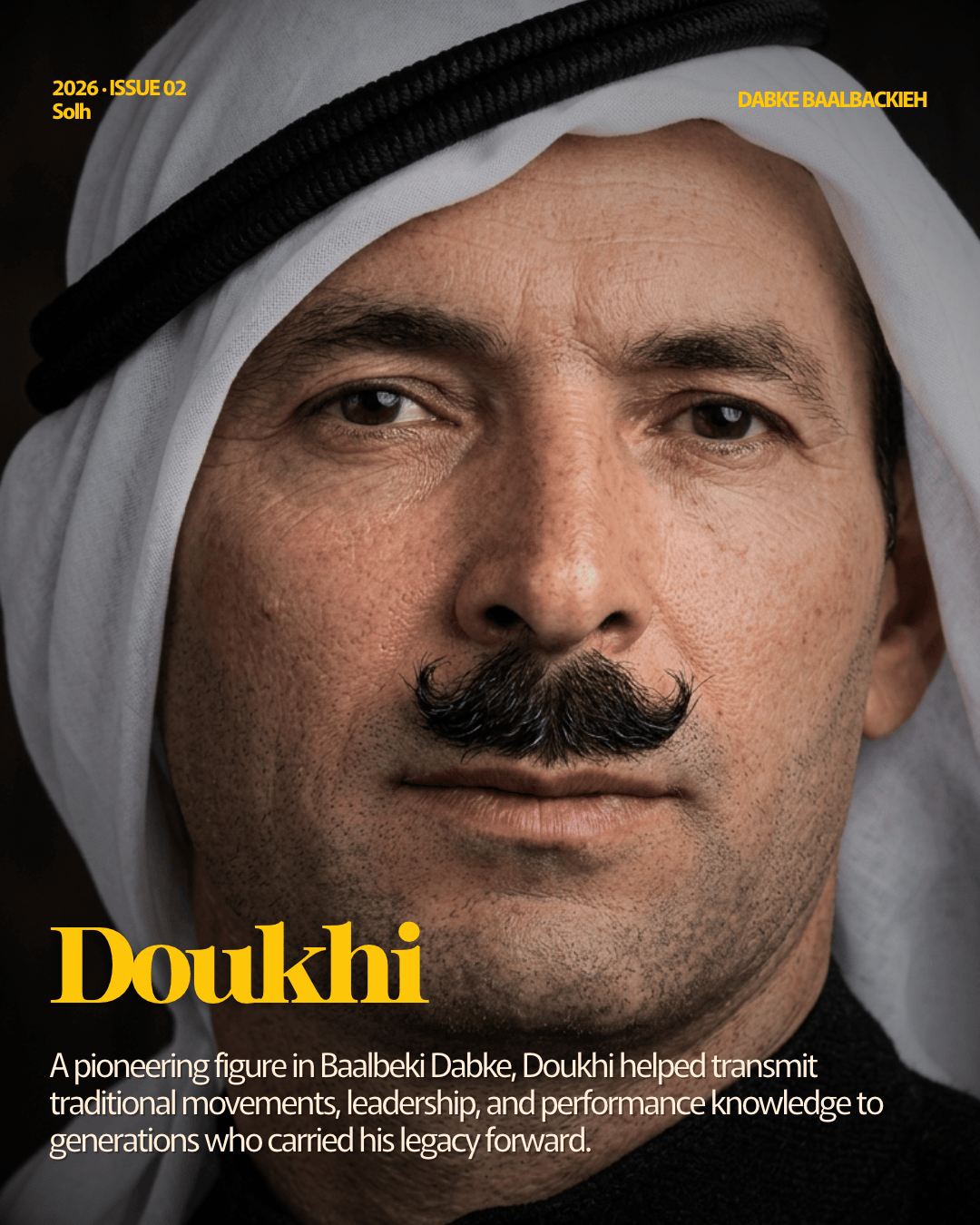

The photograph of Doukhi dancing with a jug is especially valuable. It preserves a form of individual performance that does not fit neatly into today’s idea of Dabke as a synchronized line. His reputation, as recounted by family members, included theatrical invention, mimicry and the ability to hold an audience’s attention on his own.
His importance therefore cannot be reduced to the claim that he invented every step later associated with Baalbek. That would be difficult to prove, and folk dances rarely have a single inventor. What the available testimony supports is a more interesting conclusion: Doukhi was a formative performer who gave local practices a distinctive public presence and transmitted them to dancers who would become famous in their own right.
The family account names sons including Ali, Abdel-Karim, Mahmoud (Abu Tamer) and Mohammad (Abu Bilal). It also describes Zakaria Solh, later celebrated as Abu Yahya, as Doukhi’s nephew through his sister. This is a reported family relationship, not a reason to merge all the Solh performers into one unbroken genealogical chart. [1]

The Masters in the Photograph
As the decades passed, the faces most closely associated with Baalbeki Dabke changed. The masters who later became known collectively as the shuyukh al-dabke, or elders of the dance, developed a reputation not through identical performances but through their different personalities.
Abu Yahya could command attention at the front. Abu Majed was associated with Dabke and sword performance. Hassan Shalha carried the songs and vocal traditions that made the wedding a larger musical event. Abu Khaled and Ibrahim Maroun belonged to the collective discipline of the line. The result was a shared art in which no single person contained the whole tradition.
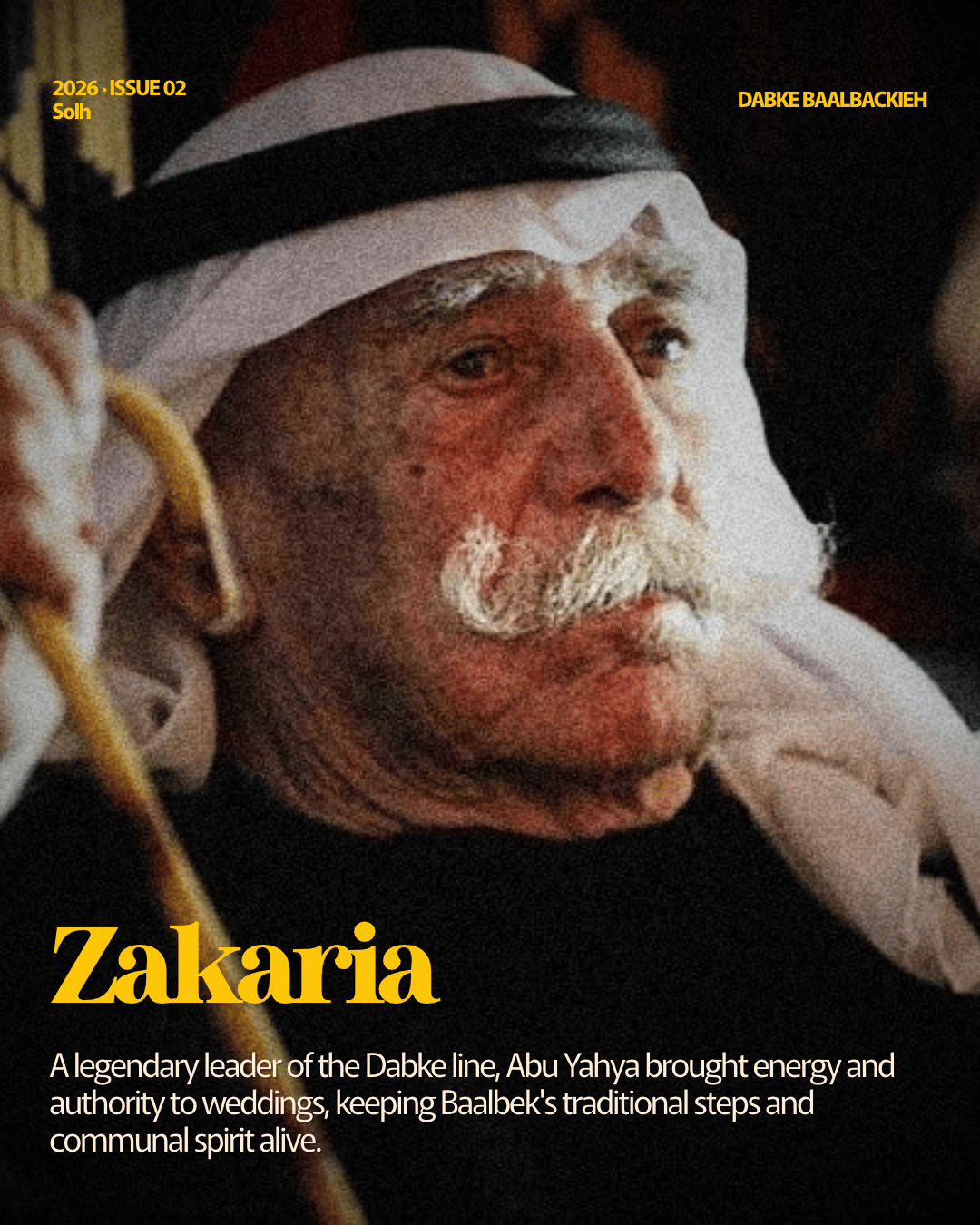
Zakaria Solh
At the head of the line, Abu Yahya turned precise movement into an event. His presence made the old Baalbeki styles recognizable far beyond his neighborhood.
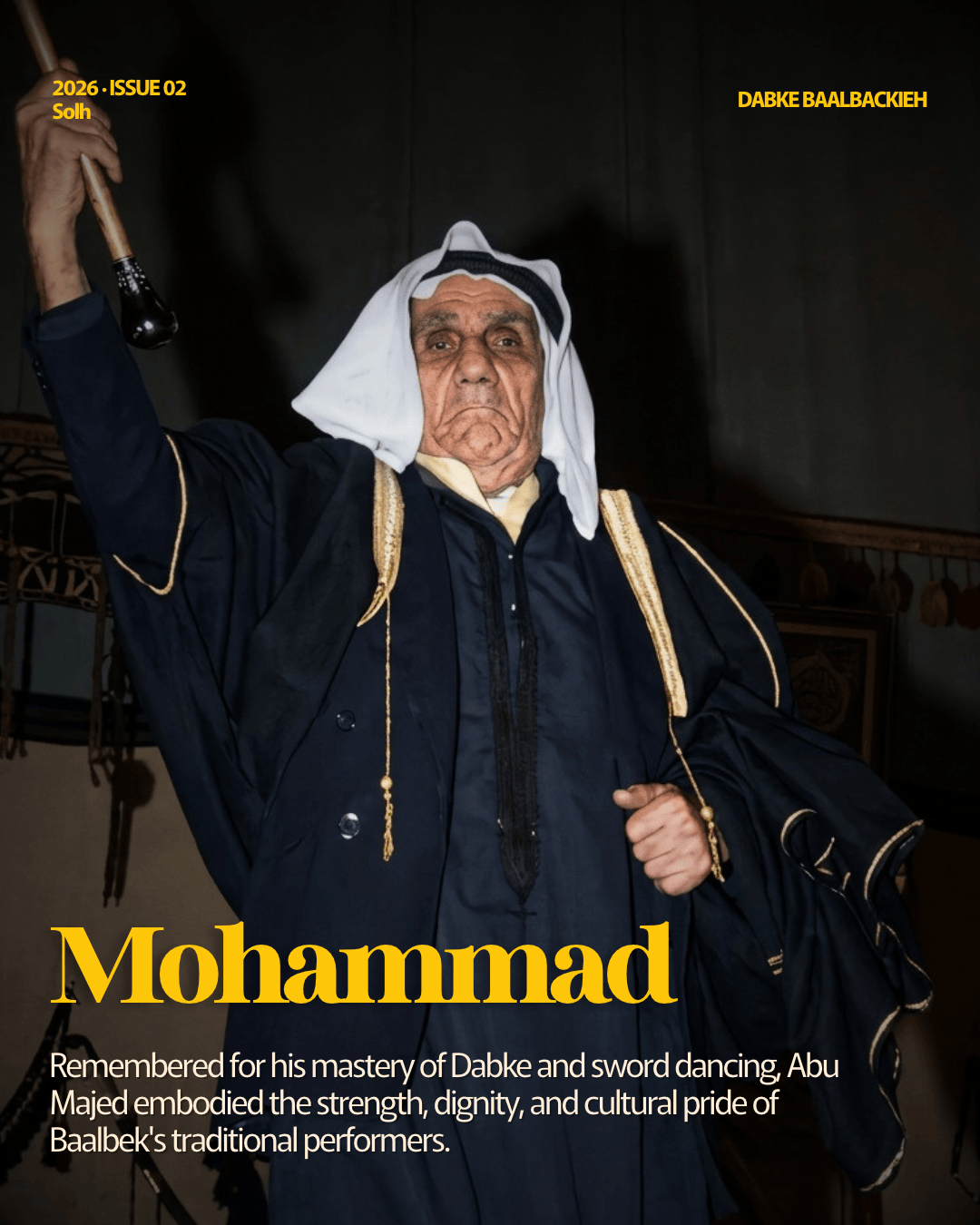
Mohammad Solh
Abu Majed belonged to the celebrated generation of wedding masters. His life also connects Baalbek’s performance heritage with the city’s wider twentieth-century history.
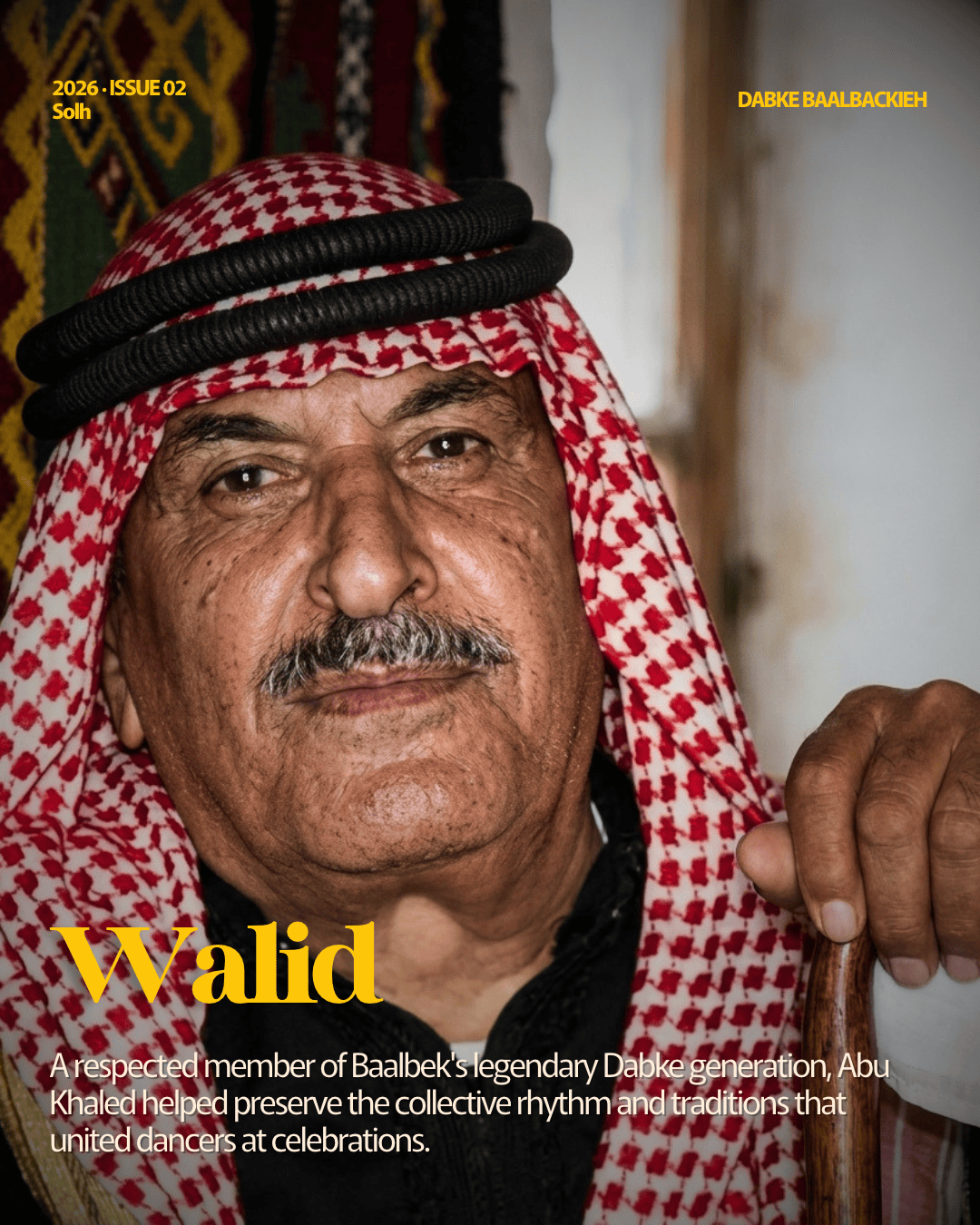
Walid Solh
Remembered among Baalbek’s old masters, Abu Khaled helped give the ensemble its recognizable presence at weddings and celebrations, where unity mattered as much as individual display.
His precise parentage remains under review.
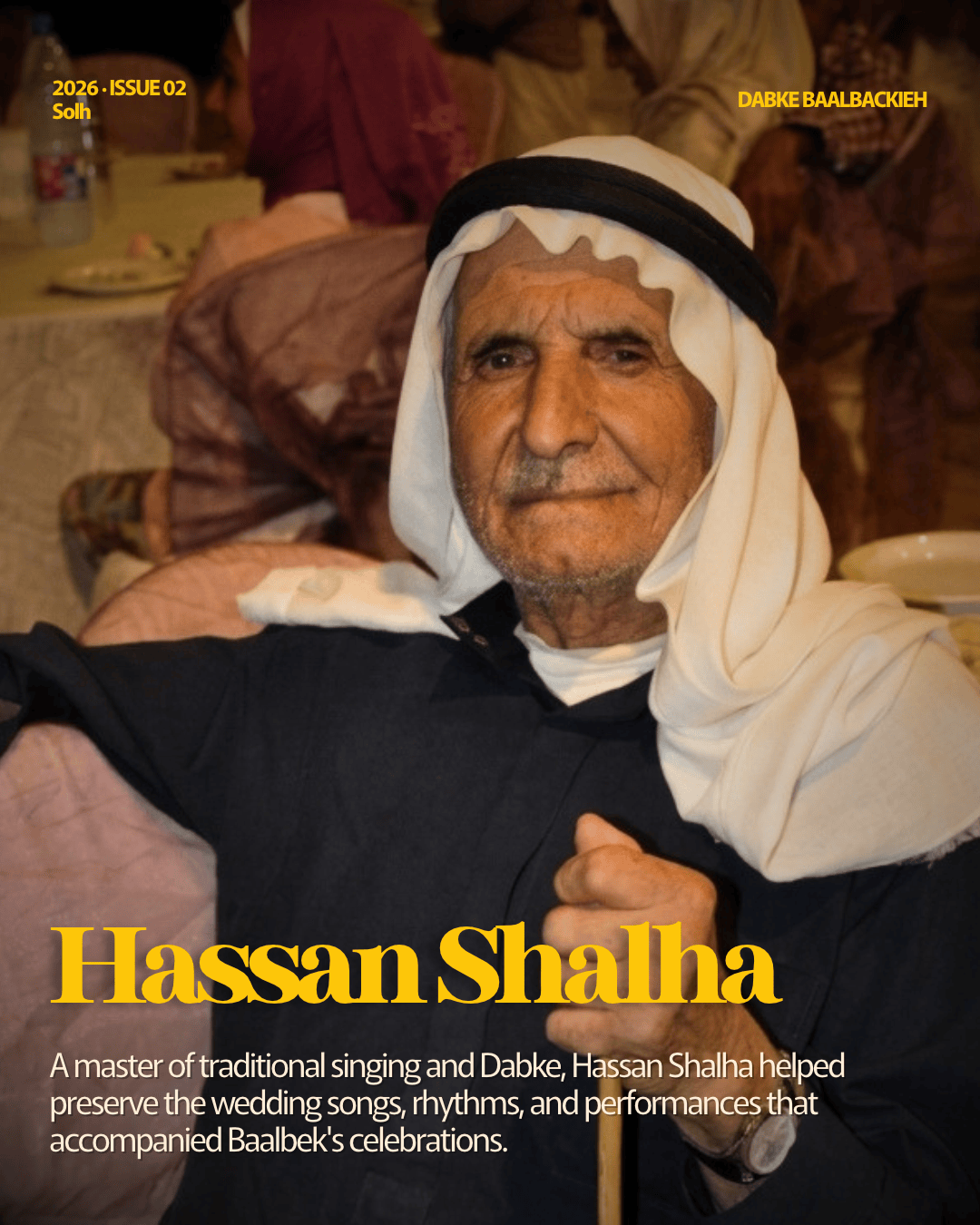
Hassan Shalha
A singer and dancer, Abu Mustafa reminds us that the heritage survived through voices as well as feet. He remained a beloved figure among the old masters.
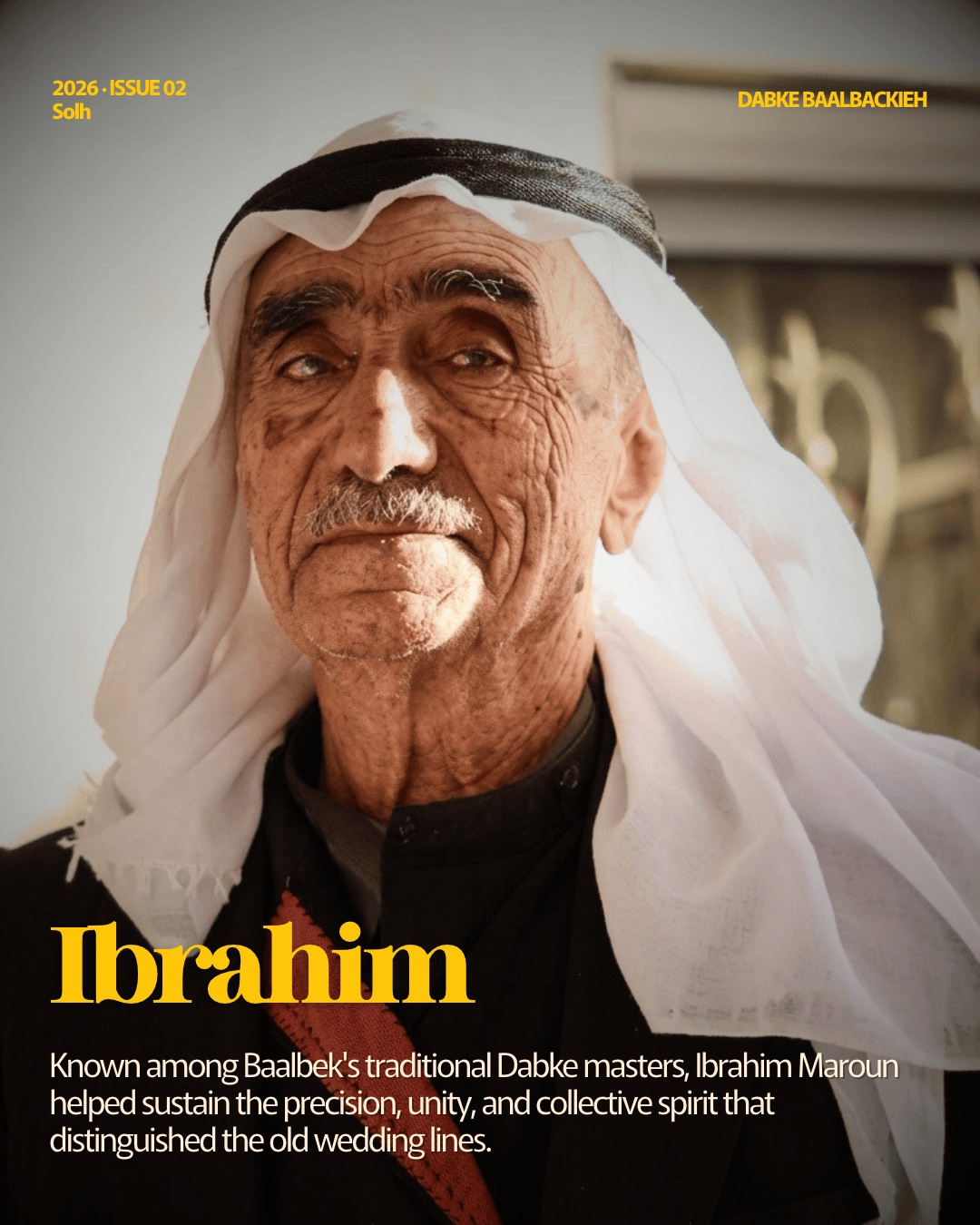
Ibrahim Solh
Known as Abu Youssef Maroun, Ibrahim appears beside the masters in the photographic record, part of the discipline and shared memory of the Baalbeki line.

Ali Doukhi Solh
Doukhi’s son Ali carried another facet of the tradition: the theatrical strength and dexterity of sword-and-shield dancing, recalled in contemporary reporting.
Abu Yahya: the art of leading
Zakaria Ismail Solh, known as Abu Yahya, became one of the most recognizable figures in the history of Baalbeki Dabke. His authority was not based on formal choreography or a diploma. It came from the experience of leading people through demanding sequences while maintaining the energy of a celebration.
His obituary in As-Safir, published in October 2012, remembered him as a figure whose movements and cane had become inseparable from Baalbek’s folk identity. The report recorded his death at approximately 88 years of age. That contemporary age report should take precedence over later attempts to assign him an exact birth year without a civil record. [4][5]
He also spoke about teaching. In the 2012 account, Abu Yahya described the way dancers added difficulty to established forms and worked to pass the styles to younger performers. This matters because it shows tradition as something practiced and adjusted, not a fixed museum object.
Abu Majed: more than a performer
Mohammad Hussein Solh, Abu Majed, also appears in sources that have nothing to do with dancing. A historical essay in the Lebanese literary journal Al-Adab lists him, along with Hassan Mohammad Shalha, among civilian volunteers from Baalbek associated with the 1948 fighting in Palestine. That is an important documented part of his biography, although the details of his individual service require separate corroboration. [6]
The 2003 As-Safir report names a celebrated dancer called Abu Majed as “Hammoud Solh,” while the Al-Adab account identifies Mohammad Hussein Solh by the same nickname. These may be variant forms used for the same man, but the article does not silently turn the discrepancy into a verified full legal name. [2][6]

That 1948 image opens a window beyond the wedding square. The lives of these masters were intertwined with farming, public affairs, political events, work and family responsibilities. Dabke was not their only identity. It was one of the ways they expressed belonging to Baalbek.
The Sound Behind the Steps
Watch a Dabke line closely and it is easy to follow the first dancer’s feet. Listen, and a second story becomes audible. A melody changes shape, a drum holds the group together, a singer calls out, and the dancers respond. Traditional Baalbeki Dabke was built through that exchange.
In the old masters’ performances, the manjira (المنجيرة), a simple reed wind instrument sometimes described locally as a shepherd’s flute, occupied a special place. Family testimony collected by Manateq also names the mijwiz and drum among the ensemble’s instruments. These are related parts of the sound world, but they are not interchangeable instruments. [1]
Abu Rashid: the musician in the photograph
The man at the far right of our opening photograph is identified by the contributing archive as Mohammed Rashid Solh, Abu Rashid, the manjira player. In its 2003 list of honored performers, As-Safir instead printed the name Mohammad Rashid Hamada. According to the family information provided for this archive, Hamada is a branch within the wider Solh family. The two name forms are presented here with that attribution, rather than as proof of a complete legal genealogy. [2][3]
His place in the photograph matters. He is not an anonymous accompanist at the edge of the story. The musician was part of the performance’s structure. His sound offered cues and atmosphere that the dancers could answer, while the dancers’ energy gave the melody its social purpose.
Hassan Shalha and the wedding voice
Hassan Shalha, Abu Mustafa, crossed the boundary between singer and dancer. He was recognized publicly as one of the elders, and when the masters were honored in 2003, he spoke on their behalf about helping younger generations preserve the tradition. A 2020 remembrance by Talal Salman described his importance to the old troupe and the emotional place he held in Baalbek’s celebrations. [2][7]
Wedding culture also included sung exchanges, poetic forms, welcoming calls and the voices of guests. Ali Hlehel, pictured with the masters, represents this broader connection between Dabke and Baalbeki song. The documentary Dabketna later turned to Hlehel to explain the traditional forms and their musical setting. [3]
The dance was never silent, and the musicians were never merely background.Editorial interpretation of the documented ensemble tradition
To preserve the names of the dancers but forget the singers and instrumentalists would leave half the heritage untold. A photograph of Abu Rashid playing the manjira, if one becomes available, deserves a place beside the most famous images of the line leaders.
A Vocabulary of Movement
There is no single step called “Baalbeki Dabke” that captures everything the masters knew. Their repertoire contained different rhythmic patterns, changes of direction, group formations and solo flourishes. The names of the forms were part of a practical vocabulary, learned by watching and joining rather than from a printed manual.
Today, one widely used teaching framework identifies six principal Baalbeki styles. The names below are presented as that modern teaching classification, not as proof that every master in every decade used exactly the same list.
Historical testimony gives a more complicated picture. In his 2024 interview, Abdel-Karim Doukhi Solh named the Arja, Zaino, Shmaliyyeh, Lala, Dalouna and Askariyyeh, and also recalled a form called Hawraba associated with mourning. This is not a simple contradiction to be edited away. It shows that a living repertoire can be grouped differently across performers and generations. [1]
The Arja and Baddawiyyeh were particularly associated with the old masters in local accounts. Abu Yahya himself spoke about developing more demanding variations. Rather than treating every name as an ancient, unchanged category, it is more faithful to the evidence to recognize a history of preservation, variation and invention within the community. [1][4]
The sword-and-shield performance offers another example. Ali Doukhi Solh, called Abu Hussein in the 2003 report, is remembered for this skill. Such solo or paired displays could sit alongside the linked Dabke line without being identical to it. The same applies to the sahja, a collective clapping and chanting tradition, and the arda, a distinct ceremonial or martial display. These neighboring traditions should be described in their own terms, not folded into one undifferentiated category.
Beyond the Wedding Square
The story of the masters also intersects with a major change in Lebanese cultural life: the movement of folk performance into formal festivals, theaters, television and international tours. That change created new audiences, but it also raised a question that remains relevant today. What happens to a communal dance when it becomes a choreographed spectacle?
The Rahbani stage tradition, the Baalbek International Festival and the later work of Caracalla helped make Lebanese folk-inspired movement visible to audiences far beyond the village wedding. Their theatrical productions, however, followed different artistic rules from the improvisational and social performances of Baalbek’s traditional masters. To celebrate both histories is not to claim that they were the same institution or that one family single-handedly created the other. [1][3]
In an interview with Manateq, Abdel-Karim recalled performances by the traditional troupe in countries including Jordan, Syria, Iraq, Bahrain, France and Argentina. He also described appearances at official receptions and alongside well-known Lebanese singers. These are valuable first-person recollections, although the exact dates and venues of each appearance require further archival research. [1]
Another milestone is documented more precisely. On 14 July 2003, As-Safir reported on a ceremony organized by the Hayakel Baalbek association at Ras el-Ain to honor the elder performers. Abu Yahya led the entrance, and the newspaper listed Abu Majed, Abu Mustafa, Abu Youssef, Abu Ibrahim, Abu Hussein, Abu Tamer and Abu Rashid among the honored masters. Younger dancers joined them in performance, including a sword-and-shield display. [2]
A public tribute, a private inheritance
The 2003 ceremony was more than a celebration of famous personalities. It made visible a transfer that usually happened without formal announcements: older performers teaching younger ones how to carry the music, the movements and the responsibility of representing Baalbek.
It also showed the tension between recognition and neglect. The masters had given decades of performances to their community, yet formal acknowledgment came relatively late. Their greatest audience had always been the people who gathered around them.
Passing On the Inheritance
Doukhi Solh’s story did not end with his own performances. His son Abdel-Karim Doukhi Solh, known as Abu Doukhi, became a visible link between the earlier masters and younger troupes. He should never be confused with his father, the elder Doukhi, despite the shared name that often causes errors in short online accounts.
In 2024, Abdel-Karim spoke about the old ensemble and its repertoire, describing the importance of its members, the instruments that accompanied them and the places where they performed. His testimony is especially useful because it comes from someone who participated in the tradition rather than observing it from outside. It is still a recollection, subject to the same need for careful comparison as any oral history. [1]
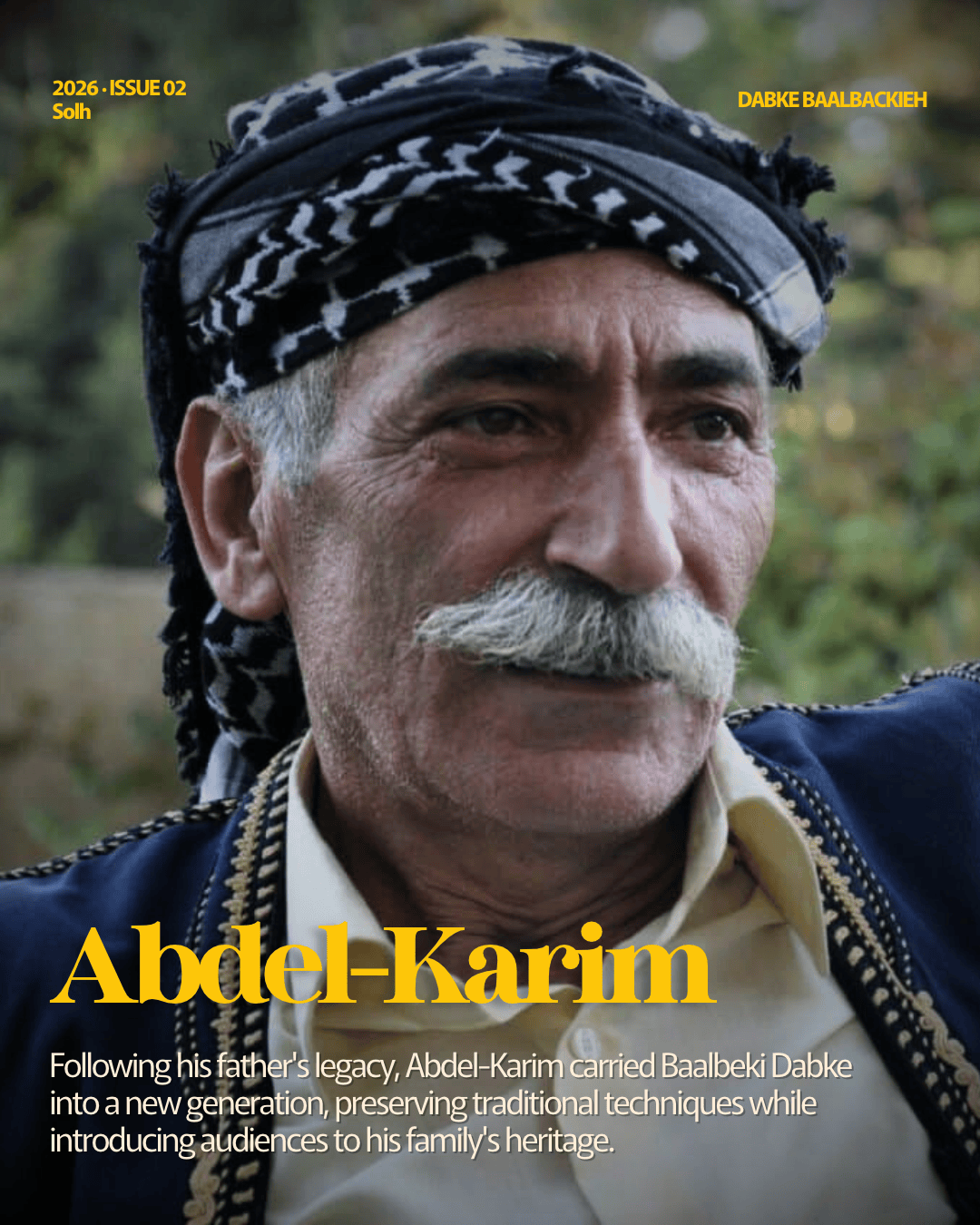
The inheritance also traveled beyond one household. The 2024 account names younger organizations such as Shams Baalbek, Hayakel Baalbek and Al-Majd among groups connected to the elders’ teaching. The documentary Dabketna records a later wedding in which Abdel-Karim and other experienced dancers led the line before younger participants joined. These scenes are important because they show preservation as an ongoing act rather than a historical slogan. [1][3]
Teaching a traditional style is more than demonstrating a sequence of foot placements. It means learning how to stand with others, hear the music, respond to the leader and understand when a movement belongs to a particular occasion. A recording can preserve the visible step, but the knowledge of when and why it was performed often lives in the people who remember the gathering.
A timeline of people and memory
Birth year given for the elder Doukhi Solh in the 2024 Manateq family-history article.
Period of Doukhi’s growing reputation and performance activity, as reconstructed from family recollections.
Abu Majed and Hassan Shalha are named among Baalbek volunteers in a later historical essay; the archive also supplies a photograph dated 1948.
Death of elder Doukhi, dated 15 January in the Manateq report; other accounts differ.
Public tribute to the old Dabke masters at Ras el-Ain, documented by As-Safir.
Death of Zakaria Solh, Abu Yahya, recorded in contemporary newspaper reporting.
Death of Hassan Shalha, Abu Mustafa, remembered in a tribute published on 29 April.
Families, teachers, archives and performers continue to preserve the steps, songs and stories.
What the Archive Remembers
Photographs have a peculiar power in the history of folk dance. They can freeze a movement but cannot reproduce its rhythm. They can show a master at the front of a line but cannot tell us the exact instruction he gave, the tune being played, or what the crowd shouted in reply.
That is why the photographs in this collection are presented alongside contemporary journalism, family testimony and documentary research. Each source contributes something different. The 2003 newspaper report confirms the names publicly honored at a particular event. The 2024 interview offers family memory about Doukhi and the troupe. The 2021–2022 Dabketna project preserves voices and images from a later moment. The contributing archive supplies the identification of the photographs reproduced here. [1][2][3]
These sources do not agree on every detail. Some names appear in more than one form. Some family relationships still need documentary confirmation. Even the boundaries of the repertoire changed with time. Such uncertainties are not a weakness to hide. They are part of the work of preserving a living tradition with care.
What remains unmistakable is the place of the masters in Baalbek’s cultural memory. They were not simply dancers whose performances happened to survive on film. They were neighbors, relatives, singers, farmers, musicians and teachers. They turned a gathering into an occasion people remembered. And they left later generations something that could only stay alive by being practiced.
About names and identifications
The contributing archive identifies the group photograph’s reed-flute player as Mohammed Rashid Solh and explains Hamada as a branch of the Solh family. As-Safir uses Mohammad Rashid Hamada. It also records Ali Doukhi as Abu Hussein and uses Hammoud Solh for Abu Majed. We retain these differences transparently. Dates or family relationships that have not been independently confirmed are attributed rather than presented as established archival facts.
Photograph credits
Historical images and individual identifications supplied by Dabke Baalbackieh / Zorba Academy via the Learn Dabke media archive. The six-master group photograph is credited as restored by Zorba Academy. Original photographers, dates and rights holders are not established for every image. Please add any known original photographer or collection credits before publication.
A tradition survives when someone remembers the steps, and someone else joins the line.
Sources & Further Reading
- Shahira Zaiter, Manateq (6 June 2024). “آل صُلح وحكايتهم مع الدبكة البعلبكيّة من الدوخي المؤسّس إلى الأبناء.” Interview-based family history including Abdel-Karim Doukhi Solh. Read source.
- Abdel Rahim Shalha, As-Safir (14 July 2003). “بعلبك تكرّم فرقة آل صلح الشعبية: أعمدة تضيء سماء السهل.” Contemporary account of the Ras el-Ain tribute and its honorees. Read source.
- Fatima Sharafeddine, Dabketna (2021–2022). Lebanese University media graduation documentary on traditional Dabke, interviews, music and photographed masters. Explore documentary.
- Abdel Rahim Shalha, As-Safir (2 October 2012). “رحيل زكريا صلح.. العمود السابع في هيكل جوبيتير.” Contemporary obituary and recollections of Abu Yahya. Read source.
- National News Agency, republished 2 October 2012. “الموت يغيّب عميد الدبكة اللبنانيّة زكريا صلح أبو يحيى.” Read report.
- Hassan Kasr, Al-Adab (20 June 2017). “صفحات من نضال بعلبك (مقدّمة).” Names Mohammad Hussein Solh (Abu Majed) and Hassan Mohammad Shalha in a retrospective account of 1948. Read source.
- Talal Salman (29 April 2020). “أبو مصطفى يلتحق بأبي يحيى في دبكة وداع الشمس.” Tribute to Hassan Shalha. Read tribute.
Leave a Reply