
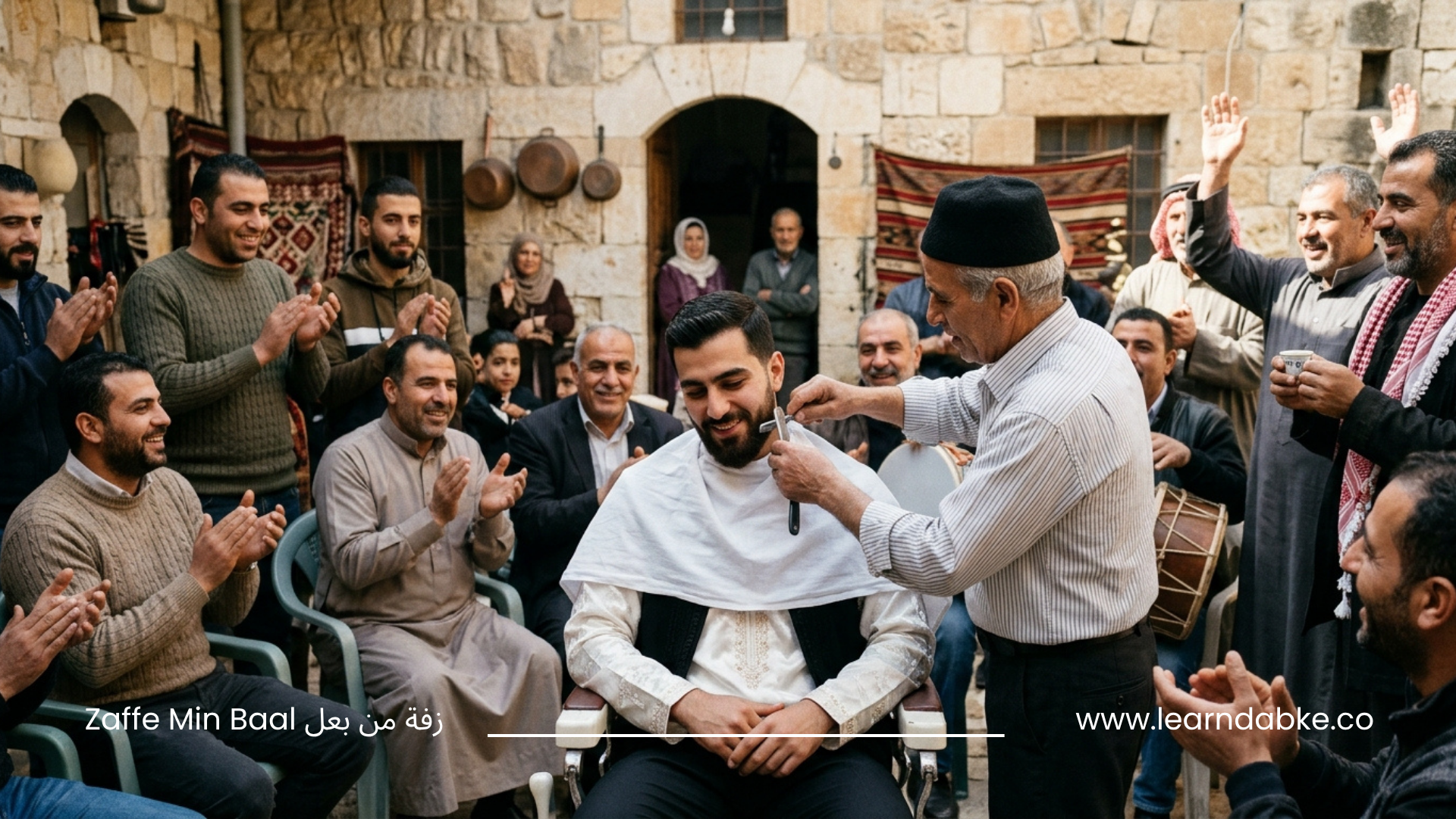
Before the wedding entrance, before the Zaffe, and before the bride and groom are brought together, an older Lebanese tradition celebrates the groom through shaving, ceremonial dressing, music, and the gathering of an entire community.
In a traditional Baalbek wedding, the groom’s preparation was not something that happened quietly behind a closed door. His family, friends, and neighbors gathered to celebrate it. A barber prepared his hair and beard, young men carried his wedding clothes, singers performed traditional chants, and relatives welcomed him with clapping and ululation.
This custom is known as Hilaqat al-Aris (حلاقة العريس), the Lebanese groom shaving tradition. It was closely associated with Talbisat al-Aris (تلبيسة العريس), the ceremonial dressing of the groom, and could form part of a larger celebration involving henna night, horseback processions, Dabke, and the traditional Lebanese Zaffe.
In Baalbek and parts of the Bekaa Valley, the groom’s preparation became one of the most distinctive moments of the wedding. What elsewhere might have been a brief visit to a barber was transformed into a gathering filled with songs, friendship, hospitality, and family pride.
The tradition reveals something important about older Lebanese weddings: marriage was not only a private occasion for two people. It was a celebration in which relatives, neighbors, musicians, and friends all had a part to play.
What Is the Traditional Groom Shaving Ceremony in Lebanon?

Hilaqat al-Aris, literally meaning “the shaving of the groom,” is a traditional Lebanese wedding custom in which the groom is shaved or given a haircut in the presence of relatives and friends, often accompanied by folk singing and ceremonial celebration.
In some communities, the groom would sit on a chair or raised seat in the family courtyard, inside a wedding tent, or in an open village square. The barber prepared his appearance while young men gathered around him, singing verses specifically associated with shaving.
The ceremony could continue with the presentation of the groom’s wedding clothes. His companions helped him dress, praised him, and accompanied him toward the next stage of the wedding.
The custom was not exclusive to Baalbek, nor did every Lebanese family follow an identical ceremony. Regional variations appeared in the location, songs, clothing, timing, and people involved.
What distinguished the traditional ceremony from ordinary grooming was the presence of the community. The groom was not simply having his hair cut. He was being publicly prepared and celebrated before beginning married life.
The Historical Origins of Groom Shaving
When did the Lebanese groom shaving tradition begin?
There is no reliable historical evidence identifying one exact date or place where the custom originated. Although ceremonial wedding processions existed in many ancient societies, the specific Lebanese practice of publicly shaving and dressing the groom cannot confidently be traced to a particular Phoenician, Roman, or other ancient ceremony.
The strongest historical material comes from Lebanese folk research, oral testimony, and descriptions of village weddings.
In his study of traditional Lebanese marriage customs, researcher Dr. Issam Al-Hourani documented practices associated with earlier generations, including accounts from Baalbek-Hermel. His research describes how the groom was seated before the wedding gathering while young men carried his clothing and sang verses appropriate to the occasion.
Research collected from local communities, including testimony gathered during the twentieth century, helps connect these practices to an older social environment in which village weddings were shared events.
The custom also belongs to a broader Eastern Mediterranean tradition of preparing the bride and groom publicly.
Historical studies of Greek weddings, for example, describe ceremonies in which the groom was shaved while musicians performed. Cyprus also preserves traditions involving the shaving and dressing of the groom with the participation of relatives, friends, and musicians.
These similarities are significant, but they do not prove that Lebanese groom shaving was borrowed from one specific country.
It is more accurate to understand the tradition as part of a wider regional pattern: personal preparation became a ceremonial occasion because marriage was a major social transition.
In Lebanon, that pattern developed its own local character through Arabic wedding chants, regional clothing, processions, music, and the participation of family and neighbors.
Why Was the Groom Shaved Before Marriage?

The groom’s haircut and shave had an obvious practical purpose. He was preparing his appearance for his wedding, one of the most important occasions in his life.
But the ceremony also carried social meaning.
The groom sat before people who had known him since childhood. His friends stood nearby, older relatives congratulated him, and the family prepared to welcome his new status as a married man.
From an anthropological perspective, public grooming can be understood as a rite of passage. The groom’s appearance changed as he prepared to enter a new stage of adulthood and family responsibility.
This does not mean every participant consciously understood the ceremony as a symbolic transformation. Some simply regarded it as a happy family custom that had been practiced for generations.
Its meaning can be seen in the way the ceremony was organized.
The groom received special attention. His companions prepared him, praised him, and sometimes teased him. The barber became part of the celebration. Relatives gathered to offer congratulations, while traditional singers gave the moment its musical identity.
There was also an element of friendship and trust.
The groom allowed another person to handle his appearance at an emotional moment in his life. Around him stood companions who wanted to contribute to his wedding and share the occasion.
The result was a ceremony in which a personal task became a public expression of affection and support.
Groom Preparation in the Traditional Baalbek Wedding
The groom shaving ceremony becomes easier to understand when placed within the larger Baalbek wedding tradition.
Older descriptions of Baalbek weddings recount celebrations that could extend across several days, sometimes following a seven-day sequence. Such festivities depended on the family’s circumstances, available resources, and local customs.
The wedding was not always confined to one venue or one evening.
Relatives visited the bride’s and groom’s homes. Neighbors helped prepare meals. Young people organized invitations and processions. Traditional singers and Dabke dancers joined gatherings, while family elders participated in the ceremonial stages of the marriage.
For some families, the festivities included henna night, the playful kidnapping of the groom, a morning procession, public shaving, ceremonial dressing, communal dining, and the final Zaffe.
These activities were not necessarily performed in exactly the same order everywhere.
Nevertheless, they reveal the broader purpose of wedding preparation in Baalbek. The celebration involved many people, each contributing to the occasion.
The groom’s shaving and dressing were therefore not isolated performances. They formed part of the wedding’s movement from family preparation toward public marriage celebration.
Henna Night: The Celebration Before Groom Preparation

In some Baalbek wedding traditions, the events leading to the groom’s preparation began with Laylet al-Henna (ليلة الحنّة), or henna night.
The celebration brought family members, friends, and neighbors together for music, dancing, hospitality, and the ceremonial application of henna.
A decorated henna tray, known as Sadr al-Henna (صدر الحنّة), could be carried into the gathering accompanied by traditional singing.
The tray might contain henna paste, flowers, candles, or other festive decorations.
In accounts from Baalbek-Hermel, an elder applied henna to the groom’s finger, often the pinky. The gesture was accompanied by congratulatory chants, including the familiar opening:
عريس عريس مدّ الكف وتحنّا
The words invite the groom to extend his hand for the henna.
Relatives and friends participated in the celebration, while songs, clapping, and ululation filled the gathering.
Henna marked the approach of marriage, but the night also gave the community another opportunity to come together.
For some Baalbek families, the conclusion of the henna celebration led to a particularly unusual custom.
Khatf al-Aris: The Playful Kidnapping of the Groom

Khatf al-Aris (خطف العريس), literally “the kidnapping of the groom,” was a playful tradition reported in parts of Baalbek and the Bekaa.
It did not refer to a real abduction. Rather, friends or relatives would take the groom to another household, where he would spend the night as an honored guest.
The host prepared food and welcomed the groom’s companions. The gathering might continue late into the night, extending the celebration beyond his family home.
The custom was associated with friendship and hospitality.
Dr. Al-Hourani’s account offers an additional explanation: in some cases, hosting the groom was a way of returning a favor or acknowledging a kindness previously offered by him or his family.
This detail is important because it moves beyond a simple explanation that the groom belonged to the entire village. The custom could also express personal gratitude and relationships of mutual support.
After the overnight stay, the host’s household prepared breakfast.
Friends and relatives then gathered to accompany the groom home, sometimes in a large celebratory procession.
The night of playful kidnapping had become the beginning of the next day’s public festivities.
Aradat al-Halaqa: Bringing the Groom Home

The morning return could become an occasion of its own.
In Baalbek wedding accounts, young men gathered at the host’s home, shared breakfast, and formed an Arada (عراضة), a celebratory procession accompanying the groom toward his family’s house.
He could be carried on the shoulders of his companions, while others walked alongside singing and clapping.
In celebrations where horsemanship was important, mounted riders joined the procession.
As the group moved through the neighborhood, women could welcome it with ululation, rice, and flower petals.
The procession brought the groom back into the center of his family’s celebration.
It also announced that preparations for the main wedding day were advancing.
An especially important expression connected to this occasion is Aradat Halaqat al-Aris (عراضة حلاقة العريس), the procession accompanying the groom’s ceremonial haircut.
In a 2024 report about Baalbek’s horse traditions, local heritage advocate Haitham Al-Debs described how horsemen gathered before the groom’s shaving, accompanied by celebratory music, traditional expressions of pride, and the participation of relatives.
His testimony demonstrates that the connection between horses and groom preparation remains part of Baalbek’s remembered and, in some settings, continuing heritage.
The Groom Beneath the Walnut Tree: The Public Shaving
Among the most memorable descriptions of the Lebanese groom shaving tradition is the ceremony held beneath a walnut tree.
In several villages of Baalbek-Hermel, accounts describe the groom seated in the wedding tent or outside the family home, sometimes under a large walnut tree providing shade.
A barber prepared to cut his hair and shave his beard.
Around the groom, young men formed a gathering. Some carried trays containing his wedding clothes. Others sang, clapped, or offered congratulatory verses.
One traditional chant recorded by Dr. Al-Hourani begins:
عريس يا عريس تحت الجوزة حلقولو
The words place the groom beneath the walnut tree and call for his shaving.
Another verse directly addresses the barber:
حلّاق يا حلّاق بالله طسّم مواسك
It asks the barber to prepare or sharpen his razor.
These songs matter because they were composed or adapted around the action taking place.
The singer was not simply performing an unrelated wedding song. He was describing the groom, addressing the barber, and guiding the mood of the gathering.
The walnut tree became part of the language of the ceremony because it represented a familiar outdoor setting. It was not necessarily a sacred or compulsory object in the ritual.
For guests, the shave could become a moment of humor, admiration, anticipation, and collective excitement.
The barber’s work prepared the groom’s appearance. The songs transformed that work into a celebration.
Tanshid: The Traditional Songs of Groom Shaving

Traditional Lebanese wedding singing once accompanied many individual stages of the marriage celebration.
There were songs for henna, for dressing, for processions, and for preparing the bride and groom.
One important term is Tanshid (تنشيد), referring to ceremonial singing and verses praising the people being celebrated.
Research presented by the AMAR Foundation for Arab Music Archiving and Research explains that older Lebanese weddings could have songs associated with nearly every important action.
Father Dr. Badih El-Hajj, discussing Lebanese folk music, describes how singers performed during the groom’s shaving, the bride’s adornment, henna ceremonies, and other wedding preparations.
This creates an important distinction between traditional wedding music and many modern Zaffe performances.
In an older celebration, the singer could respond directly to the occasion.
The verses were connected to what the people were doing.
A song addressing the barber belonged to the shaving. A verse describing the wedding suit belonged to the dressing. Other lyrics praised the family, the groom’s appearance, or the companions gathered around him.
Such singing gave ordinary activities a ceremonial character.
The Role of Hawraba
Another important form of traditional vocal expression is Hawraba (حوربة).
Hawraba is associated with expressions of pride, enthusiasm, and collective identity. Within wedding celebrations, it could be directed toward the groom and his companions.
Rather than focusing on romance alone, the words might praise courage, generosity, dignity, or the family’s standing in the community.
The AMAR research describes how this style of singing could strengthen the groom’s confidence and encourage the surrounding gathering.
Hawraba also allows us to understand why wedding songs varied so much between villages.
An experienced singer might use familiar musical structures while adapting the words to local families, personalities, and occasions.
This flexibility helped traditional wedding music survive through oral transmission.
Why Traditional Wedding Music Was Not Always Based on Drums

Modern Lebanese Zaffe is strongly associated with drums. Large percussion groups, synchronized entrances, and dramatic rhythmic arrangements are familiar features of contemporary wedding entertainment.
Older wedding music, however, could use a different sound.
Traditional accounts describe singing, clapping, mijwiz, rababa, and other folk instruments accompanying wedding gatherings.
The human voice often played the leading role.
Clapping provided a rhythmic pulse, allowing people to participate without a large professional ensemble.
The mijwiz, a traditional double-pipe instrument, was especially well suited to Dabke and outdoor celebrations.
A singer could deliver a line, the group could respond, and the music could continue according to the movement of the gathering.
This is an important part of the history of Lebanese Zaffe.
Not every traditional procession resembled today’s commercial wedding performances.
A ceremony built around a singer, a barber, and a circle of relatives could create a powerful atmosphere without theatrical lighting or a large percussion section.
Talbisat al-Aris: Dressing the Groom Before the Wedding
When the shaving was complete, the groom could move into the next stage: Talbisat al-Aris (تلبيسة العريس).
This was the ceremonial dressing of the groom in his wedding clothes.
In some Baalbek-Hermel accounts, young men carried trays containing the groom’s garments. The clothing was presented before the gathering, sometimes accompanied by verses celebrating individual pieces.
Friends and relatives helped the groom dress.
The ceremony could be playful. Folk research records occasions when young men temporarily took away the groom’s clothing before returning it amid singing and laughter.
Such gestures were part of the festive atmosphere rather than formal requirements of marriage.
In Baalbek reporting, another familiar chant begins:
يسعد مساك يا أبو طقم ليموني
The verse affectionately addresses the groom through his wedding suit.
The song illustrates how even clothing could become part of oral wedding poetry.
As the groom was dressed, guests could offer congratulations and ululation. His appearance changed before the gathering, signaling that he was ready for the next stage of the wedding.
It was this combination of clothing, music, companionship, and presentation that distinguished ceremonial dressing from simply putting on a suit.
What Did the Traditional Baalbek Groom Wear?

Wedding clothing varied across Lebanon, and Baalbek was no exception.
Traditional descriptions refer to formal garments, suits, and, in some celebrations, an Arab-style cloak or abaya worn during the wedding procession.
The choice depended on the period, family, community, and character of the ceremony.
It would therefore be inaccurate to claim that every historical Baalbek groom wore one fixed costume.
Some families embraced European-style suits while retaining older ceremonial practices. Others preserved traditional Arab clothing as part of their wedding identity.
This mixture reveals how customs can continue even as their outward appearance changes.
The groom might wear a modern suit, but his friends could still carry the clothing, sing traditional verses, and organize a celebratory procession.
In this sense, the custom was not defined by the suit itself.
It was defined by the community’s involvement in preparing him.
Jalwat al-Aris: Presenting the Groom
The expression Jalwat al-Aris (جلوة العريس) also appears in descriptions of traditional groom preparation.
Its usage overlaps with the shaving and dressing ceremonies in some local accounts.
The idea of jalwa, or public presentation, helps describe the visible result of the preparation.
The groom was seated before the gathering, groomed, dressed, celebrated, and then presented in his wedding appearance.
The ceremony brought attention to his transition into a new family role.
This interpretation should not be confused with an unchanging religious requirement. Groom shaving and dressing were folk practices whose details varied between communities and families.
Their importance came from custom, music, and social participation.
The Wedding Feast: Hospitality Before the Zaffe
Food was another essential part of traditional Baalbek weddings.
In larger celebrations, preparations could begin early, with relatives and neighbors helping cook for the guests.
Historical and local accounts describe large cooking vessels, including copper cauldrons, used to prepare meat, rice, bulgur, and other dishes.
Guests gathered around communal platters, while hosts served traditional refreshments and bitter Arabic coffee.
These meals were more than formal catering.
They depended on shared work.
Relatives helped prepare ingredients. Neighbors contributed supplies. Families welcomed visitors from their own village and surrounding communities.
In older Baalbek wedding culture, hospitality was a visible expression of generosity and family responsibility.
The groom’s shaving and dressing took place within this larger social world.
The celebration was made possible by the participation of many people, not only by hired performers.
From Groom Preparation to the Zaffe
The groom’s shaving and dressing were closely connected to the wedding procession, but they were not the same ceremony.
Hilaqat al-Aris prepared the groom’s appearance.
Talbisat al-Aris celebrated his wedding clothing.
Zaffe accompanied the wedding party through a ceremonial procession.
In older village traditions, the groom could move from the shaving and dressing gathering to a communal meal and then toward the bride’s home.
In some accounts, elders and the local mukhtar took part in the formal visit to the bride’s family.
The procession might include singing, horses, Dabke, and traditional greetings.
This sequence reveals an important difference between traditional weddings and many modern receptions.
Today, a Zaffe may last only several minutes at the entrance to a ballroom.
In earlier community celebrations, the movement toward marriage unfolded through several gatherings and processions spread across the day or multiple days.
The Zaffe was one part of a broader wedding culture.
Was Groom Shaving Unique to Baalbek?


No. Groom shaving was practiced in different forms across Lebanon and other parts of the Eastern Mediterranean.
Dr. Al-Hourani’s research describes related practices across Lebanese communities, including variations in songs and the participants involved.
He also records differences in how Christian and Muslim communities organized wedding-day preparations, reflecting the diversity of Lebanese customs.
Comparable ceremonies appear in Greek and Cypriot wedding traditions.
In Cyprus, for example, traditional groom preparation can include relatives, musicians, a barber, and a ceremonial dressing sequence.
In some Greek wedding customs, shaving was accompanied by music and gifts presented to the barber.
These comparisons show that the transformation of grooming into a public ritual was not uniquely Lebanese.
What made the Baalbeki form distinctive was its relationship with local wedding chants, horse processions, Dabke, communal hospitality, and the social customs of the Bekaa.
Similarities across regions should not be interpreted as proof that all these traditions had one common origin.
They show how different communities developed ceremonial ways of preparing a groom for marriage.
How the Tradition Changed in Modern Lebanese Weddings
Today, many Lebanese grooms prepare for their wedding at a barber shop, grooming salon, hotel, or private family home.
A professional barber styles the hair and beard. The groom may dress with a few close friends, while the photographer records the final preparations.
The larger public ceremony has become less common in many contemporary wedding settings.
At the same time, traditional elements have not completely disappeared.
Some families continue to organize groom preparation at home. Others preserve the songs or invite traditional performers to recreate parts of the ceremony.
In Baalbek, public celebrations, folk music, horse processions, and ceremonial dressing remain meaningful to families interested in preserving local heritage.
The development of professional Zaffe groups has also changed how traditional wedding customs are presented.
What once happened naturally over several hours or days may now be condensed into a short heritage performance.
This can introduce older customs to new audiences, but it also creates an important responsibility.
Performers should understand the difference between a documented tradition and a modern artistic recreation.
Traditional wedding culture deserves to be represented accurately, even when it is adapted for contemporary celebrations.
Why Groom Shaving Still Matters to Lebanese Heritage
The Lebanese groom shaving tradition reminds us that weddings once depended heavily on relationships between families, friends, and neighbors.
The barber was only one participant.
Around him stood the young men carrying the clothes, the singers performing traditional verses, the relatives offering congratulations, and the elders welcoming another marriage into the community.
The ceremony preserved local expressions, musical forms, and customs that were passed from one generation to the next.
It also offers a record of how social life worked.
People helped one another prepare weddings. Family homes became gathering places. Songs reflected real events. Traditional performance belonged to everyday community life rather than existing only on a stage.
When such customs disappear, something more than a ceremony can be lost.
The language, music, memories, and relationships surrounding them may disappear as well.
For that reason, documenting Hilaqat al-Aris is not simply about preserving an unusual wedding ritual.
It is about understanding an important part of Lebanese social history.
Can Groom Shaving Be Included in a Modern Lebanese Wedding?
Yes. Couples who value traditional Lebanese heritage can include elements of ceremonial groom preparation in their wedding.
A gathering can be organized at the groom’s home before the main Zaffe.
Family members and friends can join him while the barber completes the final grooming. Traditional singers may perform documented verses associated with the shave, followed by ceremonial dressing and congratulations.
The family can then move into a Dabke gathering or a procession toward the wedding venue.
Such a celebration does not need to recreate every aspect of an older multi-day wedding.
The most important consideration is understanding the custom before adapting it.
Traditional verses should be used in an appropriate context. The groom should remain the center of the celebration. The gathering should reflect family participation rather than becoming a staged performance disconnected from its cultural purpose.
A modern wedding can preserve an older custom without pretending that time has stood still.
Frequently Asked Questions About the Lebanese Groom Shaving Tradition
What is the Lebanese groom shaving tradition?
The Lebanese groom shaving tradition, or Hilaqat al-Aris, is a ceremonial preparation in which the groom receives a haircut or shave surrounded by relatives, friends, and traditional singing before his wedding.
Why did Lebanese grooms shave in public?
Public shaving transformed personal grooming into a shared wedding celebration. It allowed family and friends to praise the groom, congratulate him, and participate in preparing him for marriage.
What is Hilaqat al-Aris?
Hilaqat al-Aris (حلاقة العريس) means the shaving of the groom. It can refer to the larger traditional ceremony involving the barber, family gathering, wedding chants, and subsequent dressing.
What is Talbisat al-Aris?
Talbisat al-Aris (تلبيسة العريس) is the ceremonial dressing of the groom, traditionally accompanied in some communities by songs, congratulations, and the participation of relatives or friends.
What is Jalwat al-Aris?
Jalwat al-Aris (جلوة العريس) is a local term associated with the ceremonial presentation or preparation of the groom. Its usage can overlap with shaving and dressing traditions.
What is Aradat Halaqat al-Aris?
Aradat Halaqat al-Aris (عراضة حلاقة العريس) is a celebratory procession associated with the groom’s shaving ceremony. In Baalbek, some accounts describe horsemen, singing, family members, and the groom’s companions participating.
What is Khatf al-Aris in Baalbek?
Khatf al-Aris (خطف العريس) is a playful wedding custom in which friends or relatives host the groom overnight, often after henna night, before accompanying him home the following morning.
What traditional songs accompany groom shaving?
Traditional chants can address the barber, praise the groom, or celebrate his wedding clothes. One recorded Baalbek-Hermel verse begins with “عريس يا عريس تحت الجوزة حلقولو.”
Was groom shaving a religious ceremony?
Groom shaving was primarily a folk wedding custom, although its form varied between religious communities. In some traditions, religious figures or prayers accompanied broader wedding preparations.
Did every traditional Baalbek wedding last seven days?
No. Some historical accounts describe seven-day celebrations, but the duration varied according to family circumstances, community customs, and the period.
Is the Lebanese groom shaving tradition originally Phoenician?
There is no sufficient historical evidence establishing a direct Phoenician origin for this particular ceremony. Its documented history comes mainly from Lebanese folklore research and accounts of traditional village weddings.
Is grooming the groom the same as the Zaffe?
No. Groom preparation involves shaving, dressing, and celebrating the groom before marriage. The Zaffe is the ceremonial procession associated with the wedding. The traditions can be connected but remain distinct.
Is groom shaving still practiced in Lebanon?
Elements of ceremonial groom preparation continue in some communities and heritage-focused weddings, while many modern grooms now prepare privately at barbershops, hotels, or family homes.
Conclusion: The Groom Was Never Preparing Alone
The Lebanese groom shaving tradition captures a side of wedding culture that modern celebrations can easily overlook.
Before the lights, the ballroom entrance, and the professional Zaffe, there was a gathering around the groom.
His friends came to accompany him. The barber prepared his appearance. Singers celebrated him through familiar verses. His family welcomed the guests, and the community participated in the occasion.
In Baalbek, these moments were sometimes connected to henna night, playful groom kidnapping, horse processions, ceremonial dressing, and communal meals.
The traditions varied, but their underlying character remained recognizable.
Preparing the groom was not simply a service performed before marriage.
It was an occasion for people to gather around him, acknowledge an important change in his life, and share the joy of his wedding.
The haircut might last only a short time, but the songs, friendships, and family memories surrounding it could remain for generations.
That is the heritage worth preserving.
Historical Sources and Further Reading
Dr. Issam Al-Hourani, “الأعراس في ثقافتنا الشعبية: عادات وتقاليد من أيام زمان” (2014). Documents traditional Lebanese wedding customs, groom shaving in Baalbek-Hermel, ceremonial dressing, regional songs, and local variations.
Wissam Ismail, An-Nahar, “العرس البعلبكي 7 أيام: ليلة حنّة للعروس وخطف للعريس وسرقة قطع أثرية” (2017). Describes the traditional Baalbek wedding sequence, henna celebrations, symbolic groom kidnapping, morning return, and wedding-day preparations.
“العرس البعلبكي التراثي: تاريخ الجدود وأصالة الماضي” (2021), published by IMLebanon. Describes henna night, the shaving and dressing of the groom, wedding processions, traditional songs, and communal hospitality.
AMAR Foundation for Arab Music Archiving and Research, “Folk Music in Lebanon 6.” Features the research and commentary of Father Dr. Badih El-Hajj on Lebanese wedding singing, Tanshid, Hawraba, grooming rituals, and regional music.
Tarek Al-Hujairi, Manateq, “أعنّة الخيل في بعلبك: تراث الأهل وإرثهم” (2024). Includes local testimony about Baalbek horsemanship, wedding processions, and Aradat Halaqat al-Aris.
Thornton B. Edwards, “Greek Wedding Customs (Part 2),” Folk Life, Volume 42. Provides comparative ethnographic research on groom shaving and other traditional Greek wedding preparations.
Cyprus National Commission for UNESCO, “Customs of the Traditional Cypriot Wedding.” Documents groom shaving, ceremonial dressing, musical accompaniment, and the participation of relatives and friends.
Editorial note: Historical practices varied between villages, religious communities, families, and generations. The sources document identifiable local traditions, not one fixed ceremony practiced universally throughout Lebanon.
Leave a Reply