Dabke Theory Course at Zorba Academy – The DNA of Dabke
Most people try to learn Dabke by copying steps.
Very few understand that Dabke is not built on choreography.
It is built on rhythm.
At Zorba Academy, our Dabke Theory Course is designed for serious dancers, cultural researchers, and anyone searching for a deeper understanding of Lebanese Dabke. In this class, we do not dance. We study the musical architecture, rhythmic systems, origin theories, and structural DNA that define authentic Dabke across Lebanon and the wider Arab world.
If you are searching for:
- Dabke music theory
- Iqaa in Lebanese Dabke
- The difference between Dabke styles
- The origins of Dabke
- Authentic Baalbek Dabke structure
- Dabke rhythm explained
This course was built for you.
Dabke Theory Class
The Core Principle: Rhythm is the Master
The foundation of the Zorba methodology at Zorba Academy is simple:
Rhythm is the Master. Footwork is the Slave.
Dabke is not random stepping. Every movement is dictated by Iqaa’ (rhythmic pattern), metric timing, and melodic phrasing (Maqam).
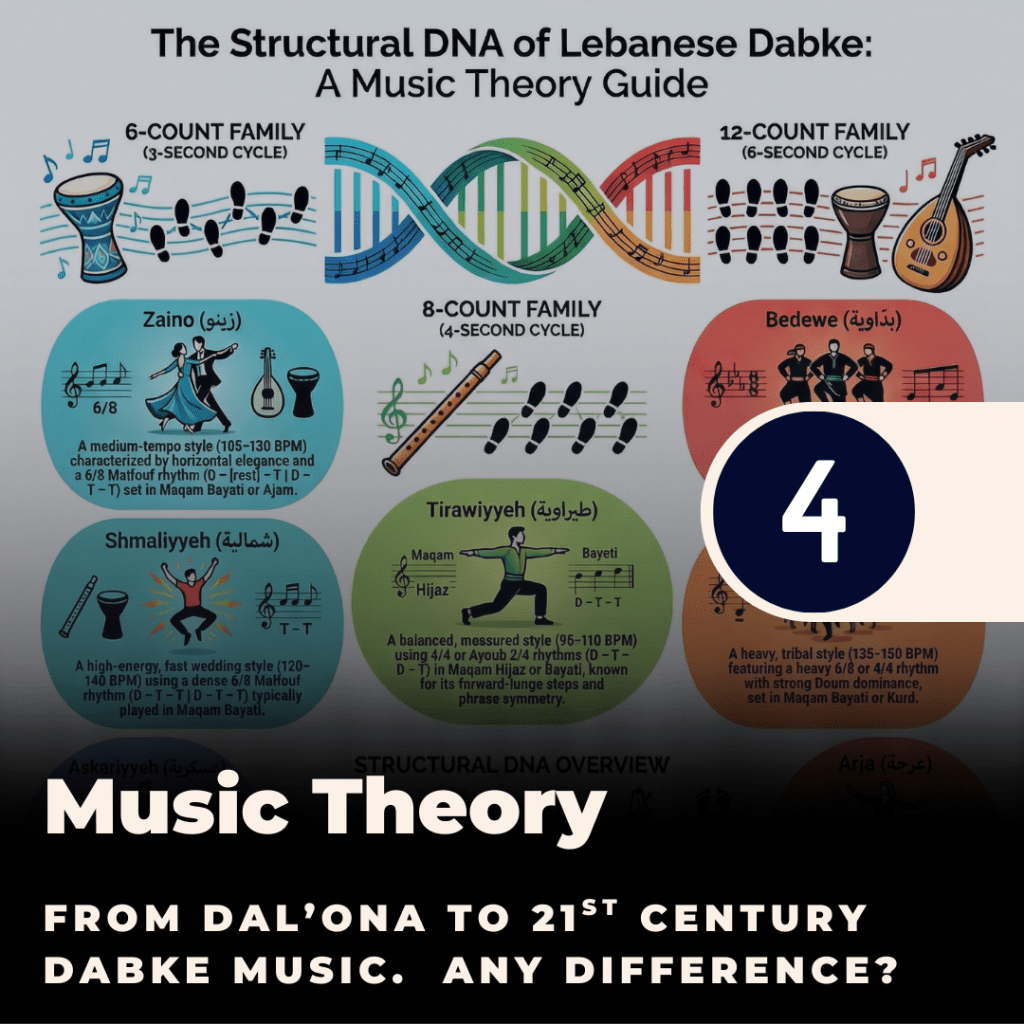
In our theory course, we break Dabke into three structural families — what we call the DNA of Lebanese Dabke.
The Three Structural Families of Lebanese Dabke
1. The 6-Count Family (3-Second Cycle)
This includes:
- Shmaliyyeh
- Zaino
- Askariyyeh
These styles operate within a 6-count rhythmic cycle, typically lasting 3 seconds, with 1 count equaling 0.5 seconds.
Musically, they are often built on:
- 6/8 Malfouf rhythm (D–T–T | D–T–T)
- 2/4 march structures
Tempo range: 100–140 BPM.
This family represents medium to fast energy. It is agile, responsive, and socially adaptable.
But here is what most dancers do not know:
Even within the same 6-count family, the leg logic changes.
Most styles begin with the left leg.
But “mirror styles” like Zaino begin with the right leg.
This is not accidental. It is structural.
2. The 8-Count Family (4-Second Cycle)
This family is represented by Tirawiyyeh.
It operates on an 8-count symmetry, often built on:
- 4/4 phrasing
- Ayoub 2/4 rhythm
Unlike the grounded heaviness of 12-count styles, Tirawiyyeh is described as:
- Airy
- Athletic
- Toe-driven
- Bounce-based
It begins with the right leg, making it a mirror style.
Its 8-count symmetry allows for smooth traveling and performance-oriented movement.
3. The 12-Count Family (6-Second Cycle)
This includes:
- Bedewe (Baddawiyyeh)
- Arja
These are slower, heavier, more grounded forms.
Built on:
- Heavy 6/8
- Stretched 4/4 phrasing
- Dominant Doum strikes
Tempo is slower but powerful.
These styles emphasize gravity, weight transfer, and upper-body authority.
In Bedewe, power comes from the waist.
In Arja, asymmetry and the “Kasra” (step-break) define the sway.
This is where Dabke becomes almost martial.
Mapping Lebanese Songs to Dabke Styles
One of the most important elements of our Dabke Theory Course is song-style classification.
We analyze how iconic Lebanese songs fit into specific structural families.
For example:
Fairuz – “Zayno Zayno” / “Ya Ghzayel”
→ Zaino style
Balanced Doum-Tak patterns, horizontal elegance, moderate tempo.
Nasri Shamseddine – “Ala Dalʿona”
→ Shmaliyyeh
Fast Tak-driven festive rhythm, light transitions.
Assi El Helani – “Al-ʿAyn”
→ Bedewe
Heavy amplified Doum, vertical stomp potential.
Zaki Nassif – “Rajea Rajea Yitʿammar Lebnan”
→ Askariyyeh
2/4 patriotic march pulse, military stepping logic.
Samira Tewfik – “Ya Rakib ʿal-ʿAbiyye”
→ Tirawiyyeh
8-count melodic symmetry, structured travel.
This musical mapping proves something critical:
Dabke style is not chosen emotionally.
It is chosen structurally.
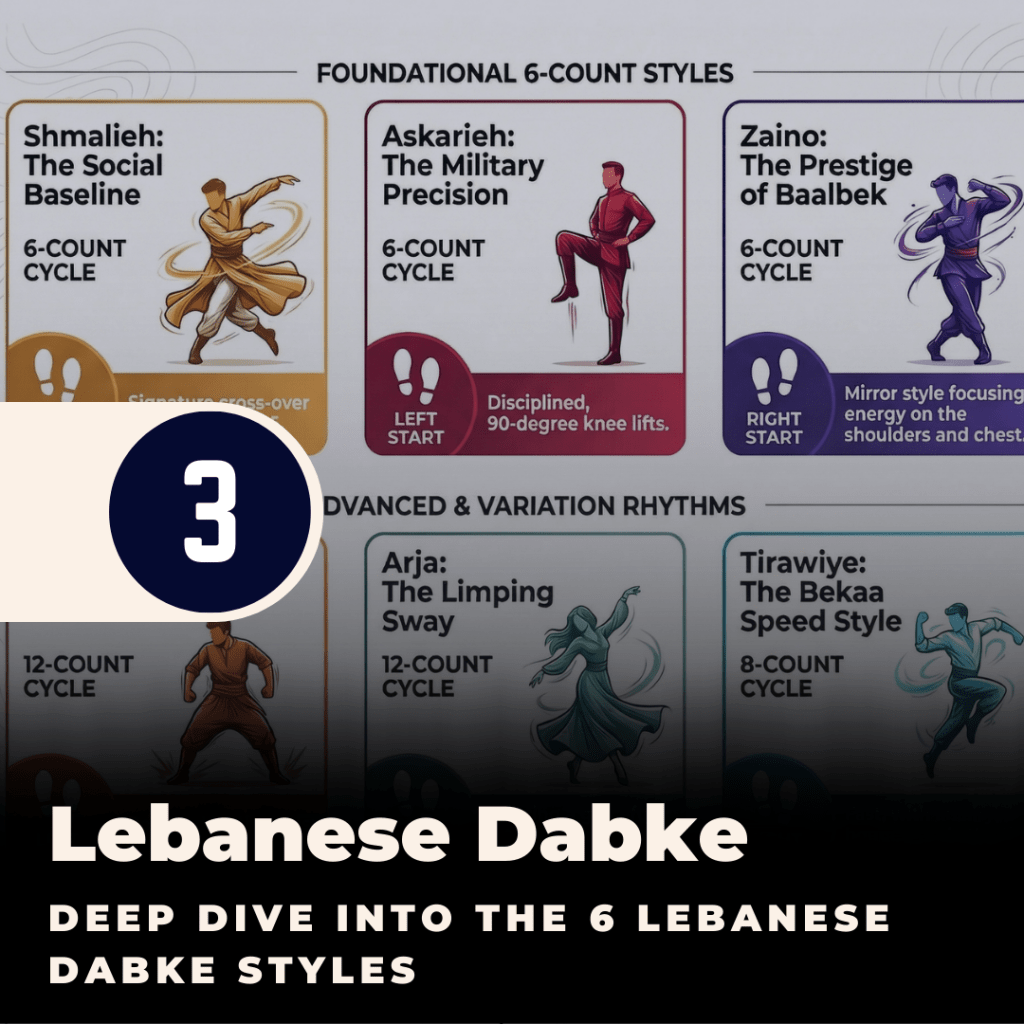
The Six Core Lebanese Styles (Technical Overview)
At Zorba Academy, we organize Lebanese Dabke into six core authentic styles:
Shmalieh – The Social Baseline
6-count, left leg start. Cross-over at counts 4–5.
Inclusive, foundational, universal.
Askarieh – The Military Precision
6-count, left leg start.
Knees raised to 90 degrees. March discipline.
Zaino – The Prestige of Baalbek
6-count, right leg start.
Heaviness (Tequl), chest forward, Shamkha (pride).
Bedewe – The War Dance
12-count, left leg start.
Grounded, stomp-heavy, waist-driven.
Arja – The Limping Sway
12-count, left leg start.
Kasra break, instrumental, asymmetrical grace.
Tirawiye – The Bekaa Speed Style
8-count, right leg start.
Toe-based, rapid, performance-only athleticism.
Each style is analyzed in terms of:
- Count structure
- Starting leg
- Rhythmic pattern
- Musical compatibility
- Physical metaphor
The Origin Theories of Dabke
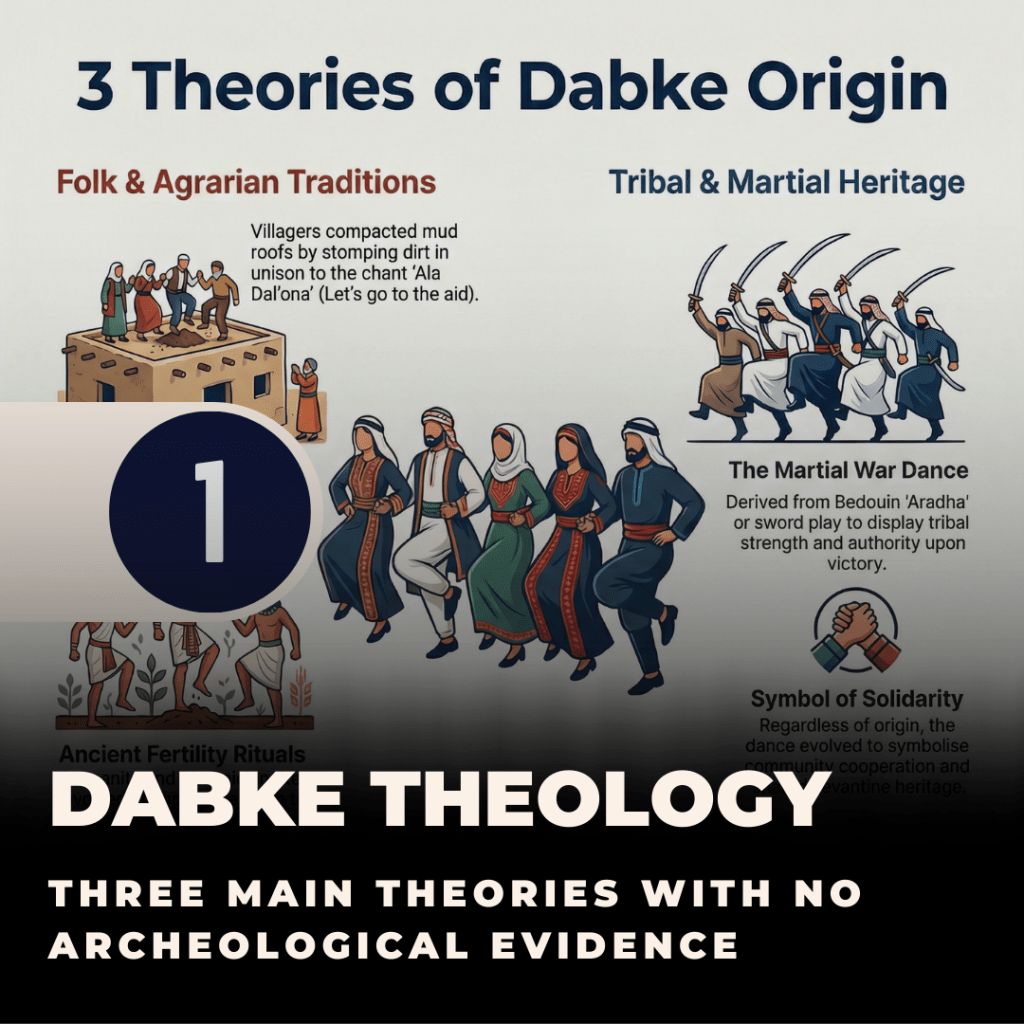
We dedicate a full module to Dabke origin theories.
1. Roof-Stomping Legend (Al-Aouna)
Villagers stomped mud roofs in unison while chanting “Ala Dal’ona.”
Communal labor evolved into communal dance.
2. Fertility Ritual Theory
Linked to Canaanite and Phoenician agricultural rituals.
Stomping used to awaken the earth and simulate rainfall.
3. Martial War Dance Theory
Connected to Bedouin Aradha sword dances and Ottoman marching drills.
Emphasizes Haybeh (aura), tribal prestige, and strength.
We analyze each theory critically — not romantically.
Arab World Comparative Study
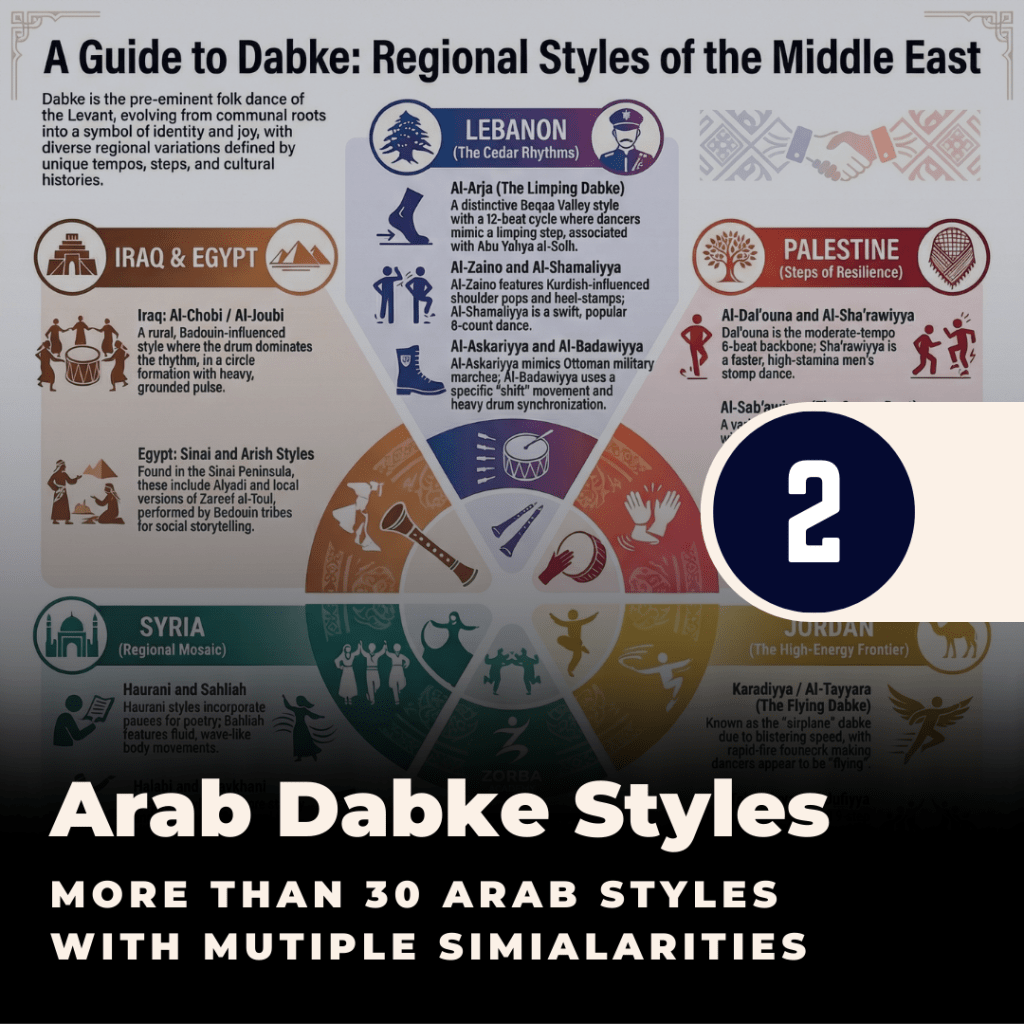
The course expands beyond Lebanon.
We study:
Palestinian Dabke – Resistance symbolism (Sumud), shoulder-linked solidarity.
Jordanian Dabke – Athletic diversity, Qirba (bagpipe), Jufiyya duel formations.
Syrian Dabke – Regional mosaic (Haurani, Halabi, Niswaniyyeh).
Iraqi Chobi – Drum-dominant tribal structure.
Egypt Sinai styles – Migration-linked Levantine forms.
This gives students a macro-view of Arab folk dance systems.
The Five-Stage Performance Narrative
Professional Dabke follows a structured energy arc:
- Basic (Alignment)
- Intermediary (Signal)
- Opening (Fatha)
- Performance (Showcase)
- Closing (Handoff with Milwa)
Understanding this narrative changes how you watch Dabke forever.
Who Is This Course For?
This course is ideal for:
- Dabke dancers seeking technical depth
- Lawweeh (leaders) wanting rhythm control
- Cultural researchers
- Lebanese diaspora reconnecting with heritage
- Wedding performers seeking structural clarity
If you want to move beyond imitation and understand the architecture of Lebanese Dabke, this is where mastery begins.
Learn the Architecture Behind the Dance
Dabke is not just steps.
It is timing.
It is structure.
It is history.
It is identity encoded in rhythm.
At Zorba Academy, we teach the DNA.
For structured training and cultural education:
www.learndabke.co
WhatsApp: +961 03 301 443
 Learn Dabke