
Heritage Lebanon | @heritagelebanon
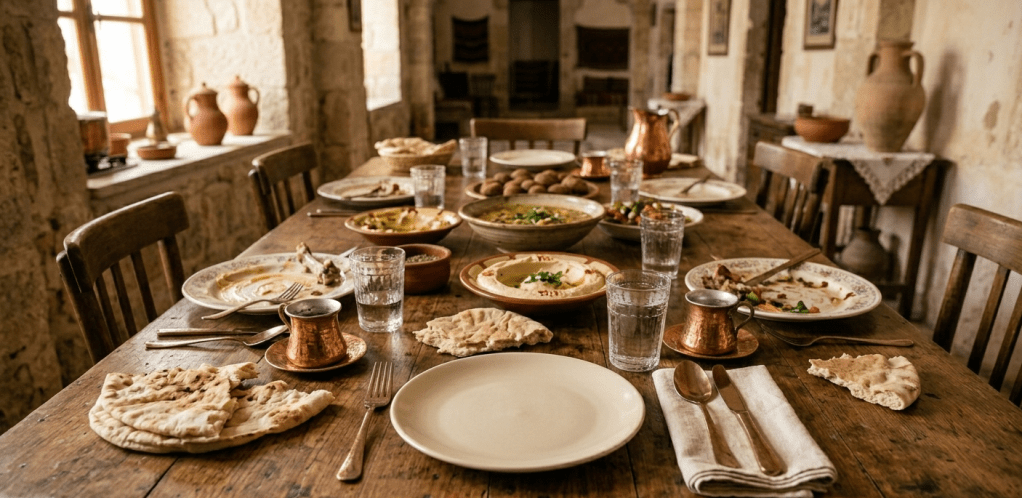
There is no dedicated dining room in the traditional Lebanese house.
This is not an oversight. It is one of the most important facts about Lebanese food culture, and almost nobody talks about it.
Friedrich Ragette spent years documenting Lebanese domestic architecture across the eighteenth and nineteenth centuries — the period when the traditional Lebanese house reached its most complete and characteristic form. What he found was a building that organized its entire interior around gathering, not separation. The most important room was the central hall, called in Arabic the dar — a word that simply means “home.” It was the largest space in the house, the most light-filled, the one that opened to the valley view. And when a family used the hall with a side entrance, the rear of this hall was the place where they ate.
Not a separate room. Not a closed-off space. The back of the house’s living heart.
This spatial fact contains everything that Lebanese food culture actually is.
A Room That Had to Do Everything
The dar of the traditional Lebanese house was what Ragette describes as the main space for family and kinship — a multi-purpose hall that served simultaneously as reception area for guests, sitting space, family gathering place, and, at the rear, dining space. It was seldom less than forty square meters, four to five meters high, opening onto the valley or the village through a triple-arched facade. The rooms of the house flanked it on both sides. The kitchen — to the extent it was inside at all — was below, or in an adjacent service space, or outdoors.
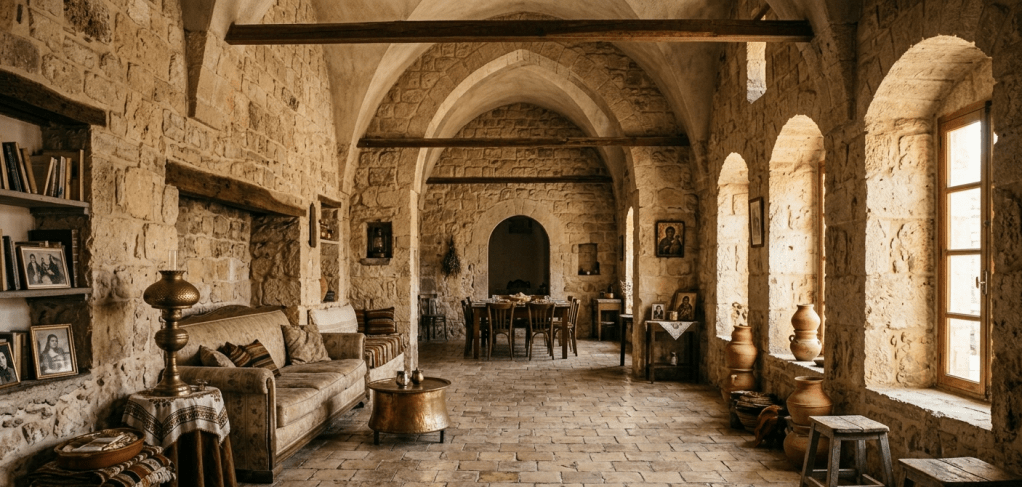
What this means is that in the Lebanese house, no activity was hidden. Food preparation happened in the open service areas of the ground floor or in the courtyard. The smells of cooking moved through the whole house. Children were present. Elders were present. Guests, when they arrived, were placed in the same hall where the family had just been sitting, and where the table would later appear.
There was no backstage. The entire house was stage.
This is why Lebanese hospitality does not feel like performance. It is structurally incapable of being performance, because the architecture never allowed for the separation between the performing self and the private self. What guests see in a Lebanese home is what the family actually is, because the house was built so that there was never anywhere else to be.
Cooking Was Not Hidden Either
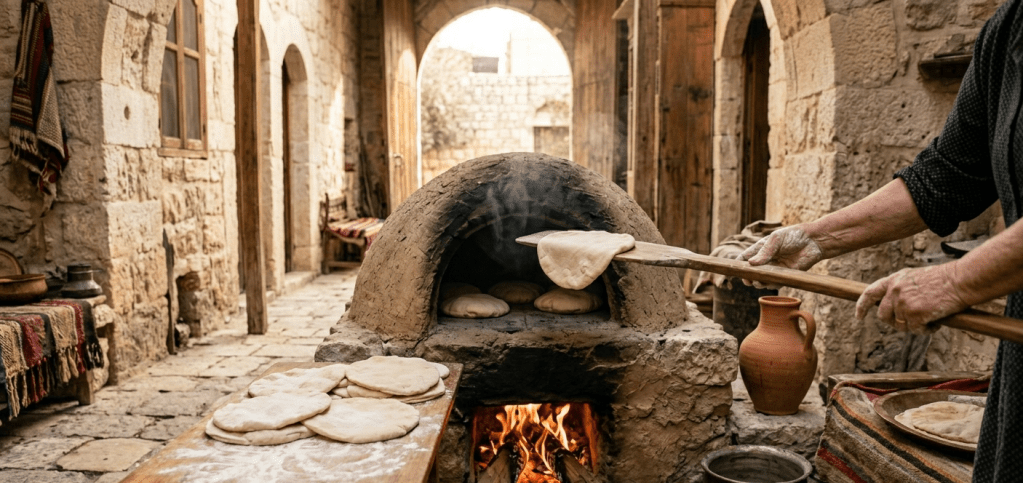
Ragette documents that in the earlier, simpler forms of the Lebanese house — and these forms persisted throughout the mountain villages well into the nineteenth century — cooking took place outside. A charcoal grill for meats, a charcoal basin for coffee and frying, and the tanour, an earthen oven built into the ground or set against an exterior wall, used for baking bread. These activities, Ragette notes, generally took place out of doors.
This detail is easy to pass over, but its implications for understanding Lebanese food culture are significant. In the closed rectangular house — the oldest and most widespread house type in Lebanon, found in villages from Baalbek to the southern mountains — there was a kitchen area inside, adjacent to the living section. Small silos for cereals stood beside it. Built-in cupboard units with wooden doors held provisions. But the bread oven was outside. The primary cooking fire was outside.
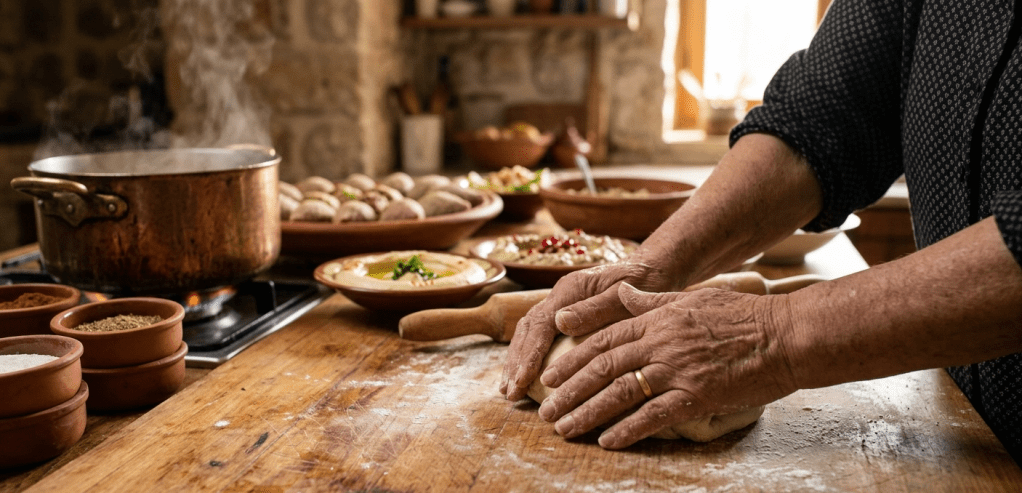
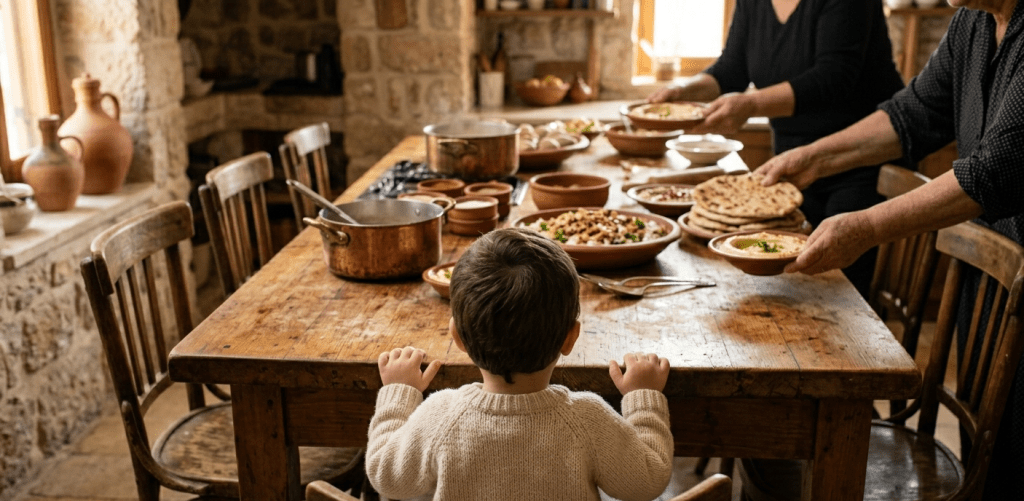
Which means that learning to cook, in this architecture, was not something that happened in a private room. It happened in the open air, in the shared space of the courtyard or the service area in front of the house, visible to anyone who passed.
This is the mechanism behind Lebanese food transmission: not instruction, but proximity. Not recipes written down, but patterns absorbed by watching the same person make the same dish in the same season for years, until the body knows the motion before the mind knows the rule.
The House That Was Built Around Winter
In the simplest Lebanese houses, Ragette documents a feature that is easy to miss in the architectural drawings but enormous in its cultural significance: a small cool space, lower than the rest of the house floor, with a small door and no window. Here, he notes, oil and olives, milk products and meat were kept.
Built into the stone. Part of the structure from the moment the foundation was laid.
This is not a pantry in the modern sense — a convenience added to a kitchen. This is a preservation chamber built into the logic of the house itself, expressing the assumption that any household worth its name would have stores that needed protecting from heat, and that protecting those stores was as fundamental a domestic responsibility as keeping the roof maintained.
The built-in silos for cereals were the same logic. Placed inside the living space, directly accessible, constructed of mud brick or basket-like wooden structures embedded in loam. Grain was not stored somewhere else and retrieved when needed. It lived in the house, in built furniture designed specifically to hold it, with a large opening at the top for filling and a small round tap at the bottom for drawing.
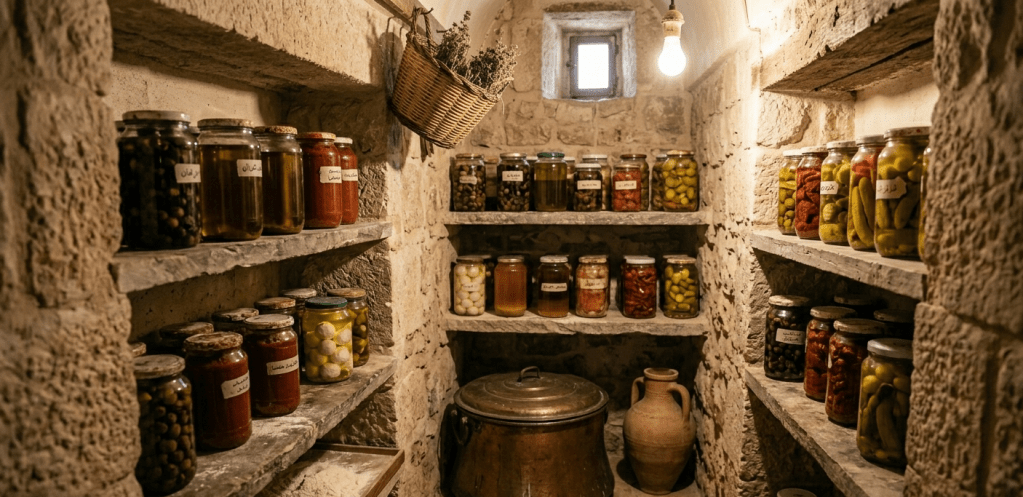
This is the architectural origin of mouneh — the Lebanese practice of preserving and storing seasonal foods: the jars of pickled vegetables, the olive oil pressed and stored, the dried herbs, the fruit leathers, the salted cheese. Barbara Abdeni Massaad documented mouneh in practice across Lebanon and found it alive in forms ranging from village cellars to apartment balconies. What she was documenting was not a charming survival of premodern practice. She was documenting the continuation, in adapted form, of a domestic philosophy that the Lebanese house had built into stone for centuries.
The house told you what food was: something you prepared, something you preserved, something you held in trust for the months when the land gave nothing.
Separating Clean from Unclean
The floor plan of the oldest Lebanese house type shows a deliberate division of space that has everything to do with how food was understood. The area next to the entrance, at ground level, was the madura — the soiled service space where shoes and tools were deposited. The living and sleeping area was raised, by twenty to seventy-five centimeters, onto a clean platform called the mastabeh.
The same logic of clean and unclean structured the relationship between the stable — where animals were kept, in the same building — and the family area, which was separated by silos and wardrobes. Even when the whole family lived in a single room with their animals, the spatial grammar insisted on a distinction.
This distinction is the root of what is sometimes called Lebanese fastidiousness about food — the insistence on freshness, on cleanliness, on the specific way a dish must be prepared. It is not a recent middle-class anxiety. It is a spatial philosophy encoded in the earliest forms of the Lebanese house and maintained as the houses became more sophisticated. The clean platform, the cool storage space, the separation of preparation from service: these were not rules. They were the shapes of the rooms.
What the Silk Economy Did to the Table
Kamal Salibi’s history of Lebanon, A House of Many Mansions, is not a book about food. But it contains the context without which Lebanese food culture cannot be fully understood: the specific social and economic conditions that shaped Lebanese mountain life during the centuries when the traditional house was taking its form.
The silk economy of the Lebanese mountains — developed under the Maan emirs in the seventeenth century, expanded under the Shihabs in the eighteenth — created a class of Christian peasant farmers producing silk for export to European markets. It was, Salibi notes, an economy dominated by Christians at every level: as the peasants who produced the silk, as the money-lenders who advanced credit on the crop, as the brokers who carried it to Sidon or Beirut, as the merchants who arranged its export.
This economic structure had a direct consequence for the material culture of food. A peasant economy centered on a cash crop requires provisions stored across seasons. The silk season was specific. The rest of the year required different forms of subsistence. The mountain slopes were terraced for agriculture — olives, grapes, cereals, vegetables — and what could be preserved, was preserved. The mouneh culture was not incidental to the silk economy; it was its domestic complement.
Salibi also identifies what he considers Lebanon’s genuine uniqueness in the Ottoman Arab world. Not its political autonomy, but a specific social condition: a silk economy feeding into Beirut, a Christian mountain society with strong ties to Western Europe, and a Druze mountain society confident enough in its tribal solidarity to have Christians living among it in growing numbers. The mountain and the city were married, as he puts it, and influences from the West arrived not with gunboats but by invitation, stage by stage, with grace.
The sophistication of the Lebanese table is not in its complexity. It is in its clarity about where things come from.
The Family as the Unit That Held
Ragette observed, citing the sociologist John Gulick’s study of Lebanese village life, that the Lebanese social structure was fundamentally egalitarian. Great class differences were unknown. Families were distinguished from each other by degrees of prosperity, but that prosperity was understood as transitory — luck, not destiny.
In such a society, the family table was not a display of status. It was a demonstration of sufficiency — of the household’s capacity to provide, to host, to make what was present into enough for everyone who arrived.
Ragette notes that even after emigration began — the wave of Lebanese who left for the Americas starting in the late nineteenth century — the emigrants remained attached to their home communities and kept sending money back. This is what he calls the central position of the family in the extensive framework of communal attachments and traditional loyalties of Lebanese society.
Akram Fouad Khater’s study of that emigration period, Inventing Home, shows what happened to Lebanese domestic culture under the pressure of migration and return. The emigrants who came back, or who sent money and instructions from abroad, brought new ideas about how a respectable home should look. But they also brought back, or recreated at a distance, the desire for the specific domestic world they had left. The table was one of the things that traveled. The specific flavor of a dish preserved in memory, reproduced in new conditions, served to children who had never seen the original place.
This is how Lebanese food heritage entered the diaspora: not as cuisine, but as memory encoded in practice.
When the Central Hall Was Abandoned
Ragette documents the moment when the central hall scheme was finally discarded. It happened after the Second World War, as Beirut became the commercial center of the Middle East and the demand for apartments grew faster than the city could absorb it. In the new apartment buildings, rooms had to be arranged parallel to the main facade to capture light and view. The kitchen, laundry, storage, and service spaces were finally separated into their own zone.
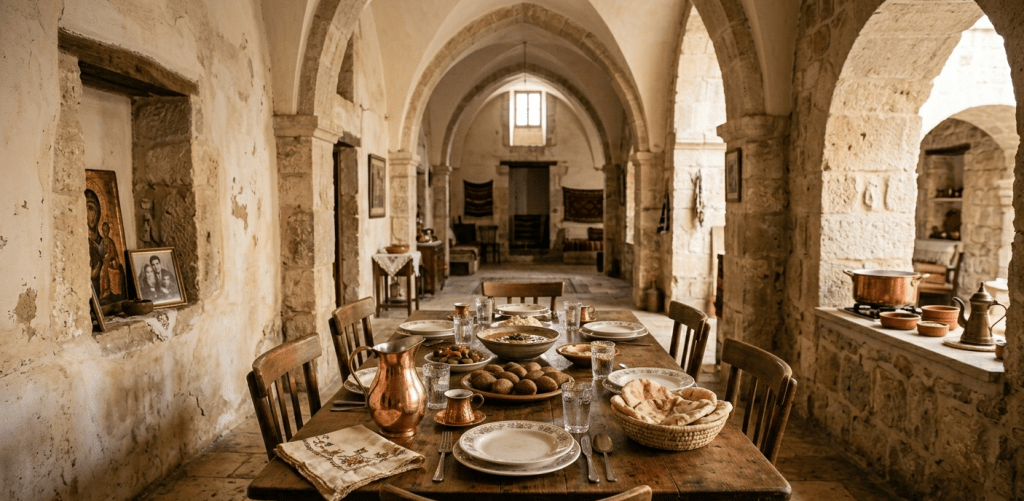
The separation that the traditional Lebanese house had always resisted — the separation of the table from the heart of the house — was now complete. Ragette traces this directly to a deeper social change: the slow disintegration of the tightly knit family unit into a group of individuals, the increasing preference for privacy as opposed to togetherness.
The Lebanese who still host the way their grandparents hosted are not being old-fashioned. They are exercising a form of resistance — insisting, against buildings designed for efficiency and privacy, that the table is still the center of the house, even when the house has been redesigned around something else.
What the Table Carries
The Lebanese table, understood through the architecture that produced it, is several things at once.
It is a spatial claim: the assertion that the most important room is the one where people gather, and that gathering around food is among the most important things people do.
It is a preservation system: built into the house as stone storage chambers and grain silos, continued in the practice of mouneh across centuries and continents, expressing the conviction that food is something you hold in trust, not just consume.
It is a transmission mechanism: food knowledge was never separated from daily life, so it was never formally taught and never formally lost. It passed through presence, through watching, through the repetition of seasons.
It is a social philosophy: in an egalitarian mountain society with no fixed class, the table was the place where sufficiency was demonstrated rather than wealth, where the household’s capacity to provide was made visible to anyone who arrived.
And it is a form of memory that has proven more durable than architecture. The houses were demolished. The central hall was abandoned. The earthen ovens are gone. But the logic of the Lebanese table — the extra plate, the insistence that you eat before you talk, the specific timing of the coffee, the food cooked for someone who might come — this has moved with the people who carry it, across continents and generations, still operating by the same rules that were built into the walls of houses that no longer exist.
The house knew what the table was before anyone said it. And the table remembered even after the house forgot.
Sources
Friedrich Ragette, Architecture in Lebanon: The Lebanese House During the 18th and 19th Centuries (American University of Beirut Press, 1974)
Kamal Salibi, A House of Many Mansions: The History of Lebanon Reconsidered (I.B. Tauris, 1988)
Barbara Abdeni Massaad, Mouneh: Preserving Foods for the Lebanese Pantry (Interlink Publishing, 2010)
Akram Fouad Khater, Inventing Home: Emigration, Gender, and the Middle Class in Lebanon, 1870–1920 (University of California Press, 2001)
Heritage Lebanon documents Lebanese culture as it is lived. Follow @heritage.lebanon or visit learndabke.co/heritage.
 Learn Dabke
Leave a comment