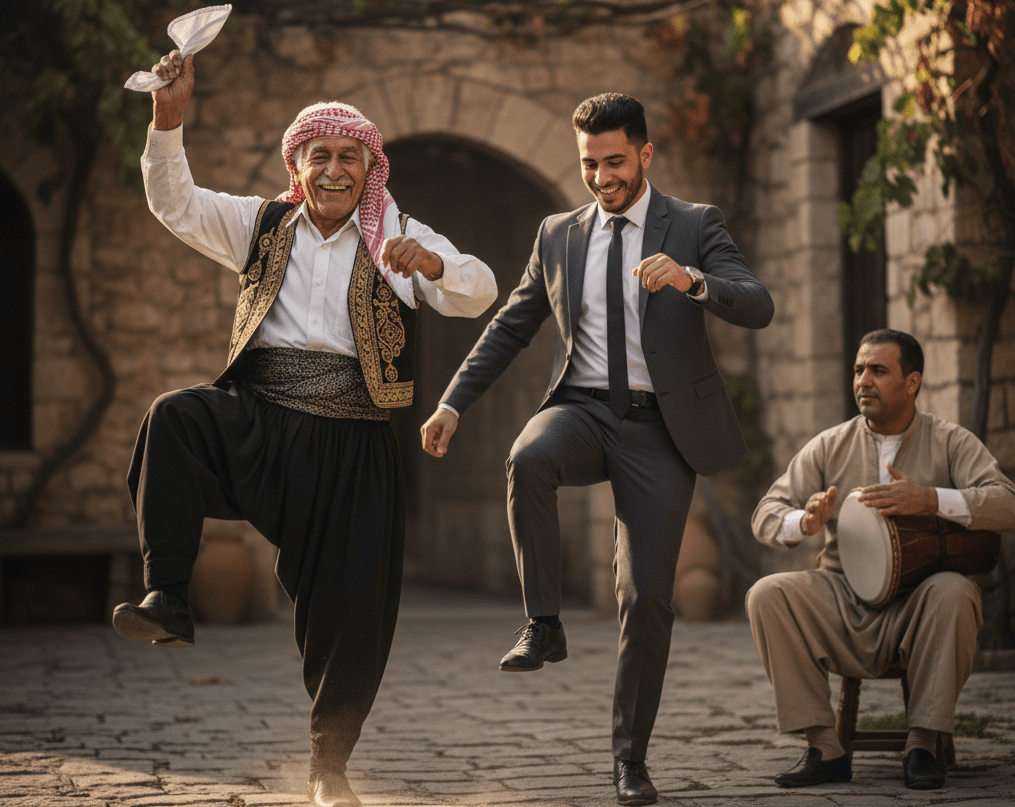
If you search online for the difference between Zaffe and Dabke, or what folkloric Dabke really means, you will often find the terms mixed together. In reality, they are three distinct expressions of Levantine heritage. They share the stomp and the linked hands, but their purpose, structure, and cultural role are very different.
Understanding this difference is essential if you care about Lebanese weddings, authentic Dabke, or the preservation of cultural identity.
I. Actual Dabke: The Authentic Communal Heartbeat
Actual Dabke is the living, breathing communal dance of the Levant. It is spontaneous. It is unchoreographed. It happens in courtyards, village squares, weddings, and harvest celebrations.
The word Dabke comes from the Arabic dabaka, meaning “to stamp the feet.” Without the stomp, it is not Dabke.
Two main legends explain its origins. One speaks of villagers gathering to stomp mud roofs back into place during winter, calling out “Ala Dal’ona” as they moved together. Another traces it to Canaanite fertility rituals, where stomping awakened the earth and protected crops.
In Baalbek, authenticity is defined by rhythmic logic, not choreography. The main frameworks include:
- Al-Shamaliyya: A 6-count pattern driven by Malfuf (2/4), light and agile.
- Al-Arja: A grounded 12-beat sequence, Doum-led and instrumental, danced with quiet authority.
- Al-Zaino (Al-Aadiyya): A 6-beat structure dictated by vocal phrasing, featuring the heel-stomp and shoulder nahza.
- Al-Badawiyya (Bedewe): A 6-beat Bedouin framework emphasizing full weight transfer and gravity.
- Al-Askariyya: A military-influenced pattern reflecting march structure.
Authentic Dabke uses its own vocabulary. Movements like Kasra (torso break), Karja (leader flourishes), Naqla (transition), Zakha (grounded descent), and Natta (jump) are part of a technical language passed down by masters.
Among the most respected figures:
- Zakaria Solh (Abu Yahya), known as the Dean of Lebanese Dabke.
- Mohamed Solh (Abu Majed), who mastered all Baalbek styles.
- Walid Doukhi Solh, famous for dancing with a water jug balanced on his head for hours.
Actual Dabke is not spectacle. It is unity. It is rhythm shared by a community.
Learn Dabke
II. The Zaffe: The Professional Wedding Procession
The Zaffe is not simply Dabke at a wedding. It is a structured, paid ceremonial procession designed to honor the bride and groom.
While guests perform Dabke, the Zaffe is performed for the hosts.
It acts as a ritual transition, moving the couple from one space to another. Zaffe troupes surround the couple, creating a wall of sound through Tabl drums, Mijwiz, chanting, and Huwara. The atmosphere is celebratory and martial at the same time. Marriage is treated like a victory.
Zaffe features:
- Loud percussion and chanting
- Sword and shield play (Saif wa Turs)
- Groom hoisting
- Coordinated costume presentation
- Direct interaction with the couple
Prominent Zaffe groups include:
- Heikal Baalbek, founded by Omar Hamadeh Solh, performing at major weddings and global events like the 2022 World Cup.
- Murooj Troupe, led by Yasser Mazloum, known for international wedding services.
- Jouzour Baalbek, led by Khaled al-Dhikra.
- Shams Baalbek, blending elders’ expertise with modern presentation.
- Al-Ramtha Troupe and Ma’an Troupe in Jordan.
Zaffe is performance-driven. It is controlled energy. It is a service provided by professionals.
III. Theatrical Folklore: The Polish of the Stage
Theatrical Folklore is stage art. It takes the roughness of village Dabke and refines it for global audiences.
In the 1950s, the urbanization of folk music began. The Rahbani Brothers and Fairuz transformed rural melodies into structured operettas for the Baalbek International Festival. Orchestras replaced raw percussion. Harmony replaced repetition.
Stage Dabke introduced:
- Synchronized jumps and high kicks
- Concentric circles and split formations
- Western ballet and modern dance techniques
- Coordinated costuming
- Narrative storytelling
The most influential troupe is Caracalla Dance Theatre, founded by Abdel Halim Caracalla and developed alongside Omar Caracalla. They blended Dabke with ballet and Graham techniques, revolutionizing folklore.
Other major folkloric ensembles include:
- The Lebanese Baalbeck Folk Troupe
- Anwar Troupe (founded by Said Freiha)
- Al-Majd Baalbek
- Al-Funoun Palestinian Popular Dance Troupe
- Sareyyet Ramallah
- Jordan’s Government Folk Troupe
- Syrian Al-Jawzeera Troupe
- Bacchus Group
- Al-Turath Troupe
- Al Mayadine
These groups perform on stages, festivals, and international tours. The audience watches. They do not join.
IV. Side-by-Side Comparison
| Feature | Actual Dabke | Zaffe | Theatrical Folklore |
|---|---|---|---|
| Performers | Guests and villagers | Paid professionals | Trained artists |
| Location | Weddings, villages | Wedding entrances | Global stages |
| Structure | Repetitive rhythm logic | Structured showmanship | Complex choreography |
| Music | Folk iqa’ (2/4, 4/4) | Loud percussion, chants | Orchestral fusion |
| Function | Unity and solidarity | Ritual celebration | Cultural storytelling |
Dabke Theory Class
The Dilemma of Modernity
Today, social media often blends all three under one label. But each serves a distinct role.
Actual Dabke preserves the soul.
Zaffe preserves the social ritual.
Theatrical Folklore preserves national identity on the world stage.
Some masters warn that excessive theatricalization distorts the grounded language of the body. Stage Dabke emphasizes vertical spectacle. Authentic Dabke emphasizes grounded listening to rhythm and vocal phrasing.
Still, all three are necessary.
Without communal Dabke, the tradition loses its roots.
Without Zaffe, weddings lose ritual power.
Without theatrical folklore, heritage loses global visibility.
Conclusion
Zaffe, Actual Dabke, and Theatrical Folklore are not interchangeable.
Dabke is the communal heartbeat.
Zaffe is the ceremonial procession.
Folklore is the artistic stage adaptation.
They share ancestry, but they serve different purposes.
Understanding the difference protects authenticity and honors the depth of Levantine culture.
Contact Us: WhatsApp +96103301443
Website: www.learndabke.co
 Learn Dabke
Leave a comment