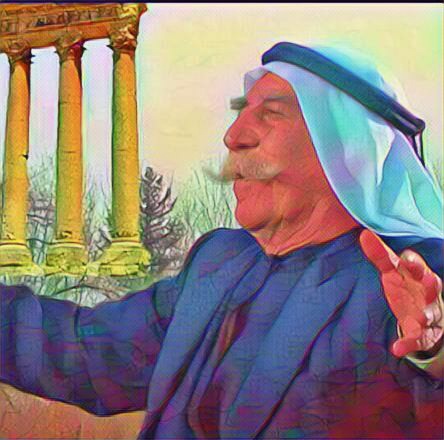
In the city of Baalbek, where stone temples rise from ancient ground and drums echo across the Beqaa plain, one name became inseparable from the soul of Dabke: Abu Yahya, born Zakaria Ismail Solh. He was not merely a dancer. He was widely known as the Dean of Lebanese Dabke and crowned by his community as the “King of Baalbeki Dabke.”
His life began and ended in Baalbek, but his influence moved far beyond it. To speak about Baalbeki Dabke without mentioning Abu Yahya is to leave out its spine, its authority, and its fire.
A Warrior in the Circle
Abu Yahya’s style was described as unmistakably masculine. When he stepped into the Dabke line, he did not simply follow rhythm — he embodied it. His movements carried the weight of a warrior advancing into battle. The beat of the tabl behind him felt like galloping horses, and every stamp of his foot struck the earth with intention.
What set him apart was not speed or athletic tricks. It was presence.
He mastered facial expression as carefully as footwork. When holding a step, he fixed his face in a firm frown known locally as the “abseh,” a look of intensity and command. When transitioning between movements, a subtle smile would appear, signaling control rather than relaxation. His eyes were famously described as “falcon eyes.” Spectators often said that once he entered the circle, it became difficult to look at anyone else.
He led the Hachieh, the head of the Dabke circle, with authority. There, he engaged in a dialogue with the music. The drummer would push; he would answer. The mijwiz would rise; he would shift. It was not choreography — it was conversation.
And when the moment demanded it, he would break from the line for a solo improvisation. These brief solos were not displays of ego, but demonstrations of mastery. Each movement proved why the title “King” was not exaggeration, but recognition.

Learn Dabke
“Alayhum bi al-Arja”
Among all styles of Dabke, Abu Yahya had a particular love for Arja, the heavy 12-count Baalbeki style known for its grounded weight and asymmetrical strength.
When he wanted the circle to begin Arja, he would call out:
“Alayhum bi al-Arja.”
(Attack with the Arja.)
The phrase became legendary. It was both command and poetry. Under his leadership, Arja was not just a dance — it was discipline. Each stamp carried intention. Each pause carried tension. The drummer adjusted the Doum–Tak pattern, and the entire circle shifted in unity.
He understood something essential: the drummer controls the dancers. A subtle change in emphasis could transform the entire atmosphere. Abu Yahya knew how to listen for that shift and answer it instantly.
Guardian of a Fading Tradition
There was a period in the last century when interest in folk traditions declined. Urbanization and modern entertainment pushed village customs aside. Dabke risked becoming a decorative memory rather than a lived practice.
Abu Yahya refused to allow that.
He became a founding member of the First Heritage Group (فرقة التراث الأولى), alongside figures such as Abu Majed and Abu Mustafa, under the sponsorship of Nidal Solh. Together, they committed themselves to preserving Baalbeki style in its authentic form.
This was not revival for performance alone. It was revival for identity.
He guarded the steps, the rhythm phrasing, and the body logic of Baalbek. He insisted on precision. He insisted on weight in the step. He insisted on dignity.
The Master Teacher
If someone wanted to learn Dabke correctly in Baalbek, they went to Abu Yahya.
He was the primary instructor for those seeking the true Baalbeki style. Weddings became classrooms. Young men stood at the edge of the circle studying his shoulders, his timing, his pauses. Entire generations learned simply by watching him.
Even his peers showed him respect. Mohammad Solh (Abu Majed) and others often gave him the lead in the circle out of acknowledgment of his command. Leadership was not requested; it was granted.
What made him extraordinary was longevity. Even at the age of 80, he retained vigor and dignity. His movements did not weaken into imitation. They remained deliberate, controlled, and sharp.
Dabke Theory Class
Seeds That Still Grow
Abu Yahya did not just dance — he planted.
Modern Baalbeki troupes carry his imprint. Most notably, the Hayakil Baalbek troupe reflects the discipline and structure he helped establish. The seeds he planted continue to grow in every circle that begins with grounded Arja, every leader who pauses with intention, and every dancer who understands that Dabke is not gymnastics — it is heritage.
In Baalbek, his name still carries weight. He is remembered not for spectacle, but for authority. Not for noise, but for presence.
Abu Yahya remains what he always was:
A guardian of rhythm.
A master of the circle.
The King of Baalbeki Dabke.
 Learn Dabke
Leave a comment