
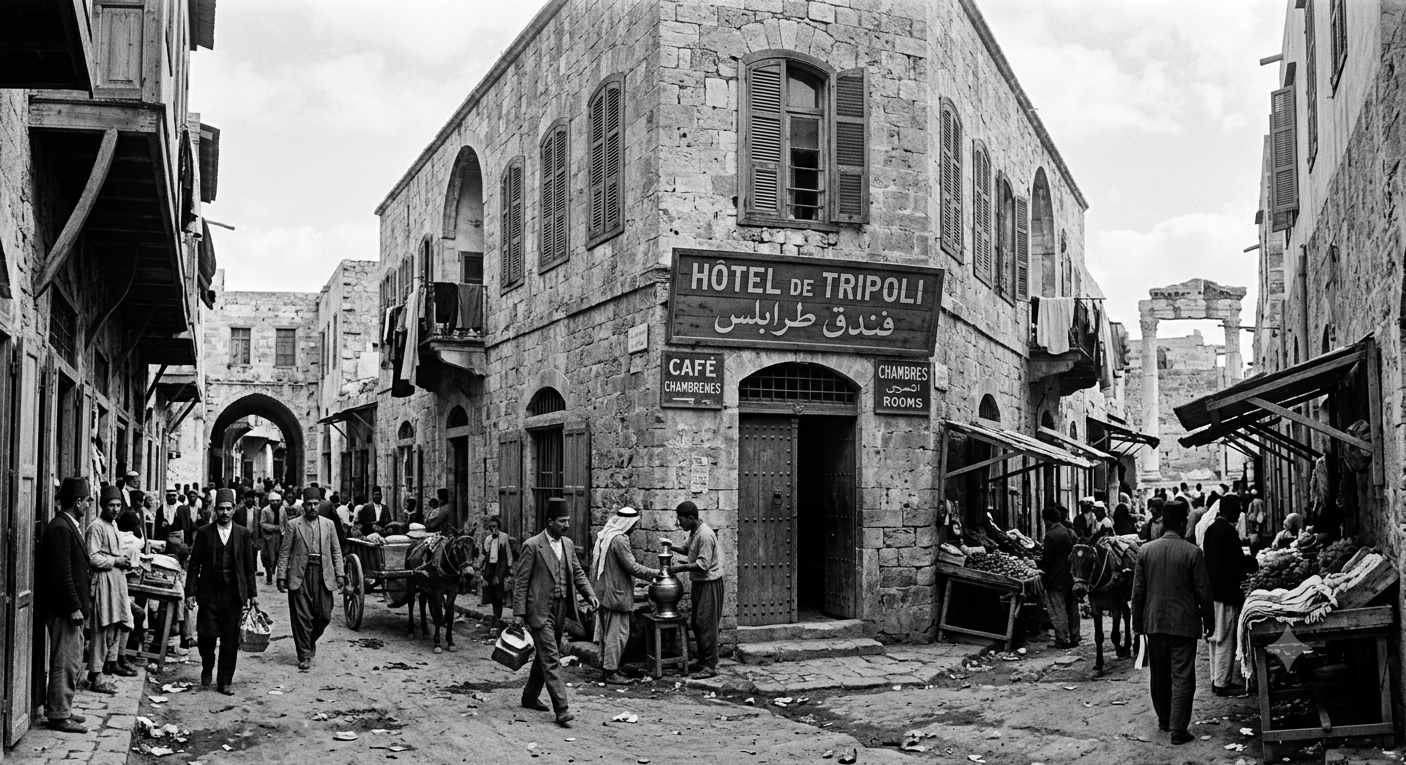
North Lebanon was never one place
North Lebanon is often spoken about as if it were one region.
It is not.
Tripoli is not Zgharta.
Zgharta is not Koura.
Koura is not Anfeh.
Anfeh is not Bsharri.
The coast is not the mountain.
The olive plain is not the old souk.
The port is not the village road that led to emigration.
North Lebanon is a cluster of worlds that learned to live close to each other without becoming the same.
There is Tripoli, the great northern city, with its port, souks, khans, hammams, mosques, madrasas, sweets, craftsmen, and memory of Mamluk urban life. There is Koura, with its olive groves, Orthodox villages, stone houses, and quiet agricultural dignity. There is Zgharta-Ehden, a double life between lower town and mountain summer, between family, politics, church, diaspora, and stubborn belonging. There is Anfeh, where the sea, salt, monasteries, archaeology, and whitewashed houses create a different kind of northern memory.
And then there is the sea.
Not only the Mediterranean as a view.
The Mediterranean as an exit.
For many families in North Lebanon, the story of place cannot be separated from the story of departure. People left for the Americas. They left for Australia. They left from mountain villages, coastal towns, olive country, and northern districts carrying village names that became surnames, club names, church names, shop names, and family stories abroad.
North Lebanon did not only keep heritage inside Lebanon.
It exported memory.
Tripoli: the northern city that remembers through stone, water, and trade
Tripoli is the heart of North Lebanon’s urban memory.
It is Lebanon’s second city, but that phrase makes it sound secondary. Tripoli is not a smaller Beirut. It is a city with its own historical grammar.
Britannica describes Tripoli as a city on Lebanon’s Mediterranean coast and notes that it was besieged and partly destroyed during the First Crusade, later rebuilt by the Crusaders, then destroyed by the Mamluks in 1289 before coming under Ottoman rule in 1516. (Encyclopedia Britannica)
That destruction and rebuilding matter.
Tripoli’s urban identity is shaped by rupture. The old coastal city and port, today associated with al-Mina, belonged to one phase of Tripoli’s life. The Mamluks then rebuilt the city inland, near the Abu Ali River, creating a new urban body of souks, religious schools, public baths, caravanserais, and stone streets. Sources on Mamluk Tripoli describe around 35 surviving monuments from the Mamluk city, including mosques, madrasas, khans, hammams, and caravanserais. (Tripoli Lebanon)
This is why Tripoli feels different from other Lebanese cities.
Its heritage is not only a castle or one monument. It is a working urban fabric. A person walking through the old city is not moving through an isolated ruin. They are moving through layers of trade, worship, craft, learning, and social life.
Tripoli’s Mamluk city was praised by medieval travelers for its mosques, madrasas, souks, baths, and water system. (My Unusual Journeys) This water detail is important because heritage is not only what rises high. It is also what runs underneath: channels, fountains, baths, courtyards, and the daily systems that allowed a city to live.
Tripoli’s sentimental meaning for its people comes from this density.
It is a city of thresholds.
The threshold of the souk.
The threshold of the mosque.
The threshold of the khan.
The threshold of the bakery.
The threshold of departure.
For many northern families, Tripoli was the city you came to before leaving. It was the administrative center, the commercial center, the port city, the place of papers, travel, goods, ships, and news. Even when the emigrant came from a village outside Tripoli, the city often stood between the village and the wider world.
That is why Tripoli belongs in a diaspora article.
Not because all emigrants were Tripolitans.
But because Tripoli was one of the doors through which the North faced the sea.
Anfeh: the place where salt kept memory white
Anfeh is one of the most visually distinct towns in North Lebanon.
It sits on the coast south of Tripoli, on a rocky peninsula, with the sea pressing close to the land. IFPO describes Anfeh as a coastal town about 15 kilometers south of Tripoli, with archaeological investigations since 2011 focusing especially on Ras al-Qalaat, a long rocky peninsula of about 3.3 hectares. (IFPO)
Anfeh’s heritage is older than its postcard image.
University of Balamand archaeological work reports prehistoric surveys around Anfeh’s caves, rock shelters, and open-air sites, with all prehistoric periods represented in the area and an emphasis on Middle Palaeolithic, Epi-Palaeolithic, and Pre-Pottery Neolithic finds. (University of Balamand)
That means Anfeh is not only a pretty coastal village.
It is a long human landscape.
It is a place where people lived, worked, worshipped, harvested, and faced the sea across many historical periods. A scholarly article on Anfeh notes that the site played an important economic role in the northern Levant from the Late Bronze Age to the Ottoman period and has been studied through rescue excavation and survey. (Ancient Ports)
But the word people feel most immediately in Anfeh is not “archaeology.”
It is salt.
Salt pans are not only an industry there. They are a landscape of labor. The white rectangles near the sea, the channels, the evaporation, the seasonal work, the knowledge of when water becomes salt — this is speaking heritage without words.
Recent heritage writing about Anfeh describes salt as once known as “white gold” and notes that only a small number of traditional salt producers remain, keeping the practice alive through hand-harvesting methods passed down over time. (Citizen Marine Monitoring Platform)
For Heritage Lebanon, Anfeh should be read as a place where the sea did not only give beauty.
It gave work.
It gave taste.
It gave survival.
It gave a white memory people could hold in their hands.
Anfeh’s sentimental meaning is not only nostalgia for blue water and white houses. It is the memory of a town that learned to read the sea as livelihood.
Koura: the olive country that taught people patience
Koura is not loud.
That is part of its identity.
Koura’s power is in olive groves, stone villages, churches, family land, and a kind of agricultural steadiness that does not announce itself loudly because it never had to.
MedCities describes the Koura region as especially known for olive cultivation and olive oil production, with around 2.5 million olive trees in its central plains. The same source says most agricultural activity in the area is centered on olive plantations and that almost every village depends on olive trees for income. (MedCities)
That single fact explains much of Koura’s emotional world.
Olives are slow heritage.
They do not speak in years. They speak in generations.
A family can leave Koura and still talk about its land through olive oil. A person can grow up in Australia or Brazil and still know that somewhere in North Lebanon there is a grove, a press, a village, a church, a cousin, a name.
Koura’s landscape also carries a distinct religious and cultural identity. Recent population genetics research notes that Koura stands out in Lebanon through its cultural foundations and its high concentration of Greek Orthodox communities. (PubMed Central) That does not mean Koura can be reduced to one community, but it helps explain why Koura often carries a strong Orthodox village memory in the Lebanese imagination.
Koura’s sentimental meaning is not dramatic.
It is rooted.
It is the person who leaves but keeps receiving oil from home.
It is the family that knows harvest season even from abroad.
It is the memory of a village where the olive tree is not decoration but economy, inheritance, and proof of belonging.
Koura teaches a different kind of heritage from Baalbek.
Baalbek overwhelms you with stone.
Koura waits for you through trees.
Zgharta-Ehden: one people, two altitudes
Zgharta and Ehden carry one of the strongest identity patterns in North Lebanon: the idea of a people living through two places.
Zgharta lies lower. Ehden lies higher. Many families historically carried a seasonal relationship between the two: winter and summer, town and mountain, lower life and upper memory.
MedCities describes Zgharta as a large town in North Lebanon, around 40,000 citizens, located about 23 kilometers from Ehden and lying between the rivers of Jouit and Rashein. (MedCities)
But numbers do not explain Zgharta-Ehden.
The emotional structure is stronger than geography.
Zgharta-Ehden is about kinship, family name, church, politics, mountain memory, and return. It is a place where belonging is not abstract. It is very specific. People do not only say they are from North Lebanon. They say the town. The family. The quarter. The church. The mountain.
This becomes especially powerful in migration.
Guita Hourani’s study on Lebanese diaspora and homeland relations gives a direct example from Ehden/Zgharta: according to the mayor of the twin cities, emigrants built the Municipal Palace, paid for the construction of an important avenue in Ehden, and financed the House of the Emigrant and the Midan Square fountains. (AUC Knowledge Fountain)
That is one of the most important details for this whole article.
It proves that emigration did not simply take people away.
It changed the towns they left behind.
Diaspora money built visible structures. It turned absence into architecture. It made longing public.
In Zgharta-Ehden, the emigrant did not only send remittances.
The emigrant built memory.
That is why the story of North Lebanon cannot be told only as people leaving for the Americas and Australia. It must also be told as people returning symbolically through buildings, roads, fountains, churches, houses, donations, and family obligations.
The emigrant may have left the town.
But the town did not leave the emigrant.
The northern road to the Americas and Australia
Lebanese emigration is not one story.
It happened in waves, for different reasons, from different regions, toward different destinations. But the late nineteenth and early twentieth centuries were especially important for migration from Lebanon to the Americas and Australia.
Research on Lebanese migration to the Americas describes the late nineteenth and early twentieth centuries as a major wave of migration shaped by Ottoman rule, economic crises, famine, and conscription pressures. (cajlpc.casjournal.org)
Paul Tabar’s work describes Lebanon as both a country of emigration and immigration and notes that Lebanese emigration began in Mount Lebanon before expanding through later patterns. (AUC Knowledge Fountain) This is important because the earliest migration narrative often centers Mount Lebanon, but North Lebanon becomes deeply important when we look at specific villages, Australia, family networks, and the way diaspora shaped hometowns.
The Khayrallah Center’s introduction to early Lebanese migration to Australia explains that throughout the 1880s increasing numbers of people from Lebanon arrived in the Australian colonies, and that migration to Australia initially mirrored migration to the Americas until the White Australia Policy of 1901 restricted free entry. (Khayrallah Center)
Another key detail from the Khayrallah Center is the role of Bsharri and surrounding northern villages in early Australia-linked migration. The center notes that descendants often recount that Australia was sometimes reached accidentally, because the intended destination was America, and it mentions families who made a six-month ocean journey in 1892 believing they were going to America. (Khayrallah Center)
That detail carries the whole emotional truth of migration.
Some people did not leave with a clean map.
They left with uncertainty.
They left from villages where the horizon was mountain and sea.
They reached countries whose names sometimes became clear only after the journey had already begun.
For many North Lebanese families, the Americas and Australia were not abstract continents. They were places where a cousin disappeared and then wrote back. A place where someone opened a shop. A place where a village name became a club. A place where Arabic changed. A place where children grew up saying Lebanon as memory before they knew it as geography.
The South Australian History Hub notes that Lebanese immigrants began arriving in Australia in the late nineteenth century from what was then the province of Syria in the Ottoman Empire, and points to economic hardship after the opening of the Suez Canal, increased European imports, and decline of craft industries as part of the push factors. (History Hub)
This is important because it moves the story away from romanticism.
Migration was not only adventure.
It was economic pressure.
It was uncertainty.
It was family survival.
It was the decision to become absent so others could remain.
What changed in the North when people left
Emigration changes a place twice.
First, it removes people.
Then, it sends memory back.
In North Lebanon, this return often came through money, houses, public works, education, religious institutions, and family status. Hourani’s Zgharta-Ehden example shows this clearly: emigrants funded municipal and public works, including the Municipal Palace and infrastructure in Ehden. (AUC Knowledge Fountain)
This created a visible diaspora landscape.
A large house whose owner lived abroad.
A renovated square.
A school donation.
A church roof.
A municipal building.
A road.
A fountain.
A family name rising in public space because someone left and succeeded.
But diaspora also changed emotion.
The village became something people visited instead of something they only lived in.
The house became a summer return.
The land became inheritance paperwork.
The olive oil became a package sent abroad.
The dialect became a memory of grandparents.
The church feast became a travel date.
The town became both real and imagined.
This is the tragedy and power of northern emigration.
People left because they had to, or because someone before them had made leaving possible. But once abroad, they did not simply become foreign. They built a second Lebanon outside Lebanon.
North Lebanon remained in them as family discipline, food, accent, church, village politics, marriage networks, music, money, and memory.
The emigrant became a bridge.
And sometimes, a wound.
How Tripoli, Koura, Zgharta, and Anfeh changed with time
Tripoli changed from medieval port-city and Mamluk urban center into a modern city carrying both heritage and neglect. Its old souks still hold enormous cultural value, but Tripoli is often reduced in national discourse to poverty, politics, or instability. That reduction hides its historic role as one of the great urban centers of the eastern Mediterranean. Britannica’s historical overview and Mamluk sources show how central Tripoli was across Crusader, Mamluk, and Ottoman periods. (Encyclopedia Britannica)
Koura changed through the pressure of modernity on agricultural life. Olive cultivation remains central, but village economies and family ties have shifted through education, migration, land fragmentation, and changing livelihoods. Its olive groves still carry identity, but fewer people live exactly as their grandparents lived. MedCities’ description of Koura’s dependence on olive plantations shows how deeply agriculture remains tied to the district’s economy and self-image. (MedCities)
Zgharta-Ehden changed through emigration and public return. The diaspora did not only send money home; it helped build civic space. That gives Zgharta-Ehden a special place in the North Lebanon diaspora story, because the absent became visible in stone, roads, fountains, and public buildings. (AUC Knowledge Fountain)
Anfeh changed through the slow decline of traditional salt work and the growing importance of heritage conservation, archaeology, coastal identity, and tourism. Archaeological work shows how deep the site’s history is, while current heritage writing about the salt industry suggests that the traditional salt landscape is becoming increasingly fragile. (University of Balamand)
This is the pattern:
Tripoli kept the city.
Koura kept the olive.
Zgharta kept the family name.
Anfeh kept the salt.
The emigrants kept the memory.
Together, they form a North Lebanon that is not only geographic.
It is emotional infrastructure.
The sentimental meaning of North Lebanon
The sentimental meaning of North Lebanon is not one feeling.
It depends on where you stand.
In Tripoli, it may be the smell of sweets, soap, old stone, river humidity, souk shade, and the feeling that the city has more history than the country gives it credit for.
In Koura, it may be olive harvest, village roads, church bells, oil tins, family land, and the silence of trees older than the people who claim them.
In Zgharta-Ehden, it may be the fierce attachment to origin, the return to Ehden, the family house, the old road, the public square, and the emigrant whose name still matters at home.
In Anfeh, it may be salt drying under the sun, the sea hitting rock, old monasteries, blue doors, and the knowledge that the town lived from the sea before the sea became scenery.
For emigrant families, the sentimental meaning becomes even more complex.
North Lebanon becomes a place remembered through fragments:
A black-and-white photograph.
A ship story.
A surname.
A village club in Sydney.
A family in Brazil.
A cousin in Mexico.
A marriage in Australia.
A house built by someone who rarely slept in it.
A summer visit where the child realizes the village already knows their name.
This is why the North matters so deeply to Heritage Lebanon.
It carries one of the strongest Lebanese contradictions:
People left.
But they did not stop belonging.
North Lebanon was not abandoned. It was carried.
The easiest way to misunderstand emigration is to see it only as departure.
Someone leaves Tripoli.
Someone leaves Koura.
Someone leaves Zgharta.
Someone leaves Anfeh.
Someone leaves Bsharri or Hadchit or Kobayat.
They board a ship.
They reach the Americas or Australia.
They build another life.
That is true.
But it is not the full story.
Because in the Lebanese case, leaving often created another form of return.
The emigrant sent money.
The emigrant built a house.
The emigrant sponsored relatives.
The emigrant preserved the village name abroad.
The emigrant joined a church or association named after home.
The emigrant returned in summer.
The emigrant buried parents in the village.
The emigrant taught children a place they had never lived.
The North was not only left behind.
It was carried.
Across oceans.
Across generations.
Across languages.
Across names.
The town became portable.
That is what migration did to North Lebanon.
It turned place into inheritance.
Closing: the North is a map of departures that still return
North Lebanon is not one story.
It is Tripoli rebuilt after destruction and still carrying the weight of its old city.
It is Anfeh holding salt between sea and stone.
It is Koura pressing olive oil out of time.
It is Zgharta-Ehden turning emigration into public memory.
It is Bsharri and the northern mountain villages sending people so far away that Australia sometimes became the accidental America.
It is the North as port, mountain, plain, monastery, market, grove, salt pan, family name, and ship story.
The people who left did not erase the places they came from.
They stretched them.
A village in North Lebanon could suddenly have a street in Sydney, a cousin in São Paulo, a family story in Mexico, a church memory in Canada, and a house waiting in summer.
This is not nostalgia only.
It is heritage.
Because heritage is not only what remains in the place.
It is also what the place leaves inside its people.
North Lebanon did not only send emigrants abroad.
It sent names, recipes, accents, obligations, saints, olive oil, family pride, photographs, and the stubborn idea that no matter how far someone goes, the village still has a claim on them.
Tripoli did not disappear into the sea.
Koura did not disappear into the olive press.
Zgharta did not disappear into migration.
Anfeh did not disappear into salt.
They kept sending parts of themselves across the world.
And the world kept answering with return.
That is the story of North Lebanon.
Not one place.
A whole region that learned how to leave without fully leaving.
Leave a Reply