
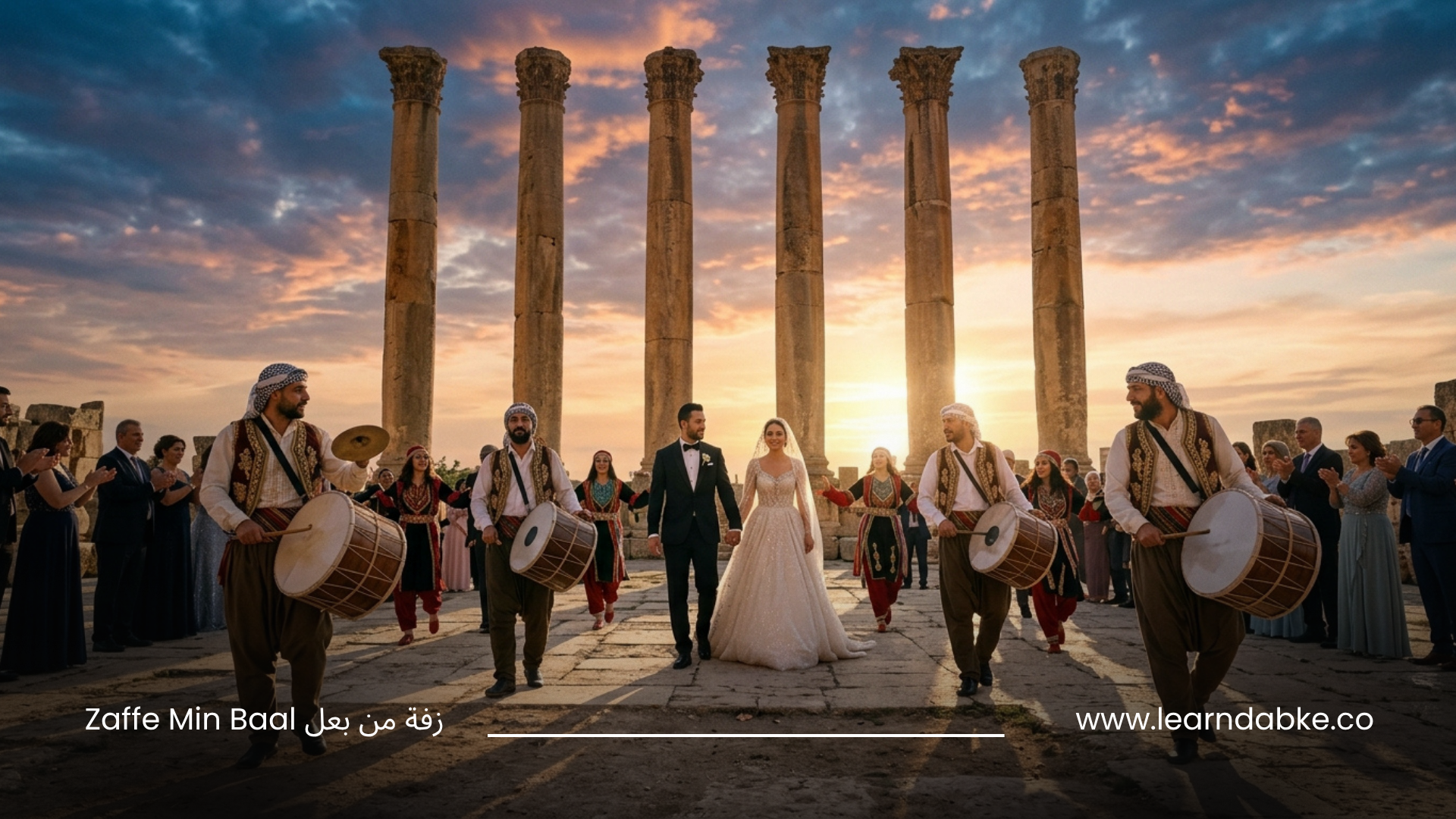
Short answer: The best Lebanese Zaffe music is not simply the most popular wedding song. It is music that matches the couple, the Zaffe style, the performers, and the movement of the entrance. Traditional Lebanese Zaffe often relies heavily on live drums, chanting, mijwiz, and Dabke rhythm, while modern entrances may combine those elements with recorded Lebanese wedding songs, custom mixes, or DJ transitions.
The most important rule is simple: choose the entrance first, then choose the music around it.
A powerful Baalbek-style Zaffe, an elegant hotel entrance, a royal-style procession, and a small family Zaffe should not all use the same musical structure.
This guide explains how Lebanese Zaffe music works, which types of songs suit different wedding entrances, how live performers should coordinate with the DJ, and what couples should consider before choosing their entrance music.
What Music Is Used in a Lebanese Zaffe?

Lebanese Zaffe music can include several elements:
- Tabl or large wedding drums
- Darbuka and percussion
- Mijwiz
- Traditional chants and wedding calls
- Live singing
- Dabke rhythms
- Recorded Lebanese wedding songs
- Custom DJ mixes
- Saxophone or other modern instruments
- A transition from live Zaffe music into the couple’s chosen entrance song
There is no single song that defines Lebanese Zaffe.
The music depends on the region, family tradition, type of Zaffe group, wedding venue, and the atmosphere the couple wants to create.
Some entrances are almost entirely percussion-based. Others begin with live drums and develop into a song. Others use a choreographed medley containing several musical sections.
The important distinction is that Zaffe music has a job to do: it must carry the procession.
A beautiful song is not automatically a good Zaffe song if its rhythm does not support the entrance.
Is Zaffe Music the Same as Dabke Music?
No.
Zaffe and Dabke are closely connected, but they are not the same thing.
Zaffe is the ceremonial wedding procession or entrance.
Dabke is a communal traditional dance.
A Zaffe can contain Dabke, and many Lebanese Zaffe groups use Dabke dancers during the entrance, but the musical structure serves a different purpose.

During a Zaffe, the music has to:
- Announce the entrance
- Build anticipation
- Give performers a clear rhythm
- Create space for the bride and groom
- Move the procession forward
- Reach a clear musical climax
- Transition naturally into the next part of the wedding
A Dabke set can continue much longer because its purpose is dancing rather than entering.
That difference matters when choosing music.
What Makes a Good Lebanese Zaffe Song?

A good Lebanese Zaffe song usually has three qualities:
A Strong Opening
Guests should immediately understand that something is beginning.
The opening can come from:
- A drum call
- A mijwiz phrase
- A wedding chant
- A dramatic instrumental introduction
- A recognizable wedding song
A weak musical beginning can make even a strong Zaffe entrance feel uncertain.
A Clear Rhythm
The performers need to move together.
The music should support the drummers, dancers, and couple rather than forcing everyone to follow a complicated arrangement.
For a heritage-focused Zaffe, rhythm is especially important.
A Clear Build-Up
The entrance should not remain at exactly the same musical intensity from beginning to end.
A well-designed Zaffe develops.
The performers may enter first.
The bride and groom may then appear.
The rhythm becomes stronger.
The family begins participating.
The couple reaches the dance floor.
Then the music transitions.
That musical progression is one reason a custom entrance can be much stronger than simply pressing play on one song.

Traditional Lebanese Zaffe Music
A traditional Lebanese Zaffe does not necessarily require a commercial song.
In many cases, the strongest musical identity comes from the performers themselves.
Live tabl establishes the rhythm.
Chanting creates participation.
The mijwiz can introduce a distinctly Levantine folk sound.
Dabke dancers respond to the rhythm.
The family claps, sings, and joins the procession.
For couples who want the entrance to feel deeply Lebanese rather than theatrical, this approach can be extremely effective.
It also allows the Zaffe group to respond to the room.
If the family becomes highly engaged, the musicians can build the moment.
If the entrance path is shorter than expected, they can finish naturally rather than cutting a prerecorded track awkwardly.
What Is Baalbek-Style Zaffe Music?
A Baalbek-style Zaffe places particular emphasis on rhythm, Dabke presence, live performance, and heritage identity.
Rather than treating the Zaffe as a choreographed show placed around the couple, the music creates the social atmosphere around them.
Elements may include:
- Strong tabl
- Mijwiz
- Baalbeki or Bekaa-style singing
- Dabke
- Wedding calls
- Sword performance
- Family participation
- Traditional wedding phrases and rhythms
The goal is not simply volume.
The sound should carry authority and rhythm while leaving enough musical space for the dancers and couple.
For couples interested in Lebanese heritage, Baalbek-style Zaffe can also connect the main wedding entrance with older wedding rituals such as the groom’s preparation, family gathering, henna celebration, and local singing traditions.

Popular Lebanese and Arabic Songs for a Zaffe Entrance
Couples who prefer a recorded song or a mix of live and recorded music have many options.
Lebanese and Arab wedding guides currently recommend songs specifically for wedding entrances, including:
- Mabrouk – Ramy Ayach
- Tallet Bil Abyad – Fares Karam
- Ares El Ghawali – Melhem Zein
- Ya Kel El Deni – Joseph Attieh
- Zaffou El Amar – Al Walid Hallani
- Tall El Arees – Walid Sarkis
These are examples rather than a fixed list.
A song may be very popular but still be wrong for a particular Zaffe.
The better question is:
What should the guests feel when we enter?
That answer should determine the music.
Which Zaffe Music Works for a Powerful Entrance?
For a powerful entrance, prioritize:
- Strong percussion
- A recognizable rhythmic opening
- Live drummers
- Dabke-compatible tempo
- Limited dead space
- A clear climax
This works especially well for:
- Baalbek-style Zaffe
- Large Lebanese weddings
- Outdoor weddings
- Village celebrations
- Large hotel ballrooms
- Entrances built around Dabke
A powerful entrance does not necessarily mean adding more instruments.
Sometimes three musical elements performed well create more impact than ten elements competing with each other.
Which Zaffe Music Works for an Elegant or Royal Entrance?

A royal or elegant Zaffe can begin more gradually.
Instead of immediately reaching maximum intensity, the entrance can use:
- Orchestral introduction
- Slow percussion build
- Saxophone
- Live vocal introduction
- Dramatic recorded music
- Lighting synchronized with the musical transition
Then the traditional Zaffe rhythm can enter.
This creates contrast.
The danger is turning the Zaffe into a generic stage show.
The Lebanese character should still be recognizable through rhythm, performers, musical phrasing, or Dabke presence.
What Music Works for the Groom’s Entrance?
The groom’s entrance often works well with stronger rhythm and direct energy.
Possible approaches include:
- Tabl-only entrance
- Mijwiz and drums
- Traditional wedding singing
- Dabke entrance with friends
- A Lebanese wedding song followed by live percussion
For some weddings, the groom enters separately before the couple’s main Zaffe.
In that case, avoid making the first entrance bigger than the actual bride-and-groom entrance.
The musical hierarchy matters.
The main couple entrance should still feel like the central moment.
What Music Works for the Bride’s Entrance?

A bride’s entrance can follow a completely different emotional direction.
It may begin with:
- A romantic Lebanese song
- An orchestral section
- A traditional bridal song
- Ululation and percussion
- A gradual transition into full Zaffe
The right approach depends on whether the bride enters alone, with family, or directly with the groom.
There is no reason every wedding needs identical bride and groom entrances.
Should You Use One Song or a Zaffe Medley?
For many weddings, a medley is stronger.
A Zaffe may contain:
Section 1: Announcement
Drums or instrumental opening.
Section 2: Performer Entrance
The Zaffe group establishes the rhythm.
Section 3: Couple Reveal
The bride and groom appear.
Section 4: Main Celebration
Music becomes fuller and family participation increases.
Section 5: Dance-Floor Transition
The live Zaffe ends and the DJ takes over.
This gives the entrance structure.
One song can still work beautifully, particularly when the route is short or the wedding is intimate.
The key is to know the physical entrance path before preparing the music.
How Should the Zaffe Group and DJ Coordinate?
This is one of the most important parts of the wedding entrance.
The DJ and Zaffe group should not meet the musical plan for the first time while the couple is waiting outside the ballroom.
Before the wedding, clarify:
- Who starts the entrance?
- Does the DJ start or do the drummers?
- At what point does the couple appear?
- Is recorded music played while live drums continue?
- Who gives the transition cue?
- What song follows the Zaffe?
- Where does the Zaffe finish?
- Does Dabke continue after the entrance?
- Does the couple immediately begin the first dance?
Wedding-music professionals specifically emphasize coordinating the hand-off between live Zaffe musicians and the DJ. A clean transition can make the whole entrance feel intentional.
How Should Zaffe Music Work With the Photographer and Videographer?
Music selection also affects the visual result.
A strong entrance needs moments where the couple can actually be seen.
If every performer reaches maximum energy at the same moment, the bride and groom may disappear behind dancers, drums, relatives, and phones.
Plan at least one clear visual moment.
For example:
- Performers enter
- Rhythm builds
- Music briefly opens
- Couple appears
- Camera gets the entrance shot
- Full rhythm returns
- Family joins
The video should document the couple inside the celebration, not just document the performers.
How Long Should the Zaffe Music Be?
There is no universal ideal length.
The correct duration depends on:
- Distance from entrance to dance floor
- Size of venue
- Number of performers
- Whether the couple stops along the route
- Family participation
- Whether Dabke follows
- Whether there are separate bride and groom entrances
The music should be designed around the physical route.
Do not choose a six-minute track for a thirty-second entrance and then try to invent reasons to keep the procession moving.
Likewise, do not prepare a short musical clip if the performers need to cross a large outdoor venue.
First walk the route.
Then build the music.

Should You Choose the Song Before Booking the Zaffe Group?
Usually, no.
Choose the type of entrance first.
Decide whether you want:
- Traditional
- Baalbek-style
- Royal
- Modern
- Dabke-focused
- Drum-focused
- Mixed traditional and modern
Then ask the group what musical structure they normally use.
Some groups perform to a fixed mix because their dancers and musicians know its cues.
Others can customize almost everything.
Couples should know which system they are booking before requesting a completely different soundtrack.
Should You Use Trending Songs for Your Wedding Zaffe?
A trending song can work, but popularity alone should not determine the entrance.
Wedding videos remain with the couple for decades.
Ask:
Will we still like this entrance when the trend disappears?
One useful approach is to keep the traditional Zaffe structure and use a contemporary song during the transition to the dance floor.
That gives the entrance both cultural identity and a current feeling without allowing a temporary trend to define the entire moment.
Common Zaffe Music Mistakes
Choosing Music Only Because It Is Popular
Popular does not mean appropriate.
A song needs to work with the movement, room, and entrance style.
Making the Mix Too Long
More music does not automatically create more impact.
An entrance that reaches its climax and then continues without purpose becomes weaker.
No DJ Coordination
Live drums ending suddenly while the DJ searches for the next track can destroy an otherwise excellent entrance.
Too Many Musical Ideas
Drums, mijwiz, saxophone, recorded song, singer, DJ effects, and several different rhythms can become cluttered.
Every element needs a purpose.
Ignoring the Venue
The same musical setup will not behave the same way in a narrow restaurant, large ballroom, outdoor château, village square, or beach venue.
Forgetting the Bride and Groom
The music exists to celebrate the couple.
The couple should not feel like background actors inside the Zaffe group’s performance.
How Do You Choose the Best Zaffe Music?
Use this simple process.
Step 1: Decide the Feeling
Choose three words.
For example:
Authentic. Powerful. Baalbeki.
or
Elegant. Modern. Romantic.
That gives everyone a creative direction.
Step 2: Choose the Zaffe Style
Traditional, modern, Baalbeki, royal, or mixed.
Step 3: Determine the Entrance Route
Know where performers start and where the couple finishes.
Step 4: Choose Live Elements
Decide whether you want:
- Tabl
- Mijwiz
- Dabke
- Singer
- Saxophone
- Sword performer
- Other musicians
Step 5: Select the Song or Mix
Now choose music that supports everything above.
Step 6: Coordinate Everyone
The Zaffe group, DJ, venue, wedding planner, photographer, and videographer should know the entrance structure.
Step 7: Keep One Person in Charge
Someone needs to give the final entrance cue.
Otherwise five professionals may all be waiting for each other.
Frequently Asked Questions About Lebanese Zaffe Songs
What are the best Lebanese Zaffe songs?
There is no single best Zaffe song. Popular choices include Lebanese wedding songs by artists such as Ramy Ayach, Fares Karam, Melhem Zein, Joseph Attieh, and Al Walid Hallani. The best choice depends on the Zaffe style, venue, performers, and atmosphere you want.
Does a Lebanese Zaffe need a song?
No. A traditional Zaffe can be performed with live drums, chanting, mijwiz, singing, Dabke rhythm, or a combination of those elements without using a commercial recording.
What music is used for a Baalbek-style Zaffe?
Baalbek-style Zaffe can emphasize tabl, mijwiz, traditional singing, Dabke rhythm, wedding calls, and live group interaction.
Is Zaffe music the same as Dabke music?
No. Dabke music supports communal dancing, while Zaffe music supports a ceremonial wedding procession. Dabke can be part of a Zaffe.
Can the DJ play music behind live Zaffe drummers?
Yes, but the arrangement should be prepared in advance so the recorded music and live percussion work together rather than compete.
Can we choose our own Zaffe song?
Usually yes, but ask the Zaffe group before finalizing it. Some groups use fixed musical arrangements or choreography, while others offer custom entrances.
Should the bride and groom use separate entrance songs?
They can. Some weddings have separate bride and groom entrances followed by a larger joint Zaffe. The final structure should make the couple’s main entrance feel like the most important moment.
Can a Zaffe mix traditional and modern music?
Yes. A mixed Zaffe can begin with traditional live rhythm and transition into modern Lebanese or Arabic music.
How long should Zaffe music last?
The duration should match the entrance path, number of performers, venue, and wedding program rather than following a fixed rule.
Build Your Lebanese Zaffe
Before choosing a song, decide what kind of entrance you actually want.
Do you want strong Baalbeki rhythm? A royal entrance? Traditional tabl and Dabke? Mijwiz? Sword performance? A modern mix?
Use the LearnDabke Zaffe Guide to choose your style, performers, instruments, and extras before requesting your Zaffe.
The music should then be built around your entrance, not the other way around.
Leave a Reply