
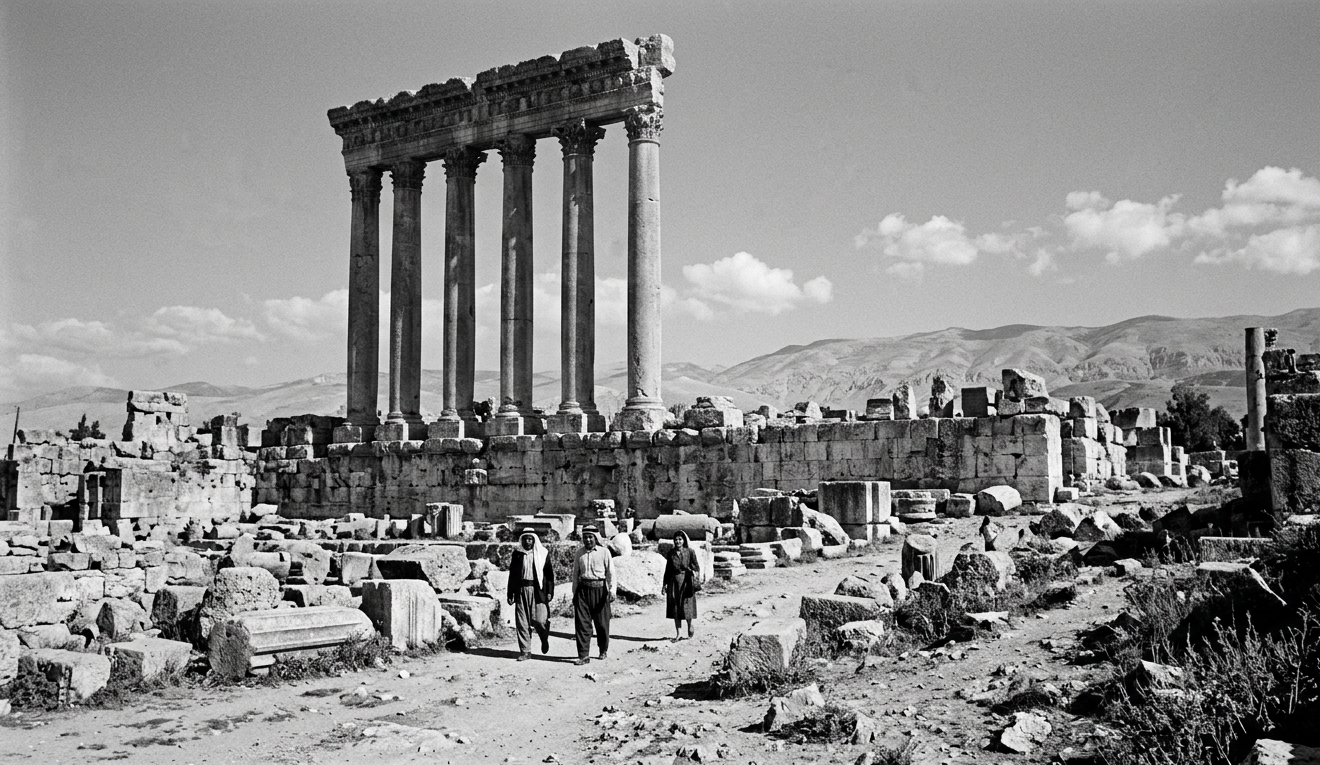
Most people who have heard the name Baalbek have heard it in one context only.
Ruins.
Roman ruins.
Six columns.
A temple.
A photograph.
A place to visit.
But Baalbek was never only that.
Before it became a postcard, it was a sacred place. Before it became a Roman monument, it already carried religious meaning. Before European travelers drew it, people were living around it. Before UNESCO listed it, generations from the Bekaa had already grown up beside it, walking past stones older than most of the nations that later claimed to understand them.
Baalbek is often treated as if it belongs only to antiquity. As if the city froze after Rome. As if the people who live there now are only neighbors of history, not part of it.
That is the first mistake.
Baalbek is not a ruin with a town beside it.
It is a town that has always lived with ruins at its center.
It is a Phoenician sacred memory, a Hellenistic name, a Roman imperial ambition, a Byzantine transformation, an Islamic administrative center, a medieval fortress, an Ottoman district, a European archaeological obsession, a UNESCO World Heritage Site, a festival stage, and a living Bekaa city.
The temples became ruins.
The city did not.
The Name Comes From a Sacred Place
The name Baalbek already tells you that this city is older than the Roman stones people usually associate with it.
UNESCO describes Baalbek as a Phoenician city where a triad of deities was worshipped, later known as Heliopolis during the Hellenistic period. The site retained its religious function under Rome, when the sanctuary of the Heliopolitan Jupiter attracted pilgrims. (UNESCO World Heritage Centre)
That sentence matters.
It means Rome did not create Baalbek’s sacredness from nothing. Rome inherited a sacred place and enlarged it into empire-scale architecture.
The name Heliopolis means City of the Sun, and Britannica notes that Baalbek was known by that Greek name after the region came under Hellenistic rule. The same source places the town in the Bekaa Valley, around 80 kilometers east-northeast of Beirut, at an elevation of roughly 1,130 meters. (Encyclopedia Britannica)
But before the Greek name, before the Roman colony, before the columns, there was the older layer: a local religious world connected to Phoenician and Syrian traditions. UNESCO identifies the Romanized triad of Heliopolis as an essentially Phoenician cult, later expressed through Jupiter, Venus, and Mercury in the Greco-Roman pantheon. (UNESCO World Heritage Centre)
This is one of the most important ideas in Baalbek’s history:
Rome did not make Baalbek sacred.
Rome made its sacredness monumental.
The Romans did what empires often do. They took a place already charged with meaning and rebuilt it in their own language of power. In Baalbek, that language was stone.
Not small stone.
Impossible stone.
Stone so large that the city became mythic.
When Rome Decided To Build Upward
Baalbek reached its architectural height under Roman rule.
UNESCO describes the temple complex as one of the finest examples of Imperial Roman architecture at its peak, with colossal structures built over more than two centuries. The site includes the Temples of Jupiter, Bacchus, Venus, Mercury, and the Odeon. (UNESCO World Heritage Centre)
This was not a small provincial shrine.
It was one of the great sanctuaries of the Roman world.
The Temple of Jupiter was the principal temple of the Baalbek triad. UNESCO notes its 20-meter-high columns and the gigantic terrace stones that supported the sanctuary. (UNESCO World Heritage Centre) Britannica gives more detail: the sanctuary stood at the western end of a vast court, and the temple itself had 54 columns, with 10 on each front and 19 on each side. Each column was about 19 meters high and 2.3 meters in diameter. (Encyclopedia Britannica)
Only six columns remain standing today.
But those six are enough.
They are not ruins in the weak sense of the word. They do not feel like leftovers. They feel like survivors.
Beside Jupiter stands the Temple of Bacchus, one of Baalbek’s most powerful monuments. UNESCO describes it as richly and abundantly decorated, with an impressive monumental gate sculpted with Bacchic figures. (UNESCO World Heritage Centre) The Temple of Bacchus is often considered one of the best-preserved major Roman temple ruins, and its decoration is usually dated to the second century CE. (Wikipedia)
The Temple of Venus, smaller and rounder, shows another face of Baalbek: not only scale, but refinement. UNESCO notes its originality of layout and harmonious form, while the Temple of Mercury survives mainly through a rock-cut stairway on Sheikh Abdallah Hill. (UNESCO World Heritage Centre)
Together, these structures made Baalbek more than a sanctuary.
They made it a statement.
In Baalbek, Rome did not whisper power.
It built it in stone.
The Stones That Made Baalbek Larger Than Explanation
Every ancient site has stones.
Baalbek has stones that feel like questions.
The most famous are the massive blocks in the Roman terrace, often discussed through the Trilithon, three enormous stones built into the podium of the Jupiter sanctuary. UNESCO notes that the Roman construction was built on earlier ruins formed into a raised plaza using twenty-four monoliths, the largest weighing more than 800 tons. (UNESCO World Heritage Centre)
The scale of Baalbek’s stones helped produce the legends around the city. When people cannot easily imagine how something was made, they create stories big enough to match the object.
Nearby is the famous quarry stone commonly known as Hajar al-Hibla, the Stone of the Pregnant Woman. It lies in the ancient quarry near the site and has become part of Baalbek’s mythology almost as much as its archaeology. Popular accounts often exaggerate it, so it should be handled carefully in final content. The safest sourced approach is to say that Baalbek’s quarry contains some of the largest worked stones known from antiquity and that their scale remains central to the site’s historical imagination.
This is where Heritage Lebanon must separate wonder from fantasy.
Baalbek does not need fake myths to be extraordinary.
The real stones are enough.
The real engineering is enough.
The real fact that people lived beside these stones for centuries is enough.
Baalbek became mythic because its stones feel too large for ordinary history.
Sacred Ground That Kept Changing Hands
Baalbek did not end with Rome.
That is the part many people forget.
After the Roman period, the site passed into Byzantine hands. Britannica notes that Baalbek became Byzantine and later came under Arab domination in 637 CE. It was then administered by various Muslim rulers of Syria until the twentieth century, before the French Mandate authorities included it in Lebanon after World War I. (Encyclopedia Britannica)
This is where the city becomes more than an archaeological site.
It becomes a political and religious witness.
The temples did not remain untouched. They were transformed, reused, fortified, damaged, repaired, and reinterpreted. UNESCO notes that the “entire town within the Arab walls” forms part of the site’s essential context, along with extra-muros areas such as Boustan el Khan, Roman works, and the Mamluk mosque of Ras al-Ain. (UNESCO World Heritage Centre)
This matters because it breaks the idea that Baalbek is only Greco-Roman.
Baalbek is also Byzantine.
It is Islamic.
It is medieval.
It is Ottoman.
It is modern Lebanese.
Salibi’s account gives Baalbek a clear role in early Islamic administration. Under the early Abbasids, the governors of Baalbek collected taxes from northern Mount Lebanon. During the reign of the Abbasid caliph al-Mansur, the governor of Baalbek attacked Munaytira after a Christian revolt, subdued it, and dispersed the population, according to the Arabic historian Baladhuri. Salibi uses this to show that early Abbasid rule had access to high reaches of Mount Lebanon and fiscal control there.
That is not the story tourists usually hear.
But it is part of Baalbek’s real history.
Baalbek was not only a place of worship. It was also an administrative center. A place from which authority reached into mountain districts. A city connected to taxation, roads, defense, and the management of territory.
Later, under Ottoman rule, Baalbek remained important in the political geography of the Bekaa. Salibi discusses the Harfush emirs of the Baalbek region and notes that the Ottomans normally entrusted them with the management of the Nahie, or administrative district, of Baalbek.
That means Baalbek was not a dead ancient place waiting to be rediscovered.
It was inside the working structures of power.
The temples became ruins.
The city kept being used.
The Earthquakes That Almost Erased It
Baalbek survived empire.
But stone does not only face empire.
It faces earth.
Britannica notes that much of the ancient settlement had been destroyed by earthquake before modern excavations and restorations. (Encyclopedia Britannica) Earthquakes were among the forces that changed what survived, what collapsed, and what later generations encountered as “ruins.”
This is important because ruins can make destruction look romantic.
A fallen column can look beautiful.
A broken wall can look poetic.
But the break itself came from real force: time, earthquake, neglect, reuse, conflict, and the human habit of taking stone from old structures for new needs.
Baalbek’s present form is not exactly what Rome left.
It is what survived after centuries of movement, damage, repair, and interpretation.
UNESCO also notes that although the site underwent restoration in the 1960s and 1980s, its authenticity has remained intact, while also warning that the property remains vulnerable to changes affecting its structures and setting. (UNESCO World Heritage Centre)
This is the right way to see Baalbek:
Not as perfectly preserved antiquity.
But as endurance.
The stones did not remain unchanged.
They remained present.
How Europe “Found” What Was Never Lost
In the eighteenth and nineteenth centuries, Baalbek became an object of European fascination.
Travelers, artists, architects, and archaeologists measured it, drew it, published it, compared it, and made it part of the European imagination of the ancient Near East.
Britannica notes that European attention was first directed to Baalbek’s ruins in the sixteenth century, and that a German expedition excavated the two huge Roman temples between 1898 and 1903, beginning reconstruction. Later clearings and repairs were carried out under the French Mandate and then by the Lebanese government. (Encyclopedia Britannica)
The German Archaeological Institute gives a more detailed modern summary. It notes that the area of modern Baalbek was first settled at the end of the eighth millennium BC, that a settlement mound was found under the Temple of Jupiter, and that the Roman sanctuary was rebuilt on a new monumental plan after the foundation of the Roman colony of Berytus in 15 BC. It also states that Jupiter’s temple was built first, followed by the second-century temple known as Bacchus, and then the third-century Temple of Venus. (Deutsches Archäologisches Institut)
The same German Archaeological Institute source explains that Baalbek saw several Christian churches built between the fourth and seventh centuries, that pagan cults were slowly abandoned, that Baalbek was incorporated into the Islamic empire in 635 CE, and that from the twelfth to fourteenth centuries the sanctuary was turned into a fortress used by Ayyubid and Mamluk rulers in Damascus against Crusader states. (Deutsches Archäologisches Institut)
That is a powerful sentence for Heritage Lebanon.
Because it shows the full layered life of the site:
settlement mound, Roman sanctuary, Christian churches, Islamic city, medieval fortress, museum, modern town.
European archaeologists did important documentation and excavation work. But they did not discover Baalbek in the full human sense.
People were already there.
The city was never lost to itself.
It was only newly framed by outsiders.
The City That Never Stopped Living
The most important sentence in this article is simple:
Baalbek is not only the ruins.
It is the city around them.
Britannica describes modern Baalbek as the principal urban center of the Baalbek-Hermel governorate, with tourism as an important part of its economy, and gives a 2017 population estimate of 85,000. (Encyclopedia Britannica) But numbers alone do not explain the feeling of the place.
Baalbek is a Bekaa city.
That matters.
Ragette describes the Bekaa as a high plain between the Lebanon and Anti-Lebanon ranges, with deep alluvial soil excellent for farming and irrigation. He notes that its altitude averages around 1,000 meters and that the presence of clay and water, combined with a fairly dry climate, allowed the use of mud brick construction.
So Baalbek’s heritage is not only temple stone.
It is also valley soil.
Agriculture.
Wide horizons.
Dry climate.
Inland roads.
Village houses.
Mouneh.
Dialect.
Seasonal rhythm.
A city cannot be understood only by its most famous monument. To understand Baalbek, you have to understand the Bekaa around it.
You have to understand that the city is not simply a Roman structure placed in empty space. It belongs to a living valley where people farm, trade, celebrate, argue, cook, build, speak, and remember.
Even Ragette’s documentation of Lebanese house types includes examples from Baalbek, showing that the city belongs not only to monumental history but also to domestic architectural history: houses, thresholds, storage niches, living platforms, service space, and the everyday logic of family life.
That is the Heritage Lebanon correction.
Baalbek is not only the largest stones.
It is also the small routines.
A woman preparing food in the Bekaa.
A family crossing the city.
A guide telling the story again.
A child growing up with six Roman columns as part of the skyline.
A city that learned to live beside greatness without needing to explain itself every morning.
When the Ruins Became a Stage
In the twentieth century, Baalbek became one of Lebanon’s great cultural stages.
The official history of the Baalbeck International Festival states that it was initiated in 1956 under the patronage of President Camille Chamoun. The Roman temples were recognized as a unique setting with cultural, touristic, and socio-economic importance for Lebanon and for Baalbek itself. (baalbeck.org.lb)
This is one of the most beautiful modern turns in the city’s history.
The ancient sanctuary became a stage.
Not because the stones were dead and needed life added to them.
But because people returned to them with music.
The Baalbeck International Festival brought classical music, theater, dance, opera, jazz, modern world music, and Lebanese performance into the ancient setting. Its history is tied to the idea that Baalbek is not only inherited but activated.
Fairuz is central to that memory. The Arab Weekly notes that she shot to fame after her first performance at the Baalbek International Festival in 1957. (AW) The festival’s own highlights list includes Le Mariage au Village in 1957, part of the early Rahbani-Fairuz theatrical world connected to Baalbek’s modern cultural identity. (baalbeck.org.lb)
That is why Baalbek is not only archaeology.
It is sound.
It is stage.
It is night air.
It is Fairuz.
It is stone carrying voice.
The festival did not bring life to dead ruins.
It revealed that the stones were never silent.
Baalbek Today: A Heritage City in a Fragile Present
Baalbek today carries beauty and pressure at the same time.
That is true of many Lebanese heritage places.
UNESCO notes that the property has faced vulnerability from conflict, lack of planning controls, urban pressure, and the challenge of protecting the sanctuary’s setting. It also states that the Directorate General of Antiquities controls construction and restoration permits and has carried out consolidation and restoration work. (UNESCO World Heritage Centre)
This is important because heritage is not protected only by admiration.
Admiration is easy.
Protection is harder.
A city like Baalbek needs conservation, planning, local respect, tourism that benefits the city, and national memory that does not reduce the place to politics, stereotype, or ruins.
Baalbek is often spoken about from outside. It is described by people who do not live there, judged through headlines, visited through photographs, simplified through one frame.
Heritage Lebanon has to resist that.
Baalbek is not only what outsiders say it is.
It is also what Baalbekis know it is.
A city of pride.
A city of the Bekaa.
A city of Shiite community history, agricultural life, festival memory, local strength, and a landscape where ancient stone and everyday life are not separate.
The temples may belong to world heritage.
But the city belongs first to the people who live beside them.
A city is not preserved only by protecting its stones.
It is preserved by protecting the life around them.
What Baalbek Actually Is
Baalbek is not a single image.
It is not only six columns.
It is not only Roman.
It is not only Phoenician.
It is not only Islamic.
It is not only a festival.
It is not only a headline.
It is a city that absorbed every period and kept going.
It began as sacred ground. It became Heliopolis, the City of the Sun. Rome made it monumental. Byzantium changed it. Islam administered it. Medieval rulers fortified it. Earthquakes broke parts of it. European archaeologists measured it. The French Mandate cleared and restored parts of it. Lebanon placed it on the world stage. UNESCO listed it in 1984. Fairuz sang there. People still wake up there.
That is the real story.
Baalbek did not outlast empires by staying untouched.
It outlasted them by becoming larger than all of them.
Every empire tried to own it in its own language.
The gods named it.
Rome built it.
Byzantium converted it.
Islam governed it.
The Ottomans administered it.
Europe studied it.
Lebanon inherited it.
The Bekaa still lives it.
Baalbek is not a ruin Lebanon inherited.
It is a memory Lebanon still lives beside.
Sources Used
- UNESCO World Heritage Centre, Baalbek, for UNESCO inscription, outstanding universal value, temples, Phoenician cult, Roman sanctuary, conservation status, and site context.
- Encyclopaedia Britannica, Baalbek, for location, Heliopolis, Roman and later history, German excavation, French Mandate restoration, modern town, and population estimate.
- German Archaeological Institute, The Museum in Baalbek, for settlement history, Roman construction sequence, Christian churches, Islamic incorporation, and medieval fortress use.
- Kamal Salibi, A House of Many Mansions, for Baalbek’s role in Abbasid administration, Munaytira, Baalbek governors, Harfush emirs, and the Baalbek region’s Shiite political history.
- Friedrich Ragette, Architecture in Lebanon, for the Bekaa’s geography, farming conditions, adobe construction, and Baalbek examples in Lebanese domestic architecture.
- Baalbeck International Festival official site, History, for the 1956 founding under President Camille Chamoun.
- The Arab Weekly, Pan-Arab musical icon Fairuz celebrated as she turns 90, for Fairuz’s 1957 Baalbek performance and its significance.
Leave a Reply