

How a settlement between mountain and valley became one of Lebanon’s great market towns, a home of wine and poetry, and a city whose identity still lives around the table.
There are Lebanese cities you understand through their monuments. Zahlé is understood through movement. Water moving down from Sannine through the Berdawni. Merchants once moving grain and livestock between the Beqaa, Damascus, and Beirut. Families moving through stone houses built along the slopes. Plates moving endlessly across riverside tables. And, eventually, generations of Zahlawis moving across oceans while continuing to call one city home.
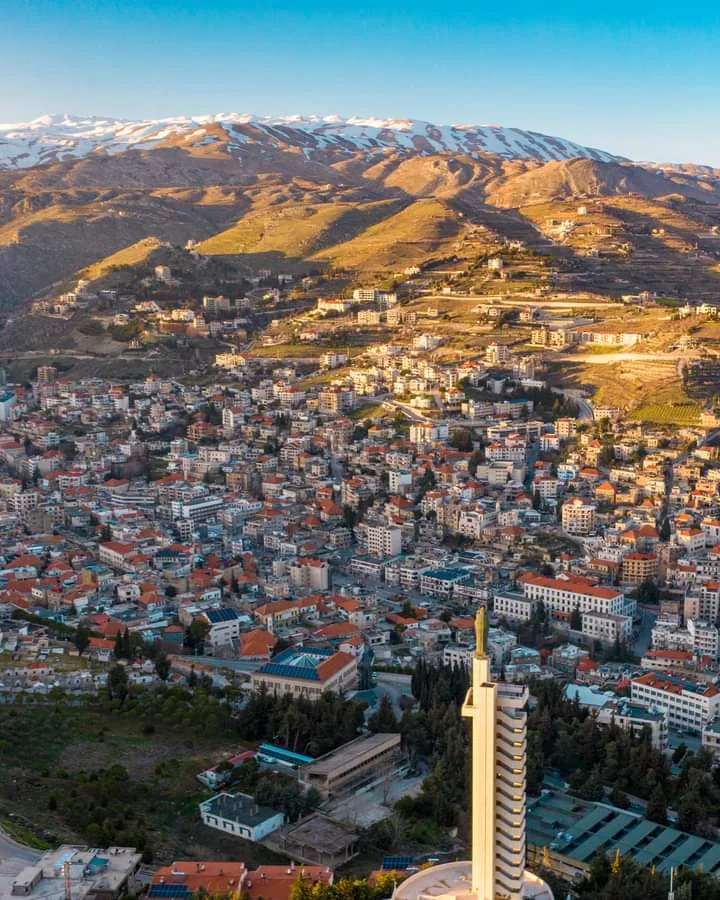
Known as the Bride of the Beqaa and the City of Wine and Poetry, Zahlé occupies a distinctive place in Lebanese heritage. It sits where the eastern slopes of Mount Lebanon descend toward the Beqaa Valley, roughly 1,000 meters above sea level, historically positioned along the routes connecting Beirut with Damascus and the agricultural interior. Geography did not simply surround Zahlé. Geography helped make it.
Today, the city is associated with wine, arak, poetry, old stone houses, red-tiled roofs, the Berdawni restaurants, and a particularly strong local identity. But these are not disconnected attractions. Together they tell the story of how Zahlé evolved from a modest eighteenth-century settlement into what historian Alixa Naff described in the title of her major study as “the principal market town in nineteenth-century Lebanon.”
To understand Zahlé, then, we have to begin before the restaurants, before the wineries, and before the city acquired its famous titles.
We have to begin with the valley.
Where Is Zahlé, and Why Did Its Location Matter?

Zahlé lies in eastern Lebanon, at the meeting point between the Mount Lebanon range and the Beqaa Valley. The city climbs along the slopes surrounding the gorge of the Berdawni River, while the broad agricultural plain of the Beqaa opens below it. Historically, this placed Zahlé between two worlds: the mountain and the plain.
That position would become one of the foundations of its importance.
The Beqaa produced grain, grapes, livestock, and other agricultural goods. Beirut developed rapidly during the nineteenth century as Lebanon’s great Mediterranean port. Damascus remained one of the major inland cities of the region. Zahlé stood between these economic spaces and became increasingly valuable as a place where goods could be collected, traded, processed, and redirected. Academic research on nineteenth-century transport networks notes the importance of the road connecting Zahlé with the coast as markets and credit systems expanded.
Zahlé therefore did not grow simply because people decided to build a larger town. It grew because its geography became useful.
The city was close enough to the fields to understand agriculture and close enough to regional routes to turn agricultural production into commerce.
That relationship between land and exchange remains one of the keys to Zahlé’s character.
The Origins of Zahlé: A Young City in an Ancient Landscape
The exact origin of the name Zahlé remains uncertain.
Several explanations have circulated. Some connect the name with Zahal and the idea of slipping or movement, possibly referring to the geology and landslides of the surrounding slopes. Another tradition associates the name with Zohal, or Saturn. Local historical sources themselves acknowledge disagreement over the etymology, so neither explanation should be presented as settled fact.
The city as we recognize it is comparatively young by Lebanese standards.
Zahlé developed substantially during the eighteenth century, although the wider Beqaa landscape contains evidence of much older settlement and ancient activity. By the end of that century, the settlement consisted of roughly two hundred houses and around one thousand inhabitants according to historical estimates reproduced in accounts of the city’s development.
What followed was remarkable.
By around 1820, estimates place Zahlé’s population at approximately 5,000. By the middle of the nineteenth century, it had reached roughly 7,000 to 8,000 people and had become a major commercial center for the Beqaa, particularly for grain.
The speed of that growth tells us something important.
Zahlé was becoming more than a village.
It was becoming a market city.
How Zahlé Became the Market Town of the Beqaa

The most important scholarly description of nineteenth-century Zahlé may be found in the very title of Alixa Naff’s 1972 doctoral dissertation: A Social History of Zahle: The Principal Market Town in Nineteenth-Century Lebanon. The title reflects the position Zahlé had acquired within the economic geography of the country.
Grain from the Beqaa moved through the town.
Livestock from the Syrian interior entered its markets.
Leather goods, woven products, and dyed textiles became part of its commercial activity. Zahlé’s merchants maintained connections with Beirut, Damascus, Aleppo, and the surrounding countryside. By the second half of the nineteenth century, merchants in the city had accumulated meaningful commercial wealth, even while many remained dependent on Beirut’s larger financial networks for credit.
This explains why Zahlé developed a character different from a purely agricultural village.
Agriculture surrounded it, but commerce animated it.
The farmer, mule driver, merchant, craftsman, innkeeper, winemaker, shopkeeper, and traveler all belonged to the same urban story.
Even the physical geography encouraged this exchange. Roads descending from the mountains and routes extending across the valley placed Zahlé within the movement of people and goods between interior Syria and the Mediterranean coast. Research on nineteenth-century Lebanese transport specifically notes the opening of the Zahlé road as part of the expansion of markets and commercial connections.
In that sense, Zahlé became a doorway.
Not quite coast.
Not quite mountain village.
Not merely agricultural plain.
A meeting place between them.
The Berdawni River: The Water That Became a Social Space
If trade explains Zahlé’s economic rise, the Berdawni River explains much of its emotional geography.
The river descends from the Sannine area and passes directly through the city. Today, its name is inseparable from Zahlé’s famous riverside restaurants and the culture of long Lebanese meals served beneath trees beside flowing water.
But the Berdawni did not begin as a restaurant promenade.
Historical research into the relationship between the city and river shows that the Berdawni supported productive activities, including watermills used to grind wheat. The river was therefore once part of the working infrastructure of Zahlé before it became one of its most famous social landscapes.
This transformation matters.
A river that once powered production eventually became a place of gathering.
Work became leisure.
The mill became the restaurant.
The agricultural economy remained present, but its products now arrived at the table as part of an elaborate social ritual.
The Berdawni’s restaurants became famous for Lebanese mezze, long lunches, arak, conversation, and the particular experience of eating outdoors beside moving water. UNESCO now specifically recognizes the historic reputation of the Berdawni’s waterside restaurants as part of Zahlé’s gastronomic identity.
This is why describing the Berdawni merely as a tourist attraction misses the point.
For generations, it has functioned as something closer to a public dining room for the city.
People go there not simply to eat.
They go to remain.
Why Zahlé Is One of Lebanon’s Great Food Cities
Zahlé’s relationship with food is deep enough that UNESCO includes it in the Creative Cities Network as a Creative City of Gastronomy. UNESCO’s profile emphasizes the city’s established culinary culture and the historic importance of the Berdawni restaurants.
Yet gastronomy in Zahlé is not simply a collection of famous dishes.
It begins with the Beqaa itself.
This is one of Lebanon’s great agricultural landscapes. Grain, vegetables, orchard produce, dairy traditions, grapes, and livestock all shaped the food economy surrounding the city. Zahlé’s historical function as a market center meant that food entered the city not only as something families produced but as something people traded, transformed, served, and built livelihoods around.
The Zahlawi table inherited that abundance.
The classic riverside meal is therefore significant not because mezze exists only in Zahlé. It does not. Mezze belongs to a much broader Lebanese and Eastern Mediterranean food tradition.
What Zahlé made distinctive was the scale and setting of the meal.
The flowing Berdawni.
The shaded restaurant.
The cold dishes arriving first.
The hot plates following.
The bottle of arak remaining beside the table.
The meal that refuses to behave like an appointment with a beginning and an end.
The table becomes an occupation of time.
That may be one of Zahlé’s strongest contributions to Lebanese hospitality: the idea that feeding people properly requires giving them enough food, but also enough time to stay.
Grapes, Arak, and the Making of Wine Country
No story about Zahlé can be complete without the grape.
Vineyards are central to the agricultural identity of the surrounding Beqaa, and older homes in and around the city traditionally incorporated vines around terraces and domestic spaces. The grape becomes fruit, molasses, arak, and wine, connecting agriculture to household tradition and commercial production.
The most important modern milestone came nearby in Ksara in 1857.
According to Château Ksara’s historical archive, Jesuit monks inherited land between Taanayel and Zahlé and began planting French grape varieties brought from Algeria. Their work helped establish the foundations of Lebanon’s modern commercial wine industry.
Château Ksara remains Lebanon’s oldest operating winery, and its location beside Zahlé reinforced the city’s association with wine at precisely the period when Zahlé itself was developing as a prosperous market town.
Wine and arak therefore became more than products.
They became part of Zahlé’s cultural vocabulary.
A vineyard represented agriculture.
A bottle represented preservation and transformation.
A table represented hospitality.
And a toast converted all three into social memory.
This is one reason the phrase “City of Wine and Poetry” feels so appropriate. Wine in Zahlé belongs to the land. Poetry belongs to the voice.
And the city became known for both.
Why Is Zahlé Called the City of Wine and Poetry?
Zahlé’s literary reputation is not decorative.
The city produced and inspired writers, poets, journalists, and cultural figures, helping make literary expression part of its public identity. Perhaps the most internationally recognizable Zahlawi literary figure of the twentieth century was Said Akl, born in Zahlé in 1911. He became one of Lebanon’s major modern poets and writers, producing poetry, prose, theater, and linguistic work over an extraordinarily long career.
But the deeper significance of Zahlé’s association with poetry is collective.
A trading city needs speech.
A hospitality city needs storytelling.
A city of cafés, gatherings, churches, schools, merchants, visitors, and emigrants becomes a place where language circulates alongside goods.
Poetry was not foreign to this environment.
It belonged naturally to it.
The name “City of Wine and Poetry” captures something essential about Zahlé because both wine and poetry depend upon transformation.
The grape becomes something larger than fruit.
An ordinary sentence becomes something larger than speech.
Perhaps this is why the title endured.
It describes not two industries, but a temperament.
The Stone Houses and Red Roofs of Old Zahlé
Walk through the older quarters of Zahlé and another layer of the city becomes visible.
Stone façades.
Tall windows.
Wooden shutters.
Arched openings.
Balconies.
Terracotta roofs appearing one behind another as the city climbs the slope.
Lebanon Traveler describes Zahlé as particularly notable for its traditional red-roofed houses, old souk, and decorated façades characteristic of nineteenth-century local architecture.
These houses matter because they belong to the same century in which Zahlé became commercially important.
Economic growth leaves architectural traces.
A prosperous merchant does not only expand his business. He improves his home. New rooms appear. Windows become larger. Decorative stonework becomes more refined. Imported tastes enter local building traditions. The city’s wealth begins to appear in façades.
The result is an urban fabric that still feels distinctly Lebanese but also distinctly Zahlawi: stone rising densely along the slopes, red roofs softening the skyline, houses looking toward the valley rather than turning away from it.
That architecture makes Zahlé feel at once like a city and an enlarged village.
Perhaps that contradiction is part of its charm.
It became urban without completely forgetting the scale of domestic life.
Souk, Street, and the Everyday City

Heritage is often photographed when it becomes exceptional: a famous building, an old church, an impressive façade.
But cities are usually remembered through ordinary streets.
The old souks of Zahlé mattered because they transformed the products of the Beqaa into social contact. Grain was weighed. Animals were traded. Cloth was sold. Crafts moved from workshop to customer. News traveled with merchants and travelers.
The market was therefore not only economic infrastructure.
It was communication.
This helps explain how a city relatively removed from the coast could develop such a strong outward-looking character during the nineteenth century. Zahlé’s merchants had to understand roads beyond Zahlé. Their livelihoods depended upon relationships reaching toward Beirut, Damascus, Aleppo, surrounding villages, and eventually much farther abroad.
Commerce taught the city to look outward.
Emigration would carry that instinct across oceans.
Zahlé and the Lebanese Diaspora
Like many Lebanese communities, Zahlé became deeply connected to emigration.
Beginning in the late nineteenth and early twentieth centuries, migration from the Eastern Mediterranean toward the Americas accelerated dramatically. Brazil, Argentina, the United States, and other destinations received migrants from communities that would later form modern Lebanon.
Zahlé participated strongly in this movement.
Community histories record important Zahlawi migration toward South America, including Brazil, Argentina, Colombia, and Venezuela, followed in later generations by migration toward North America, Australia, and elsewhere.
The exact number of descendants from Zahlé abroad is difficult to establish reliably, and inflated diaspora estimates should be treated carefully. What is beyond doubt is the cultural importance of this movement.
The emigrant left the city.
But the city often left with the emigrant.
Family names traveled.
Recipes traveled.
Arak traveled.
Religious feasts traveled.
Arabic expressions survived inside Spanish-, Portuguese-, English-, and French-speaking households.
The idea of being Zahlawi could survive even when the person carrying it had been born thousands of kilometers from the Berdawni.
This is one of the great patterns of Lebanese diaspora identity: attachment becomes more specific as distance grows.
Someone abroad may say “Lebanese.”
But inside the family, the answer is often narrower.
Zahlé.
A village.
A neighborhood.
A family house.
A particular table.
What Makes Zahlé Different From Other Lebanese Cities?
There is no single answer.
Baalbek carries monumental antiquity.
Tripoli carries the density of its medieval city.
Tyre carries the Mediterranean and layers of ancient coastal civilization.
Beirut carries scale, reinvention, and cosmopolitan movement.
Zahlé’s distinction lies somewhere else.
It lies in the way agriculture became urban culture.
The Beqaa entered the city through grain, livestock, grapes, and trade.
The Berdawni entered social life through mills and then restaurants.
The grape entered hospitality as wine and arak.
Merchant prosperity entered the city through stone houses and decorated façades.
Language entered identity through poetry.
Migration expanded Zahlé beyond its physical borders.
Few Lebanese cities combine these layers in quite the same way.
This is what makes Zahlé culture difficult to reduce to one monument.
Its heritage lives in relationships.
Land to market.
River to table.
Grape to glass.
House to street.
City to diaspora.
Zahlé Today: Heritage That Is Still Being Used
The easiest mistake in heritage writing is to describe a city as if its meaningful life happened only in the past.
Zahlé resists that.
The Berdawni is still associated with eating.
The surrounding Beqaa remains wine country.
The old stone houses still shape the visual memory of the city.
Zahlé’s culinary identity remains strong enough to be internationally recognized through UNESCO’s Creative Cities Network.
This is important because living heritage does not survive by remaining unchanged.
It survives by remaining useful.
A restaurant changes its kitchen but keeps the ritual of the long meal.
A winery adopts modern technology but still works from the same agricultural landscape.
A family abroad speaks less Arabic than its grandparents did but still prepares the same foods when relatives gather.
A nineteenth-century house may now sit beside an apartment building, yet its red roof still tells the city what it once looked like.
Heritage survives through adaptation.
Zahlé has been doing that for centuries.
Why Zahlé Matters to Lebanese Heritage
Zahlé matters because it helps us understand that Lebanese heritage was never created only in palaces, temples, monasteries, or archaeological sites.
It was also created in market towns.
At mills.
On trade roads.
Inside kitchens.
Beside rivers.
Around tables.
In vineyards.
In houses whose builders expected children and grandchildren to inhabit them.
And later, in letters sent between Lebanon and the Americas.
The history of Zahlé is therefore not simply the history of one city in the Beqaa.
It is a compressed version of something larger in Lebanese life: the ability to remain deeply attached to place while constantly looking beyond it.
The Zahlawi merchant could trade outside the valley and remain Zahlawi.
The emigrant could cross an ocean and remain Zahlawi.
The poet could turn local memory into language understood far beyond Zahlé.
The grape could leave the vineyard in a bottle and still carry the land inside it.
And the Berdawni could flow through generations of change while people continued to gather beside it.
That is perhaps the image that stays.
Not a monument.
Not a date.
A table beside the river.
Water moving beneath the trees.
Glasses on the table.
Plates arriving slowly.
A conversation that has gone on longer than planned.
And somewhere in the distance, the Beqaa opening beyond the city.
That is Zahlé.
Not heritage preserved behind glass.
Heritage still being lived.
Frequently Asked Questions About Zahlé, Lebanon
Where is Zahlé located in Lebanon?
Zahlé is located in the Beqaa Governorate of eastern Lebanon, east of Beirut and near the meeting point between the Mount Lebanon range and the Beqaa Valley. The city rises along the gorge of the Berdawni River at roughly 1,000 meters above sea level. Its location historically helped connect the agricultural Beqaa with commercial routes toward Beirut, Damascus, and the wider region.
What is Zahlé famous for?
Zahlé is especially famous for the Berdawni River and its restaurants, Lebanese mezze, arak, wine, vineyards, poetry, old stone houses, and red-tiled roofs. It is commonly called the Bride of the Beqaa and the City of Wine and Poetry. UNESCO recognizes Zahlé as a Creative City of Gastronomy.
Why was Zahlé important in the nineteenth century?
During the nineteenth century, Zahlé developed into one of Lebanon’s most important inland commercial towns. It became a major market and collection point for grain, livestock, leather, woven goods, and other products, linking the agricultural Beqaa with Beirut, Damascus, Aleppo, and surrounding communities. Historian Alixa Naff devoted her doctoral research to Zahlé as the “principal market town in nineteenth-century Lebanon.”
Why is Zahlé associated with wine?
The surrounding Beqaa Valley has ideal agricultural conditions for vineyards, and grapes have long shaped Zahlé’s local culture through wine and arak production. Nearby Château Ksara was founded in 1857, when Jesuit monks began planting imported grape varieties and helped establish the foundations of Lebanon’s modern wine industry.
Why is Zahlé called the City of Wine and Poetry?
The title reflects two deeply rooted parts of the city’s cultural identity. Zahlé and the surrounding Beqaa are strongly associated with vineyards, wine, and arak, while the city has also produced important literary figures, including the poet Said Akl. Over time, wine and poetry became complementary symbols of Zahlé’s agricultural and cultural life.
What role does the Berdawni River play in Zahlé’s heritage?
Historically, the Berdawni supported productive activities such as watermills used for grinding wheat. Over time, its banks became a celebrated dining and gathering area known throughout Lebanon for restaurants serving traditional mezze and arak. The river therefore connects two periods of Zahlé’s history: the working agricultural city and the social city built around hospitality.
Sources and Further Reading
Alixa Naff, A Social History of Zahle: The Principal Market Town in Nineteenth-Century Lebanon, UCLA doctoral dissertation, 1972.
Fawwaz Traboulsi, A History of Modern Lebanon, second edition, Pluto Press, 2012.
Joane Chaker, “Mule Drivers in Nineteenth-Century Lebanon: From Local Social History towards Global History,” 2016.
UNESCO Creative Cities Network, Zahlé, Creative City of Gastronomy.
Château Ksara, official historical archive, Our Legacy, documenting its foundation in 1857 near Zahlé.
Christine Tohme, research on the historical relationship between Zahlé and the Berdawni River, 2021.
Lebanon Traveler, historical and architectural guides to Zahlé.
Leave a Reply