
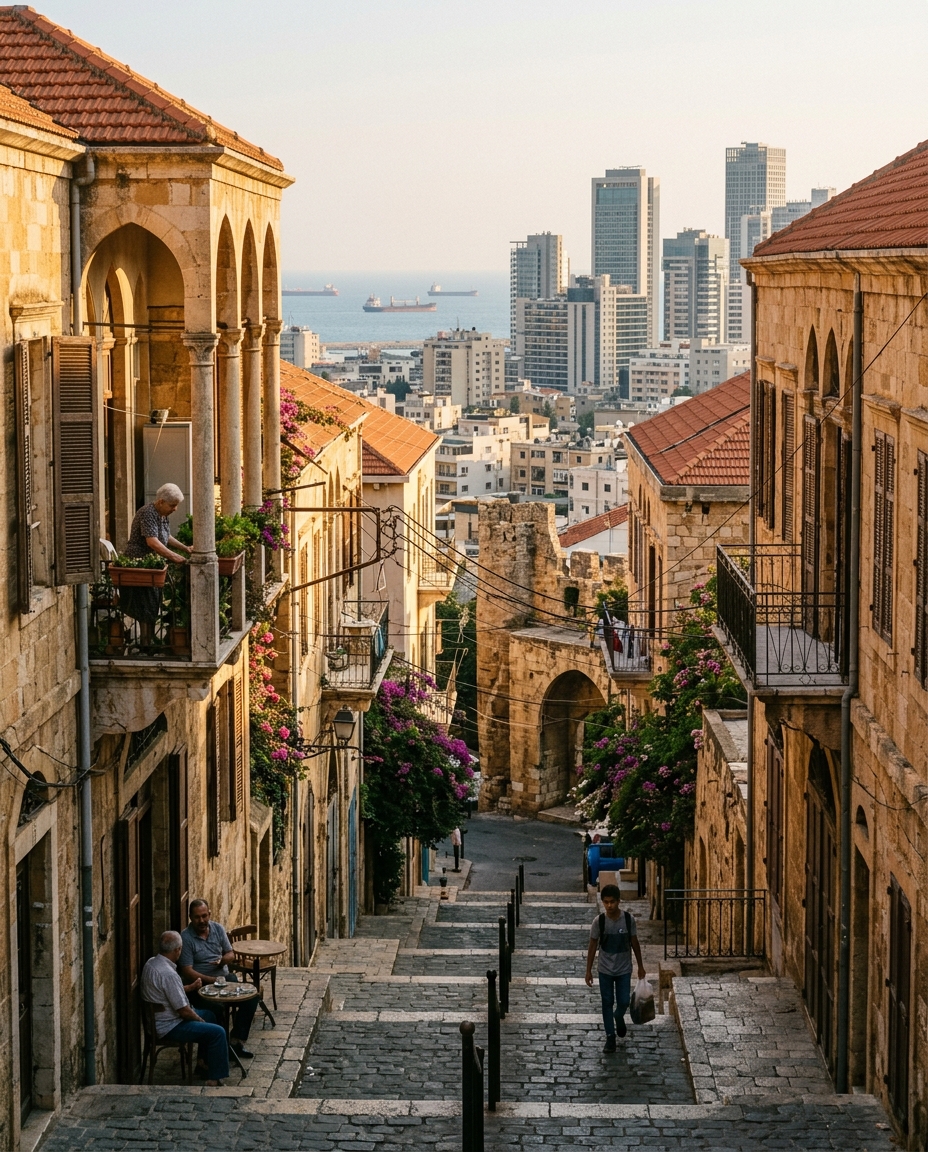
From Phoenician harbour to Roman law school, Ottoman port, Arab cultural capital, and the city that keeps rebuilding itself


There may be no city in Lebanon that has accumulated more labels than Beirut.
It has been called the Paris of the Middle East. The intellectual capital of the Arab world. A Mediterranean port. A merchant city. A university city. A banking center. A city of newspapers, cafés, cinemas, and publishers. It has also been described through war, destruction, reconstruction, crisis, and loss.
Each description contains something true.
None contains Beirut.
Because Beirut has never really been one city.
Under the streets of the modern capital are Phoenician, Hellenistic, Roman, Byzantine, medieval, Ottoman, and modern layers. Archaeologists working in the city center after 1993 uncovered fortifications whose history reaches back to the beginning of the second millennium BC. The same ground would later hold a Roman colony, a celebrated school of law, a medieval port, an Ottoman commercial town, and eventually the capital of modern Lebanon.
The pattern matters more than any one period.
Beirut receives something, changes it, and gives it back in another form.
A port becomes a commercial network.
Mission schools become universities.
Printing presses become newspapers and literary movements.
Mountain families become urban merchant families.
A residential street becomes an intellectual quarter.
A workshop district becomes an arts neighborhood.
Buildings disappear, but ways of gathering survive them.
Perhaps that is the central fact of Beirut’s heritage.
Its history is not the story of a city that remained intact.
It is the story of a city that repeatedly became something else.
1. Before Beirut: Berytus
To begin Beirut’s story with the Romans is already to begin too late.
A city beneath the city
Archaeological work in downtown Beirut has revealed settlement far earlier than classical Berytus. Excavations by the American University of Beirut’s Archaeological Museum on the ancient tell between 1993 and 1995 uncovered a continuous fortification system beginning around the start of the second millennium BC and continuing through the Hellenistic period. The excavators specifically sought evidence for the ancient Biruta mentioned in the Amarna correspondence and for Phoenician-period Beirut.
Geoarchaeological research has also documented ancient harbour installations and major changes to Beirut’s coastline over roughly three thousand years. Iron Age harbour works now buried far inland from the modern shoreline show how different the ancient coastal landscape was.
This was a Phoenician city, but not the dominant Phoenician city.
Byblos, Sidon, and Tyre occupy much larger places in the surviving history of Phoenician commerce and expansion. Beirut’s significance would increase dramatically later.
That transformation came under Rome.
Roman Berytus
After Roman power reached the region in the first century BC, Berytus was developed as a Roman colony. Veterans of Roman legions were settled there, and the city acquired an unusually strong Latin character for the eastern Mediterranean.
Its formal colonial name was Colonia Iulia Augusta Felix Berytus.
Roman Beirut contained baths, streets, public buildings, residential quarters, and entertainment structures. Excavations carried out during the reconstruction of downtown Beirut have substantially expanded knowledge of the Roman city.
Yet the institution that gave Berytus its greatest intellectual reputation was not a temple or a theatre.
It was a school.
Beirut, Mother of Laws
By the third century AD, Berytus had become one of the Roman world’s most celebrated centers for legal education.
The precise date when organized legal teaching began there remains uncertain. The earliest surviving written reference to the law school dates to the first half of the third century, by which point its reputation was already established. Modern scholarship therefore treats claims for a precise foundation date with caution.
What is not in doubt is its importance.
Students traveled to Berytus to study Roman law. The curriculum involved years of reading legal texts, imperial constitutions, interpretation, and argument. By the age of Justinian, Beirut belonged to the small group of officially recognized centers permitted to continue advanced legal instruction.
The association was powerful enough for Beirut to acquire the title Mother of Laws.
Two great Roman jurists associated with Phoenicia, Papinian and Ulpian, became central to the legal tradition later codified under Justinian. Beirut’s intellectual reputation became inseparable from jurisprudence.
Almost fifteen centuries before Beirut became famous for AUB, newspapers, and publishing houses, people were already coming to this city to study.
That continuity is remarkable.
July 551
Then, in AD 551, the coast broke.
A major earthquake struck the eastern Mediterranean on 9 July. Contemporary and later evidence describes enormous destruction along the Phoenician coast, accompanied by a tsunami. Geological and historical scholarship treats it as one of the largest known seismic disasters to affect ancient Lebanon.
Berytus was devastated.
The law school never recovered its old position in the city.
For generations, historians therefore told the event almost as an ending.
But recent scholarship has complicated that picture.
Lee Mordechai’s study of Beirut after the 551 earthquake argues that the catastrophe should not simply be understood as the city’s collapse. Population probably fell sharply in the immediate aftermath, institutions changed, and some urban practices disappeared, but archaeological and textual evidence indicates that Beirut recovered to a meaningful degree afterward.
This distinction matters.
Beirut did not survive because nothing happened to it.
It survived because something catastrophic happened, and life nevertheless returned.
That pattern will recur.
Beirut has been destroyed and rebuilt so many times that destruction itself has become part of its history.
But destruction is only half the story.
The other half is return.
2. The Arab City and the Crusader Port

The ancient city did not remain Roman or Byzantine.
During the seventh-century Arab conquests, the coastal cities of the eastern Mediterranean entered a new political and linguistic world. Beirut became part of successive Islamic states centered first in Damascus and later elsewhere.
Salibi places present-day Lebanon within this broader sequence of Umayyad, Abbasid, Fatimid, Seljuk, Ayyubid, Mamluk, and Ottoman rule. His point is essential for understanding Beirut: the city’s history cannot be separated from the larger Syrian and eastern Mediterranean world in which it operated.
For much of this period Beirut was not the great metropolis it would later become.
It was a port.
And ports survive by connecting places larger than themselves.
Frankish Beirut
In 1110, Baldwin I of Jerusalem captured Beirut during the Crusader period.
The city became a Frankish lordship within the Latin Kingdom of Jerusalem. Modern specialist scholarship by David Jacoby describes Frankish Beirut as a relatively minor economic center when compared with some of the major trading cities of the eastern Mediterranean, despite possessing a useful harbour and access toward Damascus.
The city fell to Saladin in 1187, returned to Frankish control in 1197, and eventually passed permanently under Mamluk rule in 1291. The Ibelin family was closely associated with the lordship during much of the thirteenth century.
Beirut was again changing hands.
But its geography remained constant.
The Mediterranean remained in front of it.
The mountains remained behind it.
Damascus remained beyond them.
That geography kept bringing Beirut back into circulation.
The Buhturids and the mountain behind the port

Salibi documents an important relationship that would anticipate Beirut’s later history.
Under the Mamluks, Druze chieftains of the Gharb known as the Buhturs, or Tanukhs, served within the Mamluk order. Members of the family were at times associated with the government of Beirut and Sidon. After 1291, their winter residence was established in Beirut, while branches of the family maintained summer residences in the mountain villages of Abey, Ainab, and Aramun.
This movement between mountain and city is more important than it first appears.
Beirut’s later identity would be built precisely through that exchange.
Families came down from the mountains.
Merchants looked inland from the port.
Education moved in both directions.
Agricultural wealth and silk passed toward the city.
Imported goods and foreign ideas moved in the opposite direction.
Long before modern Beirut emerged, the basic geography of that relationship already existed.
3. The Ottoman Transformation

Modern Beirut did not suddenly appear in the twentieth century.
Its decisive transformation began during the Ottoman period.
In the early modern centuries, Beirut remained modest in size compared with what it would become. Friedrich Ragette records estimates of about 6,000 inhabitants in 1775 and approximately 15,000 in 1848. After the mid-nineteenth century the city expanded at a radically different rate as commerce, migration, communications, and the port drew people toward it.
Ragette connects the later rural exodus toward Beirut with the economic disruption that affected Mount Lebanon, including changes in the silk economy and competition from European industrial production.
But numbers alone do not explain the city.
Families do.
Mountain families come to Beirut

Salibi describes an eighteenth-century Beirut surrounded by the Maronite and Druze mountain districts yet increasingly connected to European commerce.
Between 1749 and 1774, the Shihab emirs gained control over the town and harbour with support from Talhuq Druze sheikhs who controlled land around Ras Beirut.
During this period, Christian families from the mountain districts settled in Beirut. Salibi specifically identifies Maronite families such as the Tyans and Greek Catholic families such as the Pharaons, who became active in export commerce.
Alongside them were established Sunni merchant families, including the Barbirs.
The commercial world of Beirut was already crossing community lines.
The merchants maintained trading connections with Alexandria and with European commercial establishments in Italy, France, and elsewhere.
Salibi gives one tiny detail that makes this whole system suddenly tangible.
Members of the Barbir family still possessed ornamental glassware that had been presented to their ancestors as gifts from European trading associates.
History is often easier to understand through objects than through statistics.
A piece of glass sitting in a Beirut home could carry the memory of an eighteenth-century Mediterranean trading relationship.
Jazzar and interruption

Beirut’s expanding European trade was interrupted in 1774 when Ahmad Jazzar took control of the town.
Salibi dates the substantial revival of those European commercial connections to the period after Jazzar’s death in 1804.
Then the scale changed.
In the 1840s, Damascus became increasingly accessible to European trade, and Beirut acquired an enormous geographical advantage.
It became the coast for an inland world.
Goods destined for Damascus and the Syrian interior could pass through Beirut. European merchant companies established permanent offices. Consulates multiplied.
The port was becoming more than a harbour.
It was becoming an institution around which a new city could form.
The Levantine city

Salibi’s description of this new urban society is one of the most revealing passages written about Beirut.
European residents were welcomed into the city, while their local commercial partners, Christians and Muslims, formed what he calls a Levantine class: cosmopolitan, commercially connected, socially polished, and increasingly comfortable moving between languages and cultural worlds.
By the 1860s, Salibi writes, their way of life was already giving Beirut a distinctive character.
That character was not simply European.
Nor was it simply Ottoman.
Nor mountain Lebanese.
It was Beiruti.
That distinction matters.
Cosmopolitanism here did not mean the replacement of local identity by something foreign.
It meant the creation of a local culture capable of absorbing many influences without becoming identical to any one of them.
Jens Hanssen later described the nineteenth-century city as a contested Mediterranean urban project shaped simultaneously by Ottoman administration, local society, capitalism, journalism, education, public health, and competing ideas about modernity. Beirut’s promotion to provincial capital in 1888 accelerated this transformation.
The modern city was forming.
4. The City That Invented Itself

The nineteenth century is the period when Beirut becomes recognizably Beirut.
Not because its streets suddenly looked modern.
Because the city built institutions capable of reproducing ideas.
Schools.
Printing presses.
Newspapers.
Universities.
Associations.
Bookshops.
Translation networks.
Editorial offices.
It was no longer enough for goods to pass through Beirut.
Knowledge began passing through it too.
The press arrives

The American Mission Press was founded in Malta in 1822 and transferred to Beirut in 1834, where the American University of Beirut’s archives describe it as the city’s first printing press.
It published works in multiple languages, including Arabic, Turkish, Armenian, Hebrew, Greek, Kurdish, and Spanish. It eventually became a major provider of Arabic books, especially educational and religious material, and employed or collaborated with significant Arabic scholars such as Butrus al-Bustani and Faris al-Shidyaq.
Printing changed the velocity of culture.
A lecture could become a pamphlet.
An argument could travel.
A translation could enter a classroom.
A scientific term could be standardized.
A newspaper could turn a local discussion into a regional one.
Beirut was learning how to multiply words.
Butrus al-Bustani and the Nahda

The Arabic cultural renaissance known as the Nahda had centers in several cities, especially Cairo and Beirut. It should not be reduced to one city.
But Beirut was indispensable to it.
Cambridge scholar Anthony Edwards writes that one cannot discuss the nineteenth-century Beirut Nahda without confronting the importance of Butrus al-Bustani, whose combination of Arabic rhetorical tradition, education, and modern print culture made him one of the era’s defining intellectual figures.
Al-Bustani did something characteristically Beiruti.
He did not choose between inheritance and modernity.
He used one to build the other.
Arabic language and literature became vehicles for encyclopedias, modern education, journalism, translation, and new forms of public discussion.
In the early 1880s, one of Beirut’s printing houses published the first volumes of his monumental Arabic encyclopedia, Dā’irat al-Ma’arif.
The city was becoming a place where knowledge could be manufactured.
The Syrian Protestant College

Then, in 1866, another institution opened.
The Syrian Protestant College, later renamed the American University of Beirut, began classes on 3 December 1866 with only sixteen students. Daniel Bliss was its founding president. A medical school followed in 1867.
Its beginnings were small.
Its ambition was not.
The original educational program included literary, scientific, and medical education. Arabic served as the early language of instruction, and faculty members translated and wrote scientific texts in Arabic to create teaching materials that did not yet exist in sufficient quantity.
The first students studied not on today’s famous Ras Beirut campus but in rented buildings in the city, including the house of Butrus al-Bustani. The college later moved to its permanent Ras Beirut site.
Salibi adds another layer to the story.
Much of the land for the permanent campus was purchased from the Druze Talhuq sheikhs.
The same mountain-city relationship reappears.
A Protestant American educational institution rose on land tied to an old Druze family whose relationship with Beirut reached back generations.
This is what Salibi means by the marriage of the mountain with Beirut.
Makassed
Modern education was not limited to missionary institutions.
Beirut’s Muslim notables responded by developing their own modern educational structures.
The Makassed Philanthropic Islamic Association of Beirut was founded in 1878. Its enduring mission has centered on education, health, and social service.
The significance of Makassed is larger than its date.
It represents a broader Beiruti pattern: communities did not merely reject outside institutions. They watched, learned, responded, adapted, and built competing institutions of their own.
Modernization became local.
One family as a portrait of Beirut

Salibi offers perhaps the perfect human portrait of this world through Salim Ali Salam, known as Abu Ali.
By 1908 he was a prominent Sunni businessman and public figure.
But what matters for cultural history is how his household functioned.
He had studied partly at the Greek Catholic Patriarchal College.
His sisters attended the British Syrian Training College.
His sons studied at the Syrian Protestant College.
A Greek Catholic priest came to the Salam home to teach his children French.
A Maronite writer tutored one of his daughters in Arabic.
His friends included Christian intellectuals and religious figures.
He headed the Beirut municipality and presided over Makassed.
This is nineteenth- and early twentieth-century Beirut in miniature.
Not harmony without disagreement.
Not a city without boundaries.
A city in which those boundaries were repeatedly crossed through education, commerce, friendship, employment, and intellectual life.
That distinction is more historically honest than saying Beirut simply “was tolerant.”
Tolerance is abstract.
A Catholic priest entering a Sunni household to teach French is concrete.
A Maronite teaching Arabic there is concrete.
A Muslim businessman sending his sons to a Protestant college is concrete.
These were choices.
Beirut’s cosmopolitanism did not happen by accident.
People built it.
What Beirut had become
Salibi writes that Beirut eventually became both the principal convergence point for European commerce with Syria and a leading center of modern Western-style education in the Ottoman world. It became, in his formulation, a major repository for liberal intellectual currents in the Arab region.
His larger argument is even more important.
Modern influence did not arrive in Lebanon only through conquest. Much of it arrived gradually, through merchants, schools, missions, translations, families, and local invitations.
That is the heritage of nineteenth-century Beirut.
Not Europe replacing Lebanon.
Beirut choosing what to take, translating it, arguing with it, and turning it into something local.
5. From Ottoman Port to Capital
The twentieth century changed Beirut again.
After the First World War, the city became the capital of Greater Lebanon and later of the Lebanese Republic.
That new political role changed the physical city.
The Mandate city

French Mandate authorities inherited a city already transformed by late Ottoman urbanization.
They expanded and reorganized it.
Marlène Ghorayeb’s study of Mandate planning shows that the Danger Plan of the early 1930s aimed at a comprehensive modernization of Beirut through sanitation, infrastructure, circulation, public space, and urban aesthetics. Michel Écochard later proposed a more modernist planning approach.
Research published by Cambridge similarly notes cadastral surveys beginning in the 1920s, the 1932 Danger Plan, expanded port capacity, and the first full urban master plan under Écochard in 1943. Port traffic almost quadrupled between 1920 and 1939.
Beirut became more administrative.
More monumental.
More connected.
And increasingly dense.
The architecture of the Mandate did not erase what came before. Instead it joined an already hybrid urban landscape containing Ottoman houses, religious buildings, markets, European-inspired structures, and new apartment blocks.
That mixture remains one of Beirut’s architectural signatures.
The house changes with the city


Friedrich Ragette documents another transformation that happened more quietly.
The traditional Lebanese central-hall house, with its large communal dar, triple-arched façade, and surrounding rooms, gradually gave way to the apartment.
After the Second World War, Beirut’s rapid development and pressure for urban housing encouraged a different spatial logic. Rooms were increasingly organized for privacy, light, individual functions, and efficiency.
Ragette connects the architectural change to a social one: the tightly integrated family household was increasingly reorganized around individual privacy.
The city changed how Lebanese people lived inside their own homes.
Architecture is never only façade.
It reorganizes behavior.
6. The Golden Age Was Built Before It Arrived
The Beirut of the 1950s and 1960s has become almost mythical.
Hotels.
Airlines.
Banks.
Publishers.
Universities.
Cafés.
Theatres.
Cinema halls.
Hamra at night.
International visitors.
Arabic writers.
European fashions.
Gulf money.
Students from across the region.
Much nostalgia has accumulated around this Beirut.
But the prosperity was not imaginary.
The banking city
By the late 1950s and 1960s, Lebanon had become an important banking center for the Arab world. One economic study notes the extraordinary expansion of the sector, from only a handful of banks in the early 1950s to dozens by the mid-1960s.
Beirut benefited from its long commercial tradition, open financial system, geographic position, service economy, port, airlines, and connections between Arab capital and international markets.
But this “golden age” did not appear from nowhere.
The merchant families of the eighteenth century had already practiced international commerce.
The nineteenth century had already built commercial offices and consular networks.
The presses already existed.
The schools already existed.
The universities already existed.
The intellectual class already existed.
The 1950s did not invent cosmopolitan Beirut.
They inherited it at full scale.
Four major universities
By 1960, Beirut had four major university institutions whose combined presence transformed the city into one of the region’s great educational centers.
The American University of Beirut grew from the Syrian Protestant College founded in 1866.
Saint Joseph University was founded by the Jesuits in Beirut in 1875.
The nucleus of the Lebanese University, the country’s public university, was created in 1951.
Beirut Arab University opened in 1960, initially with faculties including law and arts.
The phrase “four universities” therefore needs this qualification: their structures and legal development were not identical, but by the beginning of the 1960s Beirut contained these four major higher-education institutions.
Students from different social worlds now occupied the same city.
That affects a city as profoundly as money does.
Hamra
No neighborhood demonstrates this better than Hamra.
Research on Beirut’s urban development shows that Ras Beirut remained comparatively low-density into the mid-twentieth century. The presence of AUB gave the area a distinctive social mixture of students, academics, professionals, foreign residents, and middle-class families.
In the 1950s, Hamra transformed rapidly into a commercial, business, entertainment, and residential district.
It became the Beirut of bookstores, cafés, cinemas, hotels, newspapers, students, writers, and arguments.
What happened inside the café mattered almost as much as the café itself.
People went there to meet.
To watch.
To write.
To discuss.
To be seen.
A city becomes intellectual not only because universities exist, but because ideas have somewhere to go after class.
Hamra gave them somewhere to go.
The press
Salibi describes Beirut’s free press in the 1960s as exceptional in the Arab world, with Lebanese newspapers and magazines circulating across the Arab region.
This too belonged to the nineteenth-century inheritance.
Once a city develops printers, translators, editors, writers, schools, and readers, journalism becomes a natural extension.
Beirut became a place where ideas could be published that were difficult to publish elsewhere.
Writers came because printers were there.
Publishers stayed because readers were there.
Readers multiplied because universities were there.
The ecosystem reinforced itself.
Theatre and performance
Beirut’s cultural infrastructure extended beyond books.
The Grand Théâtre de Beyrouth, inaugurated in 1929 and designed by Youssef Aftimos, became one of the city’s major performance venues. UNESCO records appearances there by figures such as Umm Kulthum, Mohammed Abdel Wahab, and visiting European companies.
By the 1960s, Lebanese theatre was expanding dramatically.
The Rahbani Brothers and Fairuz became central figures in Lebanese musical theatre, alongside other emerging theatrical movements.
But Beirut’s relationship with Fairuz is best understood carefully.
Fairuz did not represent Beirut alone.
The Rahbanis often created an imagined Lebanon of villages, mountains, festivals, memory, and longing.
Yet Beirut was one of the major stages, studios, audiences, and cultural markets through which that imagined Lebanon reached the Arab world.
The city broadcast the village.
That contradiction is deeply Lebanese.
Cinema
Cinema similarly flourished through Beirut’s position as a center of distribution, performance, production, and exhibition.
By the 1960s Lebanon supported a dense cinema culture and an expanding film industry. Beirut’s theaters helped connect Egyptian cinema, Lebanese productions, European films, and global popular culture.
Again, the important word is connection.
Beirut’s genius was rarely isolation.
It was circulation.
7. The War and the Broken City
The civil war that began in 1975 fractured Beirut physically and socially.
This article is not the place to reduce the war to one political explanation. Its causes were multiple and remain deeply studied and debated.
For the cultural history of Beirut, another fact matters.
The city itself became divided.
Roads that had connected neighborhoods became dangerous boundaries.
The line separating eastern and western sectors of Beirut became known as the Green Line.
Downtown, once a shared commercial center, was devastated.
Communities moved.
Families left neighborhoods.
Businesses relocated.
Buildings survived without their inhabitants.
Other buildings disappeared entirely.
The geography of everyday life changed.
That is one of the most destructive things war can do to a city.
It does not merely damage architecture.
It breaks routines.
Where you buy bread.
Which cinema you visit.
Which school you attend.
Which route you walk.
Whom you encounter without planning to.
A cosmopolitan city depends on accidental contact.
War reorganizes the city precisely to prevent it.
Downtown after the war
After the war formally ended in 1990, Beirut faced another enormous question.
How do you rebuild a center that is physically shattered and legally fragmented among many property owners?
In 1994, Solidere was established to oversee the redevelopment of Beirut Central District.
Its reconstruction program restored infrastructure, public spaces, façades, archaeological areas, and commercial districts. Solidere itself describes the project as a major urban regeneration scheme beginning in 1994.
But the reconstruction remains controversial.
Adrienne Fricke’s research on heritage and memory argues that rebuilding central Beirut created a fundamental tension between economic recovery and preservation of historical memory.
The World Bank later described the Beirut Central District experience as a cautionary example of excessively centralized reconstruction. Its assessment argues that the model prioritized economic development, luxury real estate, and urban design while weakening community continuity and reducing the role of the center as a place shared across social classes.
This is an important Heritage Lebanon lesson.
A building can be restored.
A street can be paved.
A façade can be reconstructed stone by stone.
And yet the social life that once made the place meaningful may still be gone.
Heritage is not only what survives physically.
It is also who still belongs there.
8. The Neighborhoods Became the City
As downtown changed, cultural life continued elsewhere.
This is why Beirut cannot be understood only through its center.
Its neighborhoods became different versions of the city.
Hamra
Hamra remained connected to universities, bookstores, cafés, hotels, restaurants, and a secular cosmopolitan public culture.
Sociologist Steven Seidman describes Hamra as one of Beirut’s most diverse and cosmopolitan neighborhoods, shaped by universities and an unusually robust public culture.
Hamra’s identity has changed repeatedly.
But the idea of Hamra remains associated with conversation.
Ashrafieh
Ashrafieh developed along the eastern hills as an important residential district of Beirut, containing old family houses, religious institutions, later apartment buildings, commercial streets, schools, and cultural spaces.
Its surviving architecture shows many of the layers that characterize modern Beirut: late Ottoman houses, central-hall forms, Mandate-period buildings, and modern towers occupying the same urban landscape.
Ashrafieh is not one architectural period.
It is accumulation.
Gemmayzeh
Gemmayzeh grew along one of Beirut’s historic eastern routes and retained a substantial stock of older residential architecture.
By the postwar period, its proximity to downtown, dense street fabric, historic houses, stairs, workshops, and small commercial spaces allowed a new cultural and nightlife economy to emerge.
Mar Mikhael
Mar Mikhael had a different history.
Academic research traces its earlier development to railway, port, industrial, workshop, and lower-middle-income activities. Armenian refugees also became part of the neighborhood’s twentieth-century history, while workshops and small industries remained important long after larger factories disappeared.
Around the late 2000s and early 2010s, design studios, galleries, bars, restaurants, and creative businesses increasingly entered the area.
The result was reinvention.
Again.
An industrial neighborhood became a cultural neighborhood without completely ceasing to be a residential one.
The southern suburbs
The southern suburbs tell yet another Beirut story.
They were not simply an extension of the old city.
Their modern urbanization accelerated during the 1950s and 1960s as families moved from South Lebanon and the Beqaa toward the capital in search of work, education, and opportunity. Later displacement dramatically accelerated their growth.
This belongs to Beirut’s heritage too.
The capital repeatedly expands by receiving people from elsewhere.
Mountain Lebanese.
Armenians.
Palestinians.
People from the South.
People from the Beqaa.
Foreign students.
Arab intellectuals.
European merchants.
Workers.
Refugees.
Beirut grows by absorbing human movement.
That movement is not a side story.
It is the city.
9. August 4, 2020
At 6:07 p.m. on 4 August 2020, Beirut was violently transformed again.
Two explosions at the city’s port culminated in a massive blast that devastated a wide area of the capital.
UNESCO’s early assessments recorded nearly 200 deaths, thousands of injuries, and at least 8,000 affected buildings.
The economic scale was enormous.
A World Bank, European Union, and United Nations rapid assessment estimated $3.8 to $4.6 billion in physical damage, with additional economic losses of roughly $2.9 to $3.5 billion. Housing, transport, and cultural assets were among the most severely affected sectors.
But Heritage Lebanon must look closer than numbers.
Six hundred and forty heritage buildings
UNESCO documented approximately 640 heritage buildings damaged by the explosions.
Around sixty were initially considered critically deteriorated.
The most affected historic urban areas included Gemmayzeh, Mar Mikhael, Rmeil, Saifi, and surrounding neighborhoods, where much of Beirut’s surviving late Ottoman and Mandate-era built heritage was concentrated.
The Sursock Museum was damaged.
Historic houses lost windows, roofs, walls, and interior decoration.
Balconies collapsed.
Traditional timber frames shattered.
Studios disappeared.
Restaurants vanished overnight.
People lost houses that had survived generations.
This was not simply architectural damage.
It was an attack on memory through force, regardless of intention.
Documenting before rebuilding
UNESCO launched Li Beirut in August 2020 to mobilize support for schools, cultural institutions, museums, galleries, and heritage structures.
A major documentation effort subsequently produced more than 100,000 images toward a georeferenced digital model of damaged Beirut, working with Lebanon’s Directorate General of Antiquities.
The effort recognized something Lebanese families have understood for generations.
Before repairing something damaged, record what was there.
Because rebuilding without memory can become replacement.
Beirut rebuilt again
There is a temptation to call what followed “resilience.”
The word is now used so often about Beirut that it can become empty.
People should not have to prove their resilience repeatedly.
So perhaps history gives us a better word.
Return.
After 551, people returned.
After sieges, people returned.
After commercial decline, merchants returned.
After war, residents returned.
After August 4, architects, volunteers, homeowners, craftspeople, students, museums, institutions, neighbors, and diaspora communities began repairing what could be repaired.
The important thing is not to romanticize destruction.
The important thing is to document return.
10. What Beirut Actually Is
So what is Beirut known for?
The usual answers are easy.
Nightlife.
Food.
Universities.
The Mediterranean.
Hamra.
Downtown.
Fairuz.
Publishing.
Banking.
The Corniche.
War.
The port.
But those answers describe the things Beirut produced.
They do not explain why it kept producing them.
The deeper pattern is visible across the centuries.
A Phoenician harbour connected Beirut to maritime trade.
Roman Berytus turned movement into scholarship and law.
Medieval Beirut remained valuable because the sea connected it with the interior.
Ottoman Beirut transformed commercial connections into a merchant society.
Nineteenth-century Beirut transformed missionaries, merchants, and local intellectuals into schools, presses, associations, and universities.
Twentieth-century Beirut transformed those institutions into newspapers, theatres, banks, cafés, film distribution, and a regional cultural economy.
Even its neighborhoods follow the same logic.
Hamra transformed education into public culture.
Mar Mikhael transformed workshops into a creative district.
Gemmayzeh transformed inherited architecture into contemporary urban life.
The southern suburbs transformed migration into another city beside the city.
Beirut’s deepest heritage is therefore not a specific architectural style.
Too many buildings are gone.
It is not the golden age.
That period cannot simply be recreated.
It is not the label “Paris of the Middle East.”
Beirut does not need another city to explain it.
Its heritage is a human habit.
To receive.
To translate.
To trade.
To argue.
To teach.
To publish.
To gather.
To absorb newcomers.
To rebuild.
Beirut’s great institutions were all versions of this habit.
The Roman law school received students from across an empire.
The nineteenth-century printing presses translated knowledge into Arabic.
The Syrian Protestant College brought students into classrooms.
Makassed created another educational network from within Beirut’s Muslim community.
The cafés gave ideas somewhere to circulate.
The newspapers sent those ideas outward again.
The port brought the world in.
Beirut sent something different back.
This may be why the city is so difficult to preserve.
Its heritage has never been static.
It lives through use.
A house matters because someone gathers inside it.
A café matters because people talk there.
A street matters because different lives cross on it.
A newspaper matters because someone can disagree in public.
A university matters because strangers learn together.
A city matters because people who do not belong to the same household, neighborhood, religion, class, or place of origin somehow learn to occupy the same space.
That was always Beirut’s difficult achievement.
And whenever that shared space was destroyed, the city lost more than buildings.
It lost encounters.
So the question for Beirut’s future is not whether every lost façade can be reconstructed.
It cannot.
The greater question is whether Beirut can continue producing the kind of human contact that made those façades worth remembering.
That is where its real heritage lives.
Not behind glass.
Not only in ruins.
Not only in photographs of the 1960s.
But in the stubborn belief that after a city has been broken, people can still make a place together again.
Beirut has been destroyed before. Its historical answer has never been simply to survive. It has been to return, rebuild, and become Beirut again.
Frequently Asked Questions About Beirut
How old is Beirut?
Archaeological evidence shows occupation going back to at least the Bronze Age, with fortifications documented from the beginning of the second millennium BC. The city therefore has a continuous history spanning several thousand years.
What was Beirut called in Roman times?
Roman Beirut was known as Berytus, formally Colonia Iulia Augusta Felix Berytus. It became particularly famous for its school of Roman law.
Why was the Roman law school of Beirut important?
By late antiquity, Berytus was one of the Roman Empire’s major centers for legal education. Justinian’s educational reforms recognized Beirut among the limited schools authorized to teach Roman law. Its reputation helped give Beirut the title Mother of Laws.
What happened to Beirut in 551 AD?
A major earthquake and tsunami devastated Beirut and other parts of the Lebanese coast on 9 July 551. The law school disappeared from Beirut afterward, although modern research indicates that the city itself recovered more substantially than older histories sometimes suggested.
When did modern Beirut begin to grow?
The most dramatic transformation began during the nineteenth century as Beirut became an important Mediterranean port linking Damascus and the Syrian interior with European commerce. Merchant firms, consulates, missions, schools, printing houses, and migrants helped expand the city.
When was AUB founded?
The Syrian Protestant College opened in Beirut on 3 December 1866 with sixteen students. It was renamed the American University of Beirut in 1920.
When was Makassed founded?
The Makassed Philanthropic Islamic Association of Beirut was founded in 1878, becoming an important institution in education, healthcare, and social service.
Why was Beirut important to the Nahda?
Beirut combined Arabic scholarship, missionary schools, local educational initiatives, printing technology, translation, journalism, and a growing reading public. Figures such as Butrus al-Bustani used print to create new forms of Arabic intellectual and public culture.
What was Beirut’s golden age?
The term generally refers to the period from the 1950s into the early 1970s, when Beirut became a major center for banking, higher education, journalism, publishing, tourism, cinema, theatre, and regional commerce.
How many heritage buildings were damaged in the 2020 Beirut port explosion?
UNESCO documented approximately 640 heritage buildings damaged, with about sixty initially in critical condition.
Principal Sources
Kamal Salibi, A House of Many Mansions: The History of Lebanon Reconsidered, I.B. Tauris, 1988.
Friedrich Ragette, Architecture in Lebanon: The Lebanese House During the 18th and 19th Centuries, first published by the American University of Beirut, 1974; Caravan Books edition, 1980.
Samir Kassir, Beirut, University of California Press English edition, 2010. The publisher describes the work as tracing Beirut’s nineteenth- and twentieth-century expansion and its post-Second World War cosmopolitan period.
Jens Hanssen, Fin de Siècle Beirut: The Making of an Ottoman Provincial Capital, Oxford University Press, 2005.
Leila Tarazi Fawaz, Merchants and Migrants in Nineteenth-Century Beirut, Harvard University Press, 1983.
Dominic Perring, “The Archaeology of Beirut: A Report on Work in the Insula of the House of the Fountains,” The Antiquaries Journal, 2003.
Nick Marriner, Christophe Morhange, and Muntaha Saghieh-Beydoun, “Geoarchaeology of Beirut’s Ancient Harbour, Phoenicia,” Journal of Archaeological Science, 2008.
Lee Mordechai, study of the social and urban effects of the 551 Beirut earthquake.
Marlène Ghorayeb, “L’urbanisme de la ville de Beyrouth sous le mandat français,” 1994.
Adrienne Fricke, “Forever Nearing the Finish Line: Heritage Policy and the Problem of Memory in Postwar Beirut,” International Journal of Cultural Property, 2005.
UNESCO, Li Beirut cultural heritage documentation and recovery program.
World Bank, European Union, and United Nations, Beirut Rapid Damage and Needs Assessment and subsequent reconstruction studies.
Leave a Reply